
A county CIO authorizes a WLAN penetration test of the civic center. What must the security team lock before any active testing begins?
Select an answer to reveal the explanation.
Short Explanation
Authorized WLAN testing is not a free-for-all scavenger hunt. Put the fences on paper first—scope, SSIDs, buildings, and a signed green light. Without that, “help” looks a lot like an attack.
Full Explanation
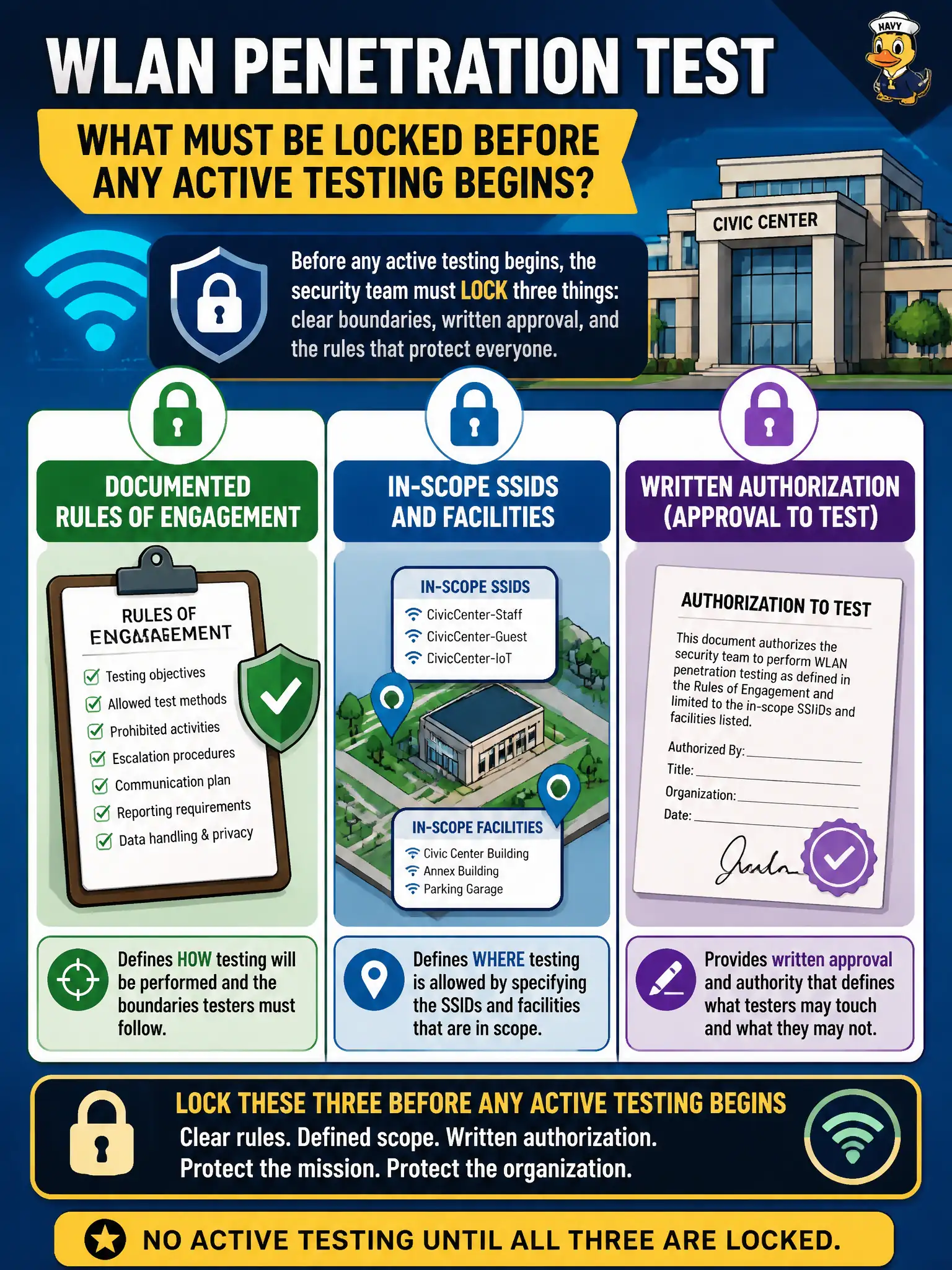
Before any active WLAN penetration test of a civic center, the security team must lock documented rules of engagement, in-scope SSIDs and facilities, and written authorization that define what testers may touch. Municipal environments often mix guest, corporate, and public-safety wireless on overlapping RF; unclear scope turns a useful test into an outage, safety issue, or policy violation. Written authorization also protects testers and the city when aggressive techniques are used under color of official assessment.
An open invitation for any staff member to run cracking tools against production guest SSIDs after hours is uncontrolled testing, not a security program. Verbal hallway approval from one technician is not durable authorization. Immediate deauthentication of every client on the public-safety SSID to “prove impact” may be reckless and out of scope even when other testing is approved.
Exam caveat: RoE should state allowed techniques, time windows, emergency stop contacts, and data-handling rules—not only a building name on an email. Operational check: obtain signed authorization and an RoE checklist naming in-scope SSIDs and facilities before test tools leave the lab, and brief the NOC/SOC on the window and kill switch.