
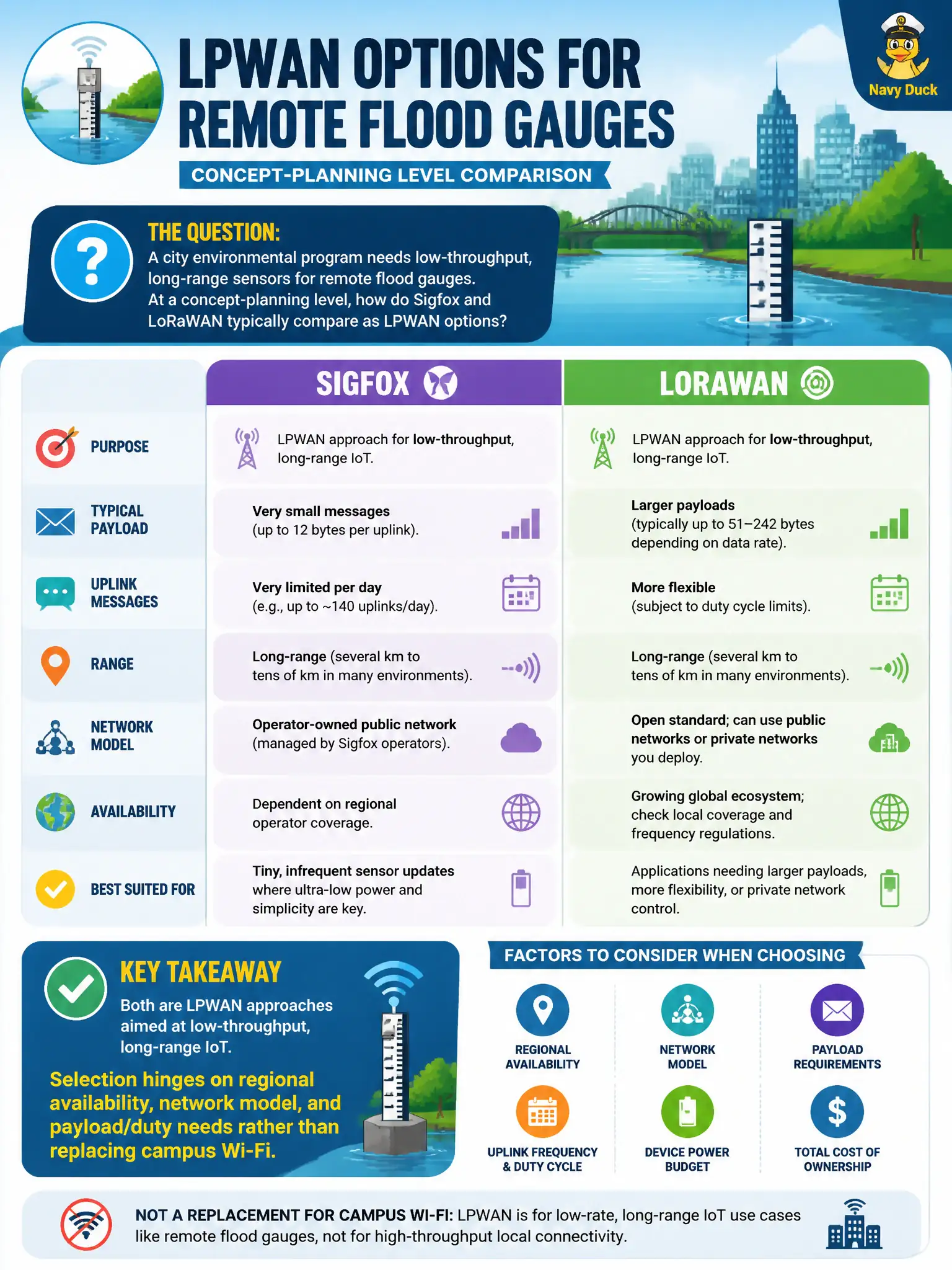
A city environmental program needs low-throughput, long-range sensors for remote flood gauges. At a concept-planning level, how do Sigfox and LoRaWAN typically compare as LPWAN options?
Select an answer to reveal the explanation.
Short Explanation
Sigfox and LoRaWAN are both in the 'tiny messages, long reach, thrifty battery' club—not fiber and not WPA3 Wi-Fi. Pick based on coverage model and payload needs for those flood gauges. Neither magically becomes a real-time plant bus.
Full Explanation
At concept-planning level, Sigfox and LoRaWAN are both LPWAN approaches aimed at low-throughput, long-range IoT; selection hinges on regional availability, network model, and payload/duty needs rather than replacing campus Wi-Fi. Neither is a drop-in replacement for multi-gigabit municipal fiber backbones. They are not identical to WPA3-Enterprise Wi-Fi association. Neither always provides guaranteed sub-millisecond industrial control loops. Exam caveat: LPWAN complements Wi-Fi for sparse telemetry; it does not replace high-rate campus access. Operational check: compare regional coverage, payload sizes, and duty cycles for flood gauges, then pick the LPWAN that fits the civic environmental program. In municipal WLAN and IoT operations, record the chosen control and the rejected alternatives in the change ticket so on-call staff understand which failure modes were avoided for city services. Re-validate after the next maintenance window that the same control still holds under the current platform code, device mix, and civic event calendar used by the wireless team. Keep RF, capacity, security, and QoS evidence attached to the municipal runbook entry for auditors and future CWNE-level reviews.