
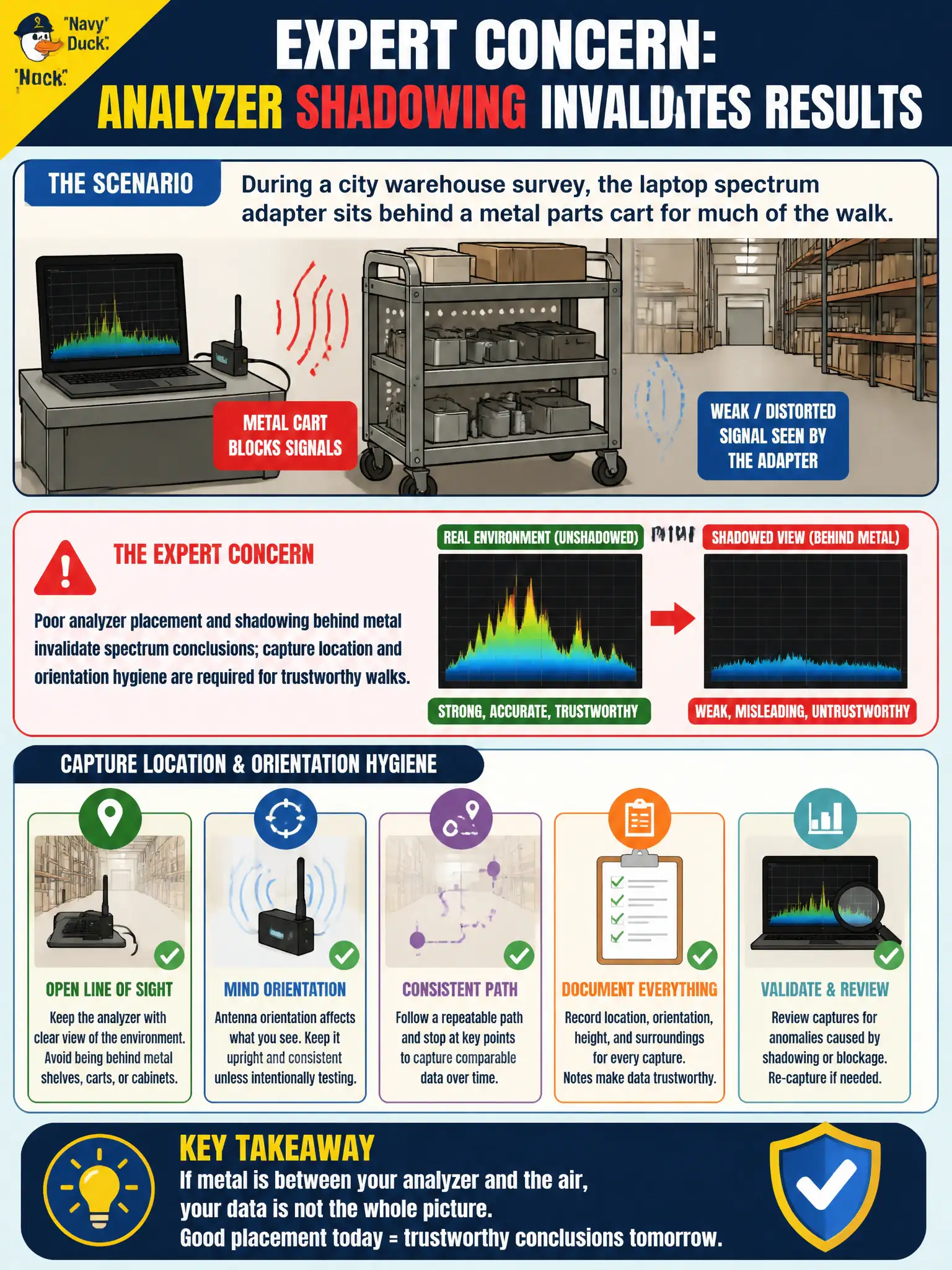
During a city warehouse survey, the laptop spectrum adapter sits behind a metal parts cart for much of the walk. What is the expert concern?
Select an answer to reveal the explanation.
Short Explanation
Stashing the spectrum stick behind a steel cart is like recording a concert from inside a filing cabinet — you'll 'prove' coverage holes that aren't real. Placement and orientation matter. Password typos don't invent RF shadows.
Full Explanation
During a city warehouse survey, leaving the laptop spectrum adapter behind a metal parts cart for much of the walk invalidates spectrum conclusions because metal shadows and attenuates the energy the analyzer should hear. Capture location and orientation hygiene are required for trustworthy civic survey walks. Expert practice keeps the adapter clear of metal shielding and documents where samples were taken.
Believing metal carts improve capture gain so placement behind them is preferred reverses shielding physics. Claiming adapter orientation never affects spectrum conclusions in enterprise surveys ignores antenna pattern and polarization of the adapter. Saying survey invalidation only occurs if the SSID password is wrong, not adapter placement, confuses authentication with RF measurement quality.
Exam caveat: bad survey hygiene produces false “clean” or false “dead” spectrum in industrial civic sites. Operational check: remount the adapter with clear LOS to the aisle under test, avoid parking behind metal carts, repeat the warehouse segment, and discard shadowed samples from the acceptance dataset. Brief survey contractors that metal carts, trucks, and racking are temporary Faraday cages—pause the walk or reposition before logging spectrum samples.