
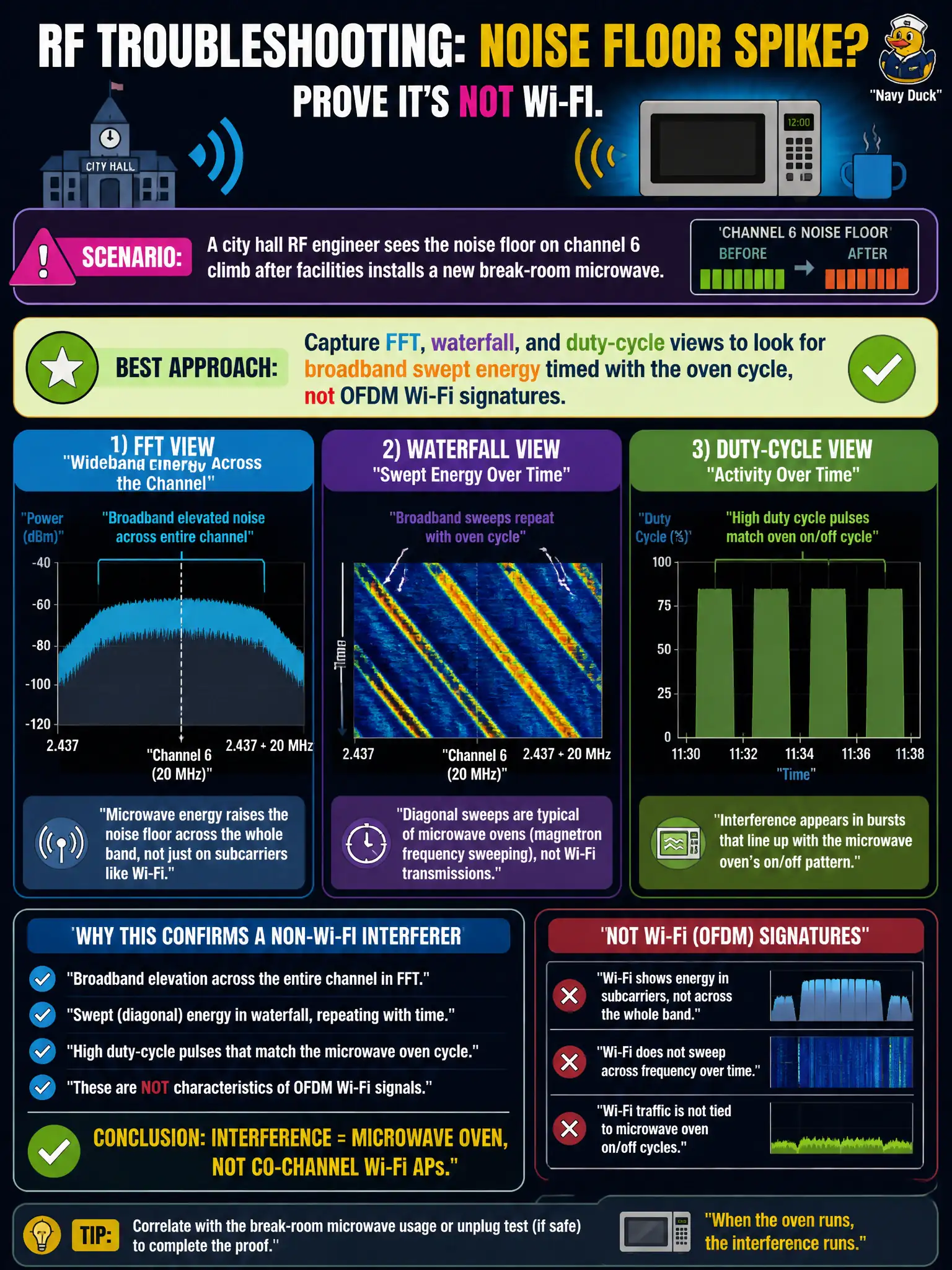
A city hall RF engineer sees the noise floor on channel 6 climb after facilities installs a new break-room microwave. Which spectrum approach best confirms a non-Wi-Fi interferer instead of blaming co-channel APs?
Select an answer to reveal the explanation.
Short Explanation
Think of the microwave like a noisy leaf blower that isn't speaking Wi-Fi — spectrum tools hear the racket even when APs look fine. FFT plus waterfall and duty cycle show that swept, non-OFDM energy tracking the oven, not another BSS. Blaming CCI or cranking power skips that signature check.
Full Explanation
At city hall, a sudden rise in the channel-6 noise floor after a break-room microwave install is classic non-Wi-Fi interference, not proof that neighboring BSS cells are the sole culprit. Microwave ovens commonly emit broadband, swept energy in the 2.4 GHz ISM band that does not present as an 802.11 OFDM PHY signature. Expert confirmation therefore uses spectrum views together: real-time FFT for amplitude versus frequency, waterfall or spectrogram for how that energy evolves over time, and duty-cycle or channel-utilization views to quantify how much airtime the interferer occupies. Correlation with the oven’s duty cycle strengthens the classification that the kitchen appliance—not another civic BSS—is raising energy detect and the noise floor.
Disabling every AP on channel 6 and treating remaining failures as co-channel interference skips classification: residual problems can still be non-Wi-Fi energy, and the experiment does not prove OFDM CCI. Raising AP transmit power does not remove broadband microwave energy that still occupies the medium and degrades SNR for clients. Adding a second SSID on the same channel creates another BSSID without cleaning the spectrum and can worsen contention during cooking hours.
Exam caveat: spectrum classification must precede RF redesign; CCI and non-Wi-Fi interferers can coexist, but their signatures differ. Operational check: capture FFT, waterfall, and duty cycle near the break room while cycling the microwave; confirm swept non-OFDM energy tracks the oven, then remediate by relocation, shielding, or channel plan—not by power or SSID proliferation.