
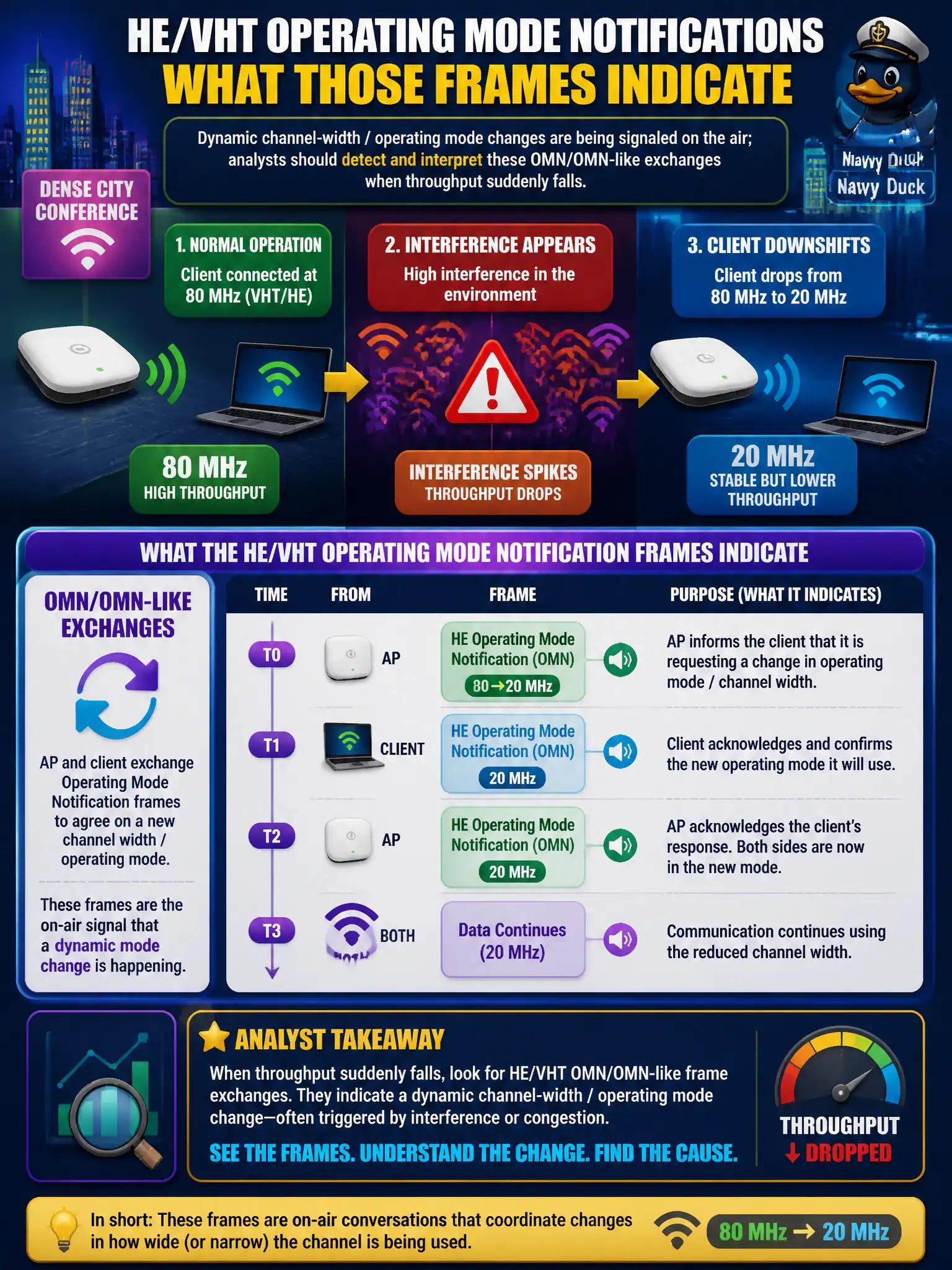
During a dense city conference, captures show HE/VHT operating mode notifications as a client drops from 80 MHz to 20 MHz under interference. What do those frames indicate?
Select an answer to reveal the explanation.
Short Explanation
That client just downshifted from an 80 MHz highway to a 20 MHz side street and sent an operating mode postcard saying so. Watch those notifications when throughput tanks under interference—they're the gear-change evidence.
Full Explanation
Operating mode notifications signal dynamic changes such as channel width or NSS adjustments while a session remains associated. During a dense city conference, HE/VHT operating mode notifications as a client drops from 80 MHz to 20 MHz under interference indicate that dynamic channel-width or operating mode changes are being signaled on the air; analysts should detect and interpret these OMN/OMN-like exchanges when throughput suddenly falls rather than assuming a permanent hardware failure.
Treating any OMN as proof the client permanently lost MIMO and must be RMA'd fails by concept: OMN commonly reflects adaptive width/NSS under conditions, not automatic hardware death. Claiming operating mode notifications only appear on wired CAPWAP fails by concept: they are over-the-air management/Action signaling between STA and BSS. Asserting an 80-to-20 MHz drop always means SSID security mode changed mid-session fails by concept: width changes are PHY/operating-mode adaptations, not security AKM changes.
Exam caveat: Sudden municipal throughput cliffs under interference often correlate with width/NSS OMN; decode those frames before redesigning the entire channel plan.
Operational check: Filter the conference capture for Operating Mode Notification / related Action frames around the throughput drop, record old versus new width/NSS, and correlate with interference or RSSI events on that client.