
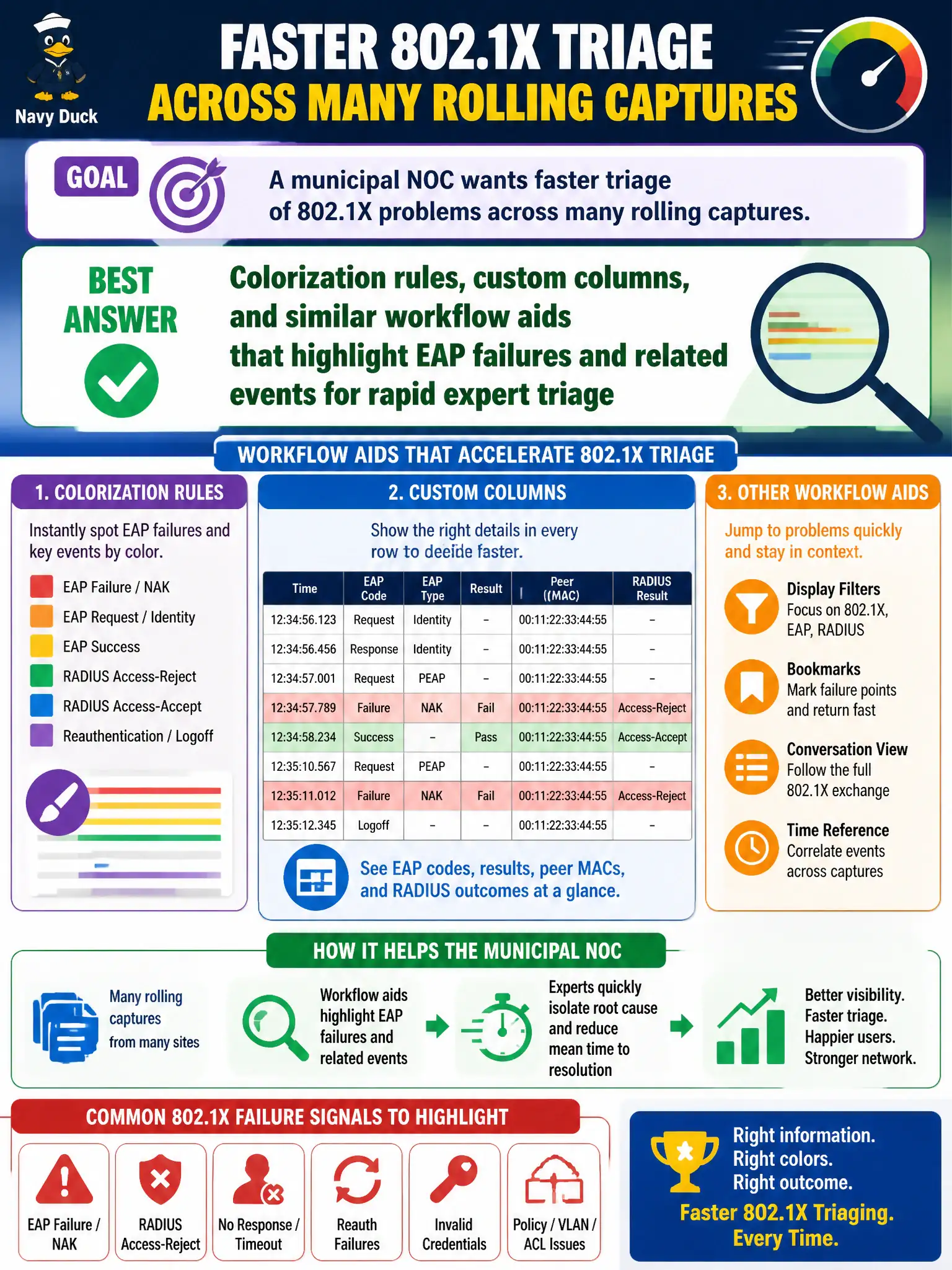
A municipal NOC wants faster triage of 802.1X problems across many rolling captures. Which analyzer workflow aid best supports that goal?
Select an answer to reveal the explanation.
Short Explanation
When the NOC is drowning in PCAPs, colorization is the highlighter on the EAP fails. Paint the pain bright so eyes jump to the broken handshakes instead of doom-scrolling grey frames.
Full Explanation
Rapid 802.1X triage across many rolling captures depends on visual and columnar workflow aids that surface EAP failures immediately. For a municipal NOC, colorization rules, custom columns, and similar analyzer aids that highlight EAP failures and related events best support faster expert triage than undifferentiated frame lists. Analysts jump to failing handshakes instead of hunting blindly through megabytes of routine data.
Removing all color and columns so every frame looks identical fails by concept: uniformity slows triage and increases miss rate on EAP faults. Exporting only Beacon frames to CSV because EAP never appears fails by concept: EAPOL/EAP exchanges are central to 802.1X diagnosis and are lost if only Beacons are kept. Relying exclusively on screenshot photos of the client login dialog fails by concept: UI photos lack frame-level EAP result codes and timing needed for NOC-scale root cause.
Exam caveat: Analyzer productivity features are in-scope CWNE skills when the operational goal is fast enterprise authentication triage across continuous municipal captures.
Operational check: Build a saved coloring rule and custom columns for EAP failure codes and EAPOL types, apply them to a rolling city capture set, and time how quickly an engineer locates the first failed 802.1X attempt.