
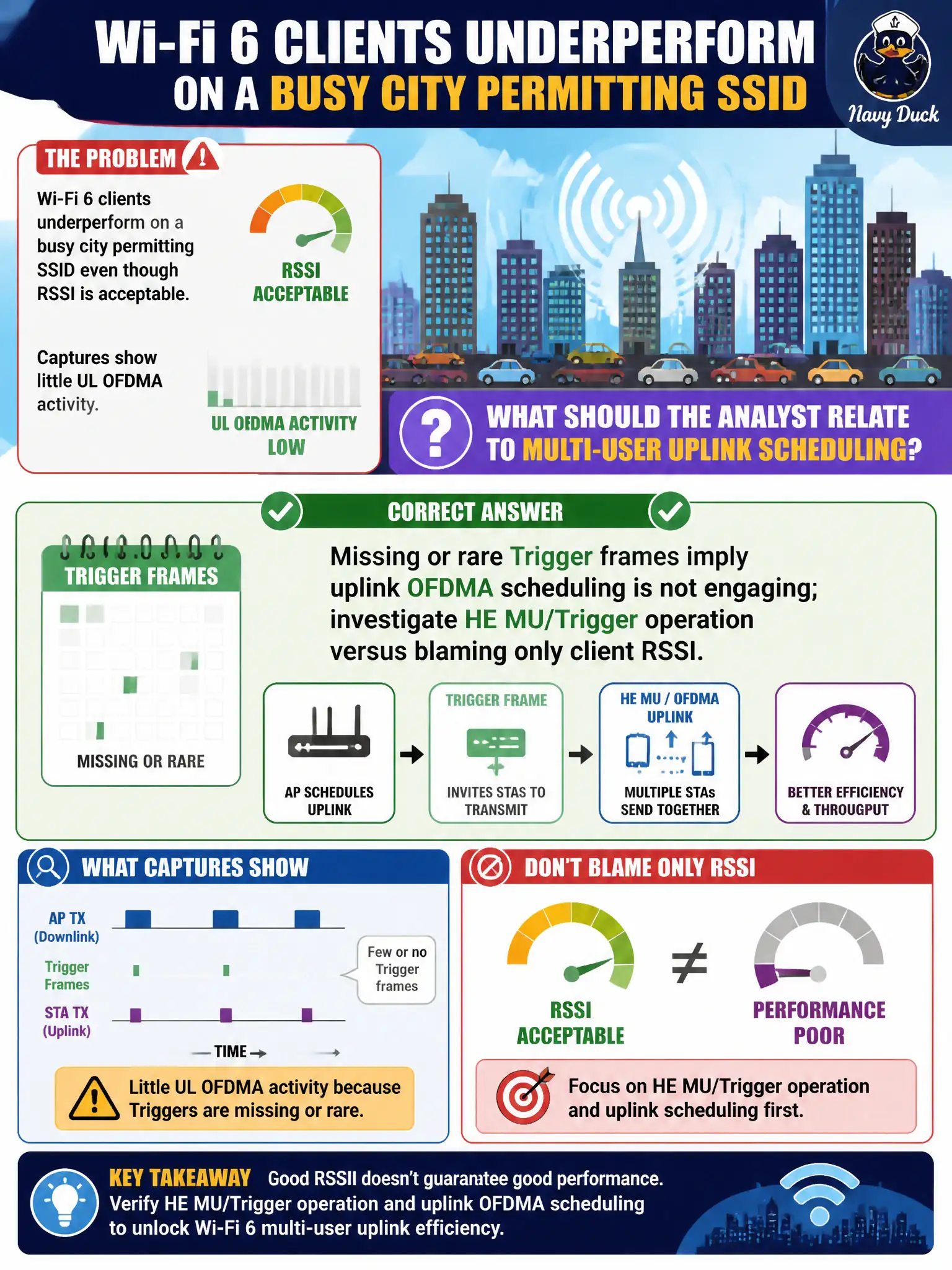
Wi-Fi 6 clients underperform on a busy city permitting SSID even though RSSI is acceptable. Captures show little UL OFDMA activity. What should the analyst relate to multi-user uplink scheduling?
Select an answer to reveal the explanation.
Short Explanation
OFDMA uplink is a conductor cueing many instruments at once—the Trigger frame is the baton. If the busy permitting SSID never shows those cues, don’t just stare at RSSI; ask whether multi-user uplink scheduling is actually on stage.
Full Explanation
Wi-Fi 6 clients underperforming on a busy city permitting SSID with acceptable RSSI but little UL OFDMA activity should prompt investigation of HE MU/Trigger operation. Missing or rare Trigger frames imply uplink OFDMA scheduling is not engaging; RSSI alone does not explain multi-user uplink efficiency. Expert analysis looks for Triggers as the conductor of UL OFDMA.
Claiming Trigger frames are used only for WEP rekey and never for OFDMA is historically and technically wrong. Saying UL OFDMA requires disabling all Acks so rare Triggers prove correct operation invents a broken Ack rule. Asserting Wi-Fi 6 clients ignore Triggers by design and that only Beacon Interval controls uplink scheduling denies HE Trigger-based uplink.
Exam caveat: UL OFDMA visibility in captures ≈ Trigger presence on busy civic SSIDs. Operational check: capture the permitting SSID under load, filter for Trigger frames, verify HE MU capabilities in Beacons/association, and escalate AP scheduler/feature config if Triggers remain absent while UL OFDMA was expected. Confirm the controller/AP feature flag for UL OFDMA/Trigger scheduling is enabled for the permitting WLAN profile, then re-capture under the same load.