
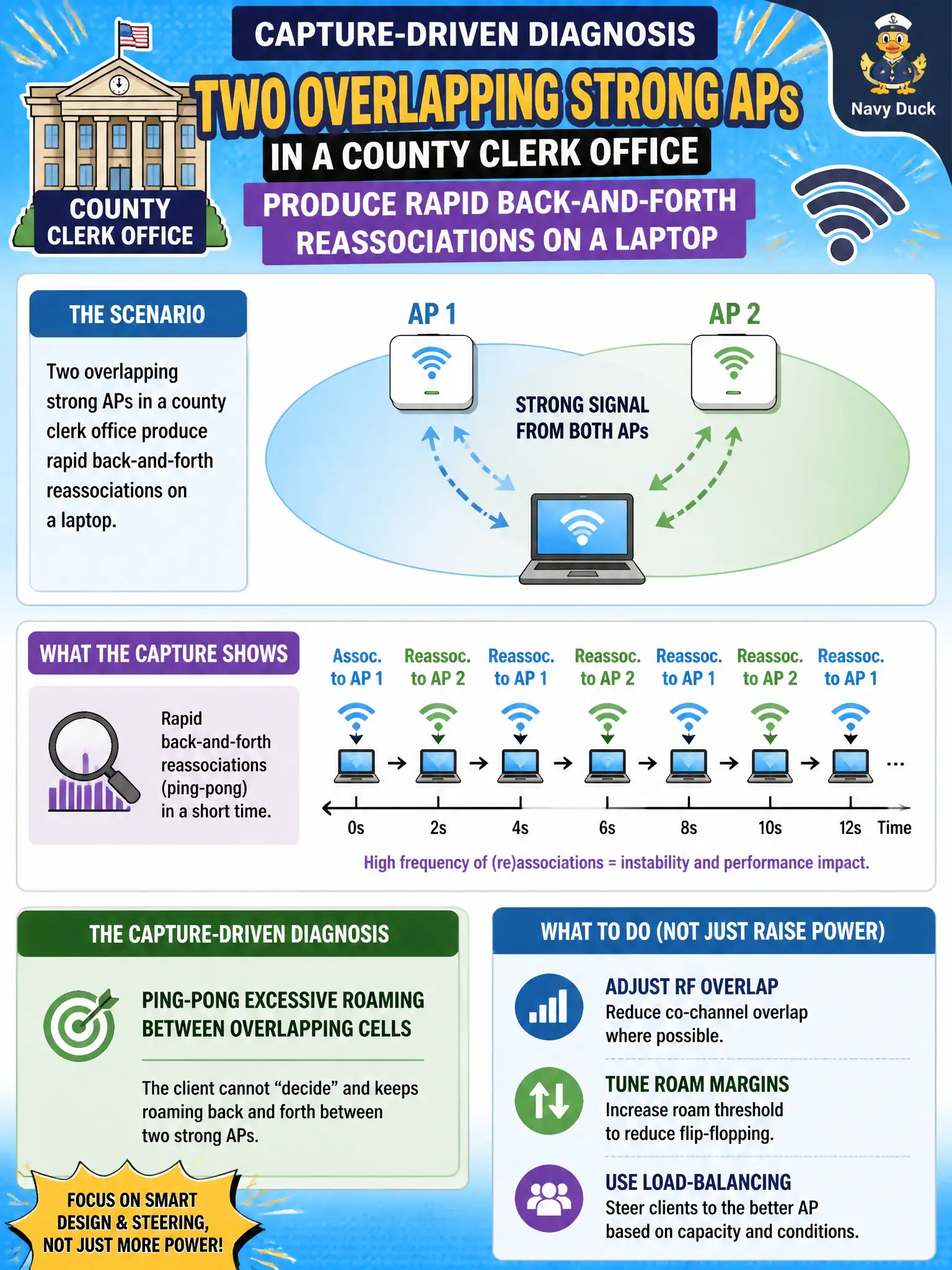
Two overlapping strong APs in a county clerk office produce rapid back-and-forth reassociations on a laptop. What capture-driven diagnosis fits?
Select an answer to reveal the explanation.
Short Explanation
When two strong APs sit on top of each other, a laptop can bounce like a ping-pong ball between counters. The capture timeline of rapid reassociations is your clue—turn down the overlap, don’t just crank both transmitters louder.
Full Explanation
Two overlapping strong APs in a county clerk office that produce rapid back-and-forth reassociations on a laptop indicate ping-pong excessive roaming between overlapping cells. Adjust RF overlap, roam margins, or load-balancing rather than only raising both APs’ power, which often worsens the bounce. Expert capture diagnosis reads the rapid reassoc timeline as ping-pong, not as healthy OKC warmup.
Calling fifty rapid reassociations a normal OKC warmup before voice is allowed mislabels instability as a required ritual. Claiming the pattern proves A-MSDU is disabled and only DFS channels can stop the roams confuses aggregation and DFS with roam hysteresis. Saying the laptop lacks a radio so only Layer-3 traceroute is valid ignores the air-side reassociation evidence.
Exam caveat: ping-pong is an RF overlap/hysteresis problem—power races are the wrong first fix. Operational check: chart reassociation timestamps between the two clerk-office BSSIDs, reduce overlap or tweak roam thresholds, and confirm the laptop settles on one AP through a clerk workflow. Prefer lowering the louder AP or tightening roam hysteresis before any dual-AP power increase in the clerk office—validate with a five-minute reassoc timeline.