
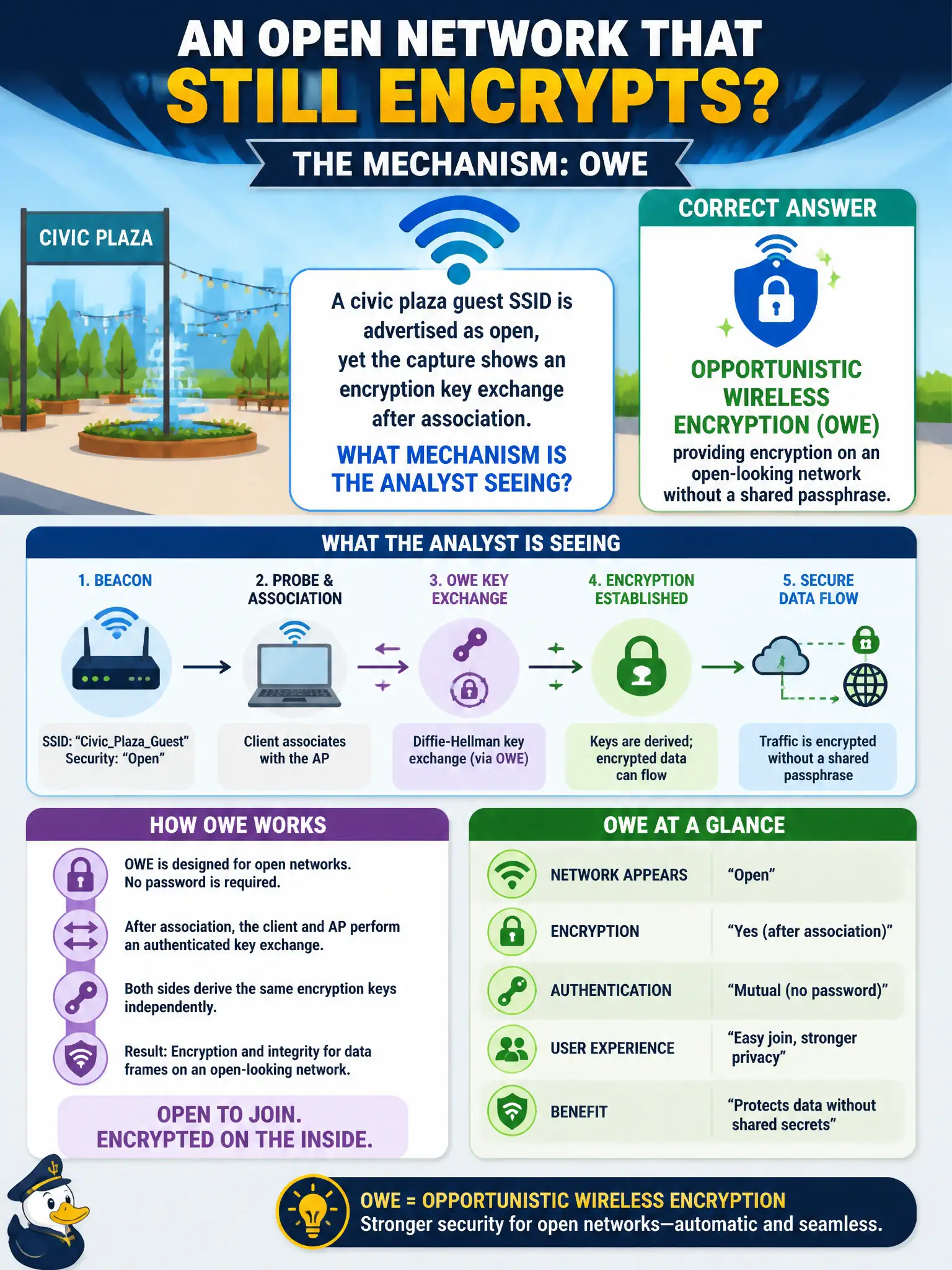
A civic plaza guest SSID is advertised as open, yet the capture shows an encryption key exchange after association. What mechanism is the analyst seeing?
Select an answer to reveal the explanation.
Short Explanation
Open Wi-Fi used to mean postcard-on-the-table privacy—anyone could read it. OWE still looks like an open join, but it quietly negotiates encryption so plaza guests aren’t sending cleartext over the air. That’s the exchange you’re seeing after association.
Full Explanation
A civic plaza guest SSID advertised as open that nonetheless shows an encryption key exchange after association is exhibiting Opportunistic Wireless Encryption (OWE), which provides encryption on an open-looking network without a shared passphrase. Users see “open” UX while air traffic is encrypted—distinct from hidden SSID tricks or legacy WEP. Expert analysts recognize OWE handshakes on modern municipal guest designs.
Calling the pattern hidden SSID mode that encrypts Beacons so probes cannot discover the name confuses SSID concealment with OWE encryption. Claiming mandatory WEP shared-key authentication is still required on all municipal open SSIDs is obsolete and insecure. Saying OKC pre-caches GTK material for every unauthenticated guest before association mislabels OWE as opportunistic key caching for roamers.
Exam caveat: open ≠ unencrypted when OWE is in play; read the association/key exchange carefully. Operational check: capture a plaza guest join, confirm open AKM/OWE signaling and post-association key exchange without a PSK prompt, and verify data frames are encrypted while onboarding UX remains passphrase-free. Explain to plaza stakeholders that “open” describes onboarding UX, while OWE supplies confidentiality—update guest Wi-Fi FAQ language accordingly.