
While validating WPA3-Personal on a municipal guest SSID, what capture evidence distinguishes SAE from a legacy WPA2-PSK join?
Select an answer to reveal the explanation.
Short Explanation
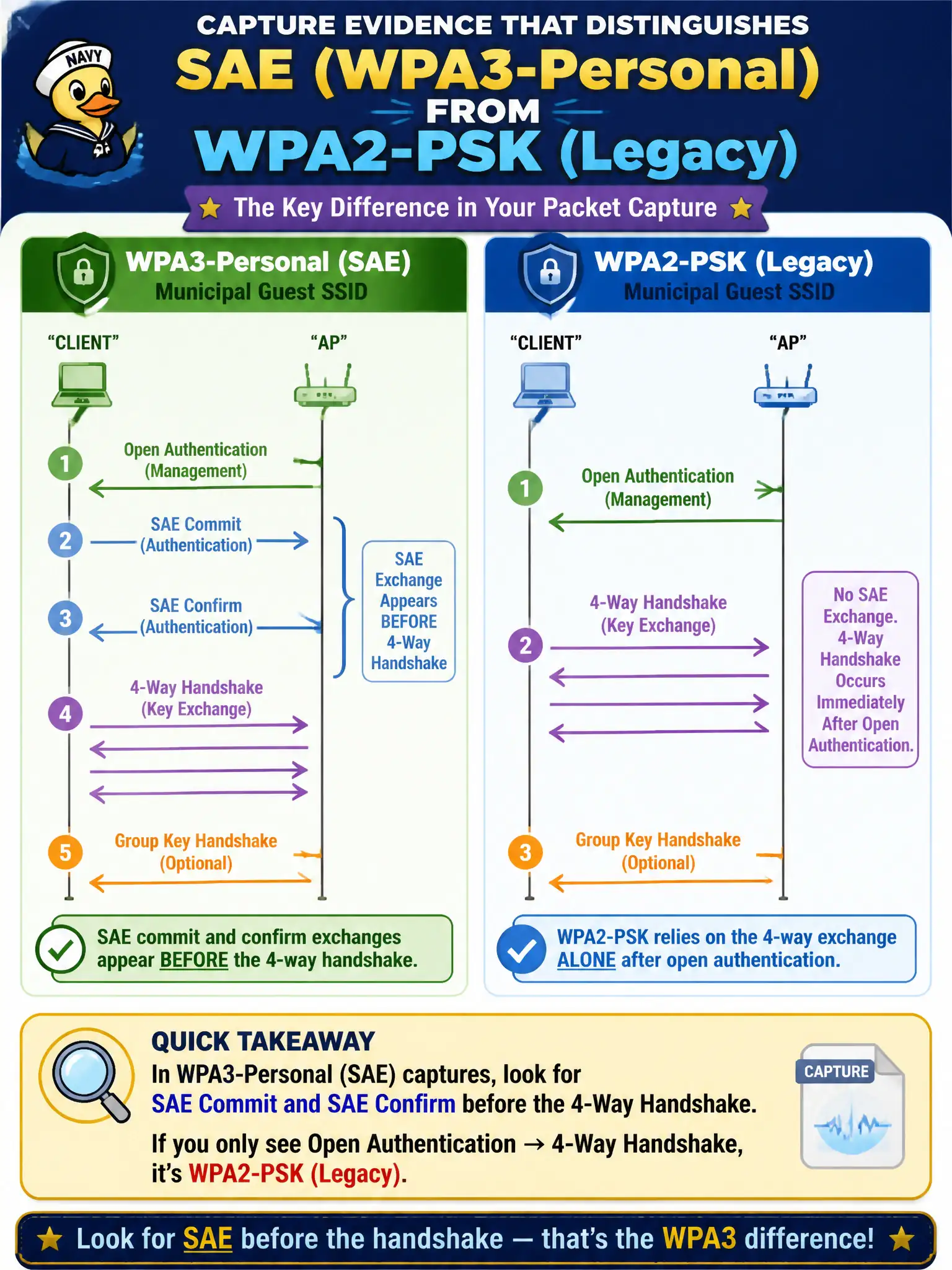
WPA2-PSK is a simple door code and a 4-way key dance. WPA3 SAE adds a mutual 'prove you know the secret without blurting it' commit/confirm before that dance. On the guest SSID capture, look for those SAE frames—they’re the migration proof.
Full Explanation
Validating WPA3-Personal on a municipal guest SSID, capture evidence that distinguishes SAE from legacy WPA2-PSK is the presence of SAE commit and confirm exchanges before the 4-way handshake. WPA2-PSK relies on open authentication plus the 4-way exchange without that SAE commit/confirm pair. Expert validation looks for SAE frames as proof of WPA3-Personal operation on civic guest networks.
Claiming WPA3-Personal never uses any handshake frames and that only captive-portal cookies prove SAE is false. Saying SAE and WPA2-PSK produce identical frame sequences with only the SSID name differing denies the SAE exchange. Asserting legacy PSK always shows GAS/ANQP before association while SAE never does confuses Passpoint discovery with PSK/SAE authentication.
Exam caveat: SAE commit/confirm are the air signature of WPA3-Personal—do not equate with WPA2-PSK lab habits. Operational check: join the municipal guest SSID with a WPA3 client, filter for SAE commit/confirm then 4-way frames, and archive that pcap as the acceptance artifact for the WPA3-Personal cutover. Reject cutover sign-off if the guest join pcap shows only a WPA2-style 4-way without SAE commit/confirm on a profile that claims WPA3-Personal.