
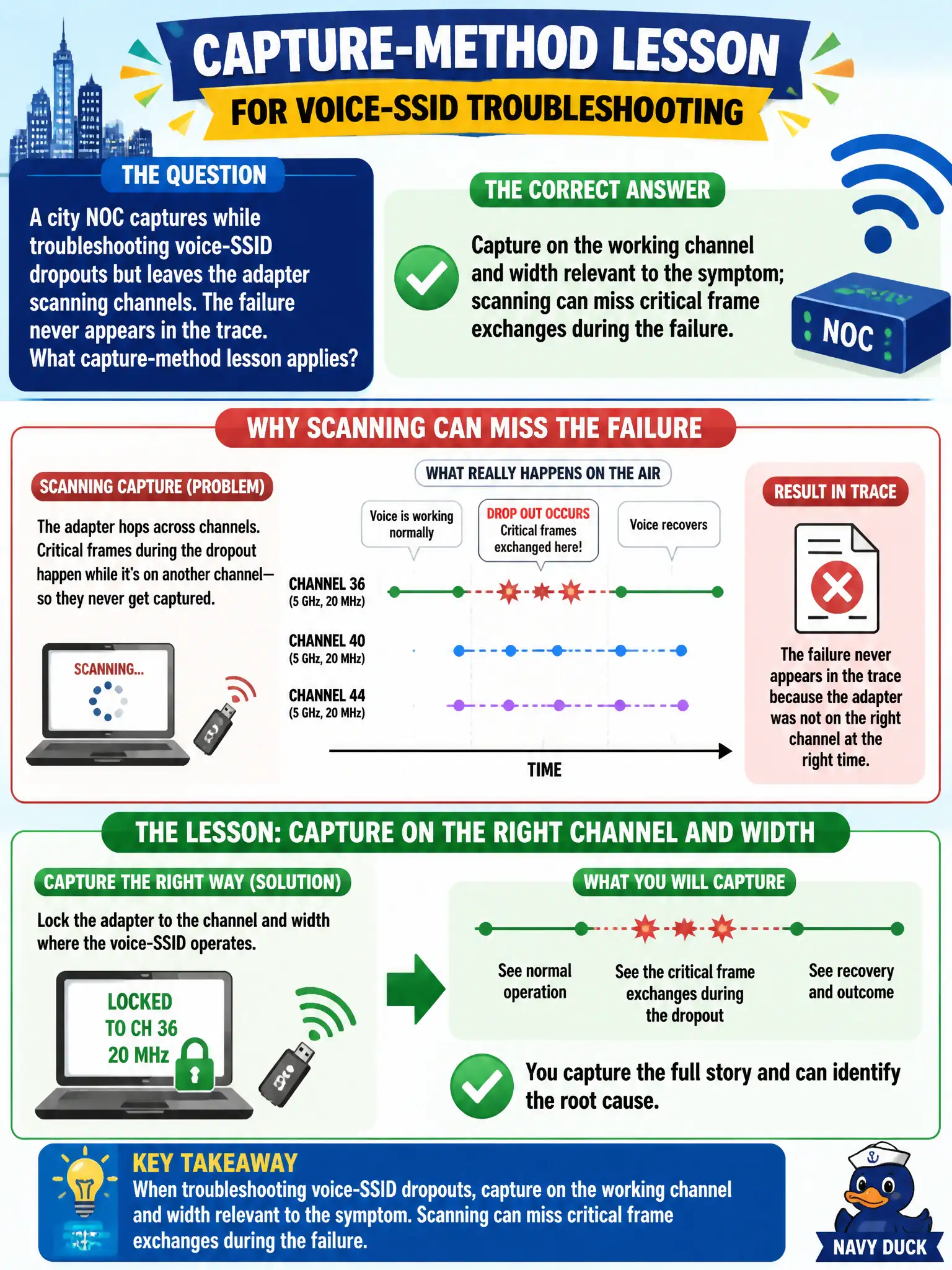
A city NOC captures while troubleshooting voice-SSID dropouts but leaves the adapter scanning channels. The failure never appears in the trace. What capture-method lesson applies?
Select an answer to reveal the explanation.
Short Explanation
If the radio is channel-hopping like a tourist, it'll miss the exact moment the voice call dies on the real channel. Lock the capture to the BSS channel and width. NetFlow won't show you 802.11 retries and roams.
Full Explanation
When a city NOC captures while troubleshooting voice-SSID dropouts but leaves the adapter scanning channels, the failure often never appears because scanning misses critical frame exchanges on the working channel during the event. Capture method must park on the relevant channel and width for the symptom. Expert lesson: channel agility for discovery ≠ channel discipline for failure reproduction.
Believing scanning captures always record every frame on every channel with zero loss ignores dwell-time gaps. Saying voice failures only appear in NetFlow so 802.11 captures are unnecessary abandons air-side root cause for VoWLAN. Always capturing solely on channel 1 regardless of where the voice BSS operates systematically misses the working BSS.
Exam caveat: lock channel/width to the civic voice BSS under test before claiming “no frames show the drop.” Operational check: set the capture adapter to the voice SSID’s operating channel and width, reproduce the dropout, and verify reassociation/retry/EAP frames appear timed with the user report. Update the voice troubleshooting playbook: “adapter locked to BSS channel/width” is step one before declaring the dropout invisible. If the dropout finally appears after locking the channel, mark that methodological fix in the NOC retrospective so scanning mistakes are not repeated.