
After accepting a new municipal WLAN, what performance artifacts should the team capture to detect future regressions?
Select an answer to reveal the explanation.
Short Explanation
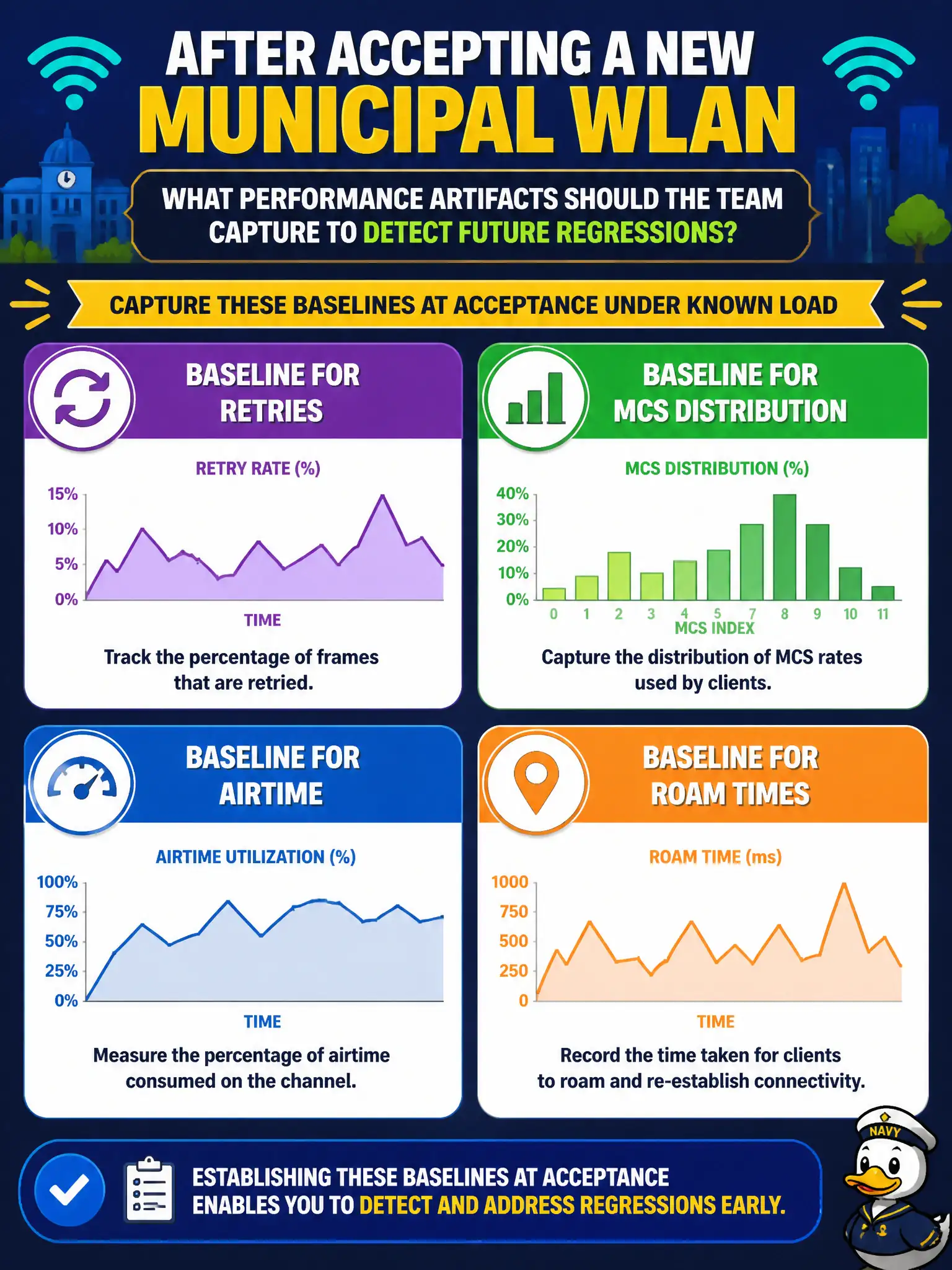
Take a snapshot while the network is healthy—retries, MCS, airtime, roam times—so next year's weirdness has a baseline to argue with.
Full Explanation
After accepting a new municipal WLAN, capture baselines for retries, MCS distribution, airtime, and roam times under known load at acceptance so future regressions are detectable against evidence—not anecdotes. Marketing screenshots of coverage heatmaps alone are insufficient baselines. AP serial numbers without RF or client metrics do not characterize performance. Unofficial crowdsourced speed-test anecdotes from social media are noisy and uncontrolled. Exam caveat: acceptance artifacts should be quantitative and repeatable. Operational check: store the baseline bundle in the municipal repository, re-run the same tests after major changes, and escalate when KPIs drift beyond agreed thresholds. In municipal WLAN and IoT operations, record the chosen control and the rejected alternatives in the change ticket so on-call staff understand which failure modes were avoided for city services. Re-validate after the next maintenance window that the same control still holds under the current platform code, device mix, and civic event calendar used by the wireless team. Keep RF, capacity, security, and QoS evidence attached to the municipal runbook entry for auditors and future CWNE-level reviews.