
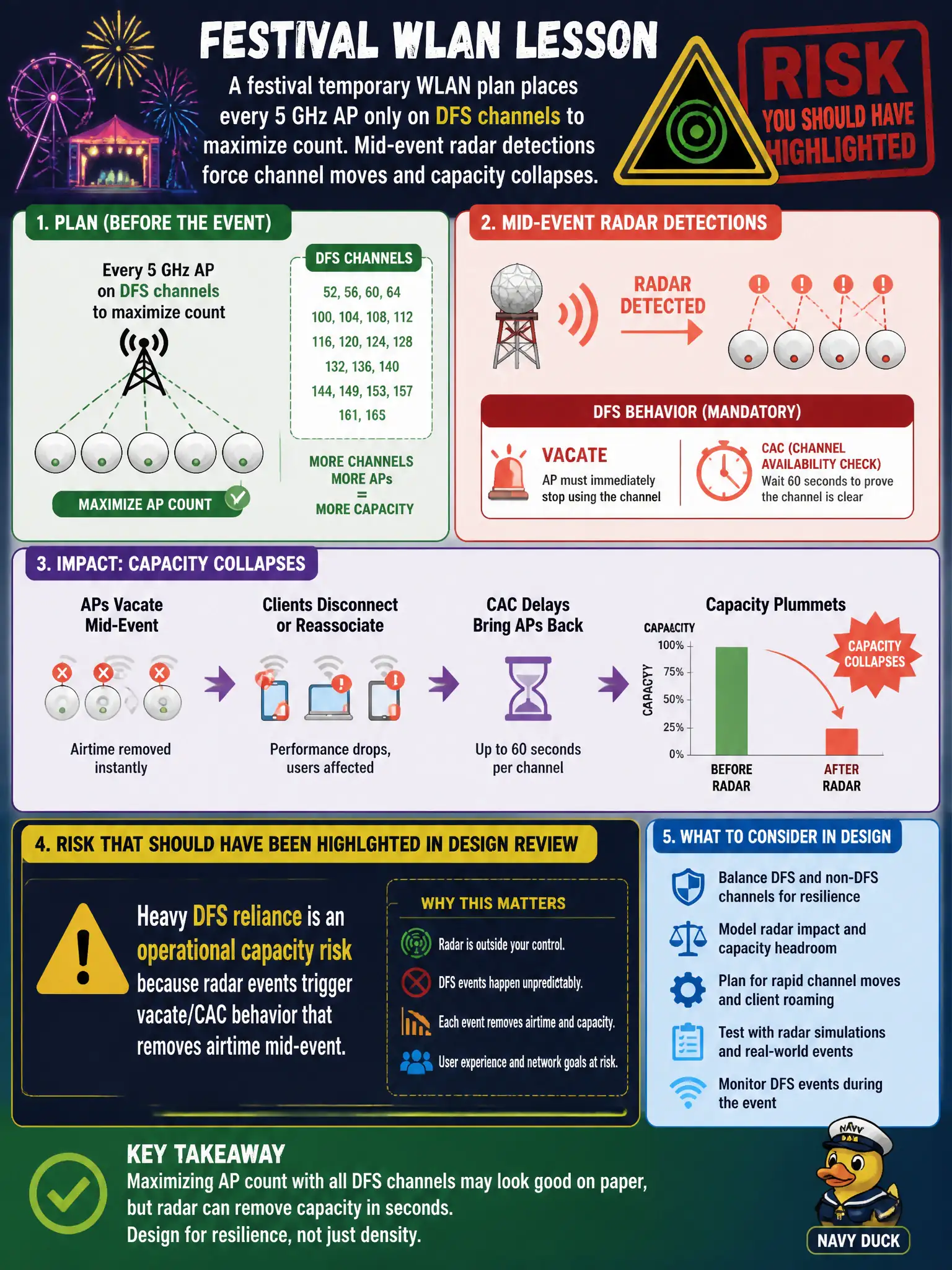
A festival temporary WLAN plan places every 5 GHz AP only on DFS channels to maximize count. Mid-event radar detections force channel moves and capacity collapses. What risk should have been highlighted in the design review?
Select an answer to reveal the explanation.
Short Explanation
DFS channels are extra lanes that close when weather radar—or anything that looks like it—shows up. If the whole festival plan lives only there, one detection sends APs packing. Keep some non-DFS capacity so the show survives radar days.
Full Explanation
Heavy reliance on DFS channels in a municipal RF plan is an operational capacity risk because radar events trigger vacate and CAC behavior that can remove spectrum precisely when council, permitting, or public-meeting load peaks. Experts must treat DFS as useful but contingent capacity, with non-DFS fallback channels and monitoring for radar-driven moves. Claiming DFS channels always provide higher MCS than non-DFS channels confuses regulatory channel sets with SNR/MCS selection. Saying radar events only affect 2.4 GHz beacon timing is factually wrong—DFS applies to designated 5 GHz bands, not as a 2.4 GHz beacon phenomenon. Asserting non-DFS channels cannot be used outdoors in any regulatory domain over-generalizes rules and is not a substitute for reading the applicable domain. Exam caveat: DFS increases available spectrum but adds vacate/CAC operational risk that capacity plans must absorb. Operational check: inventory how much peak municipal capacity sits on DFS, review radar vacate history, and ensure non-DFS channels plus AP density cover critical civic spaces if radar clears the band. In municipal WLAN operations, record the chosen control and the rejected alternatives in the change ticket so on-call staff understand which failure modes were avoided for city services. Re-validate after the next maintenance window that the same control still holds under the current controller code, client mix, and civic event calendar used by the wireless team.