
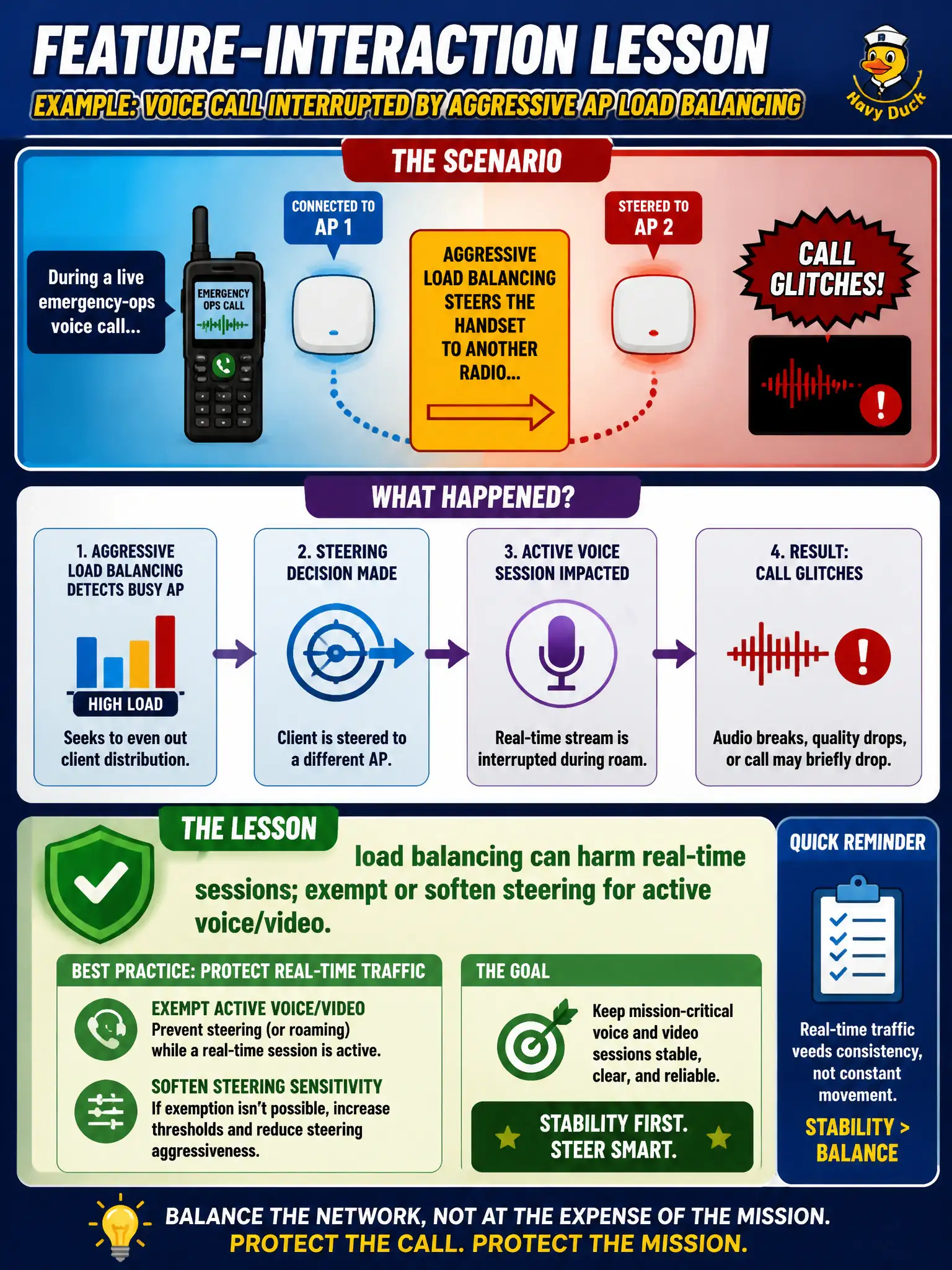
During a live emergency-ops voice call, aggressive AP load-balancing steers the handset to another radio mid-conversation and the call glitches. What feature-interaction lesson applies?
Select an answer to reveal the explanation.
Short Explanation
Moving someone’s desk while they’re on a 911-style call is a bad ops move—and so is steering a live voice client mid-talk. Load balancing is great until it interrupts real-time media. Ease up or exempt active voice/video from aggressive steers.
Full Explanation
During a live emergency-ops voice call, aggressive AP load-balancing that steers a handset mid-conversation can glitch media because steering interrupts time-sensitive sessions. The feature-interaction lesson is that aggressive load balancing can harm real-time traffic; exempt or soften steering for active voice/video so municipal emergency operations keep call continuity. Asserting load balancing should always preempt voice because airtime fairness outranks call continuity ignores public-safety-adjacent priorities during an active incident. Requiring voice clients to use static WEP so steer events cannot occur invents a false coupling, weakens security, and does not correctly solve steer policy. Disabling roaming entirely for all municipal SSIDs trades one mobility problem for sticky-client and coverage failures campus-wide. Exam caveat: controller steering and voice QoS interact—policy must protect active real-time sessions. Operational check: review steer thresholds and voice exemptions, test emergency-ops calls under intentional AP load, and document hold-downs so civic responders are not mid-call steered during incidents. In municipal WLAN operations, record the chosen control and the rejected alternatives in the change ticket so on-call staff understand which failure modes were avoided for city services. Re-validate after the next maintenance window that the same control still holds under the current controller code, client mix, and civic event calendar used by the wireless team.