
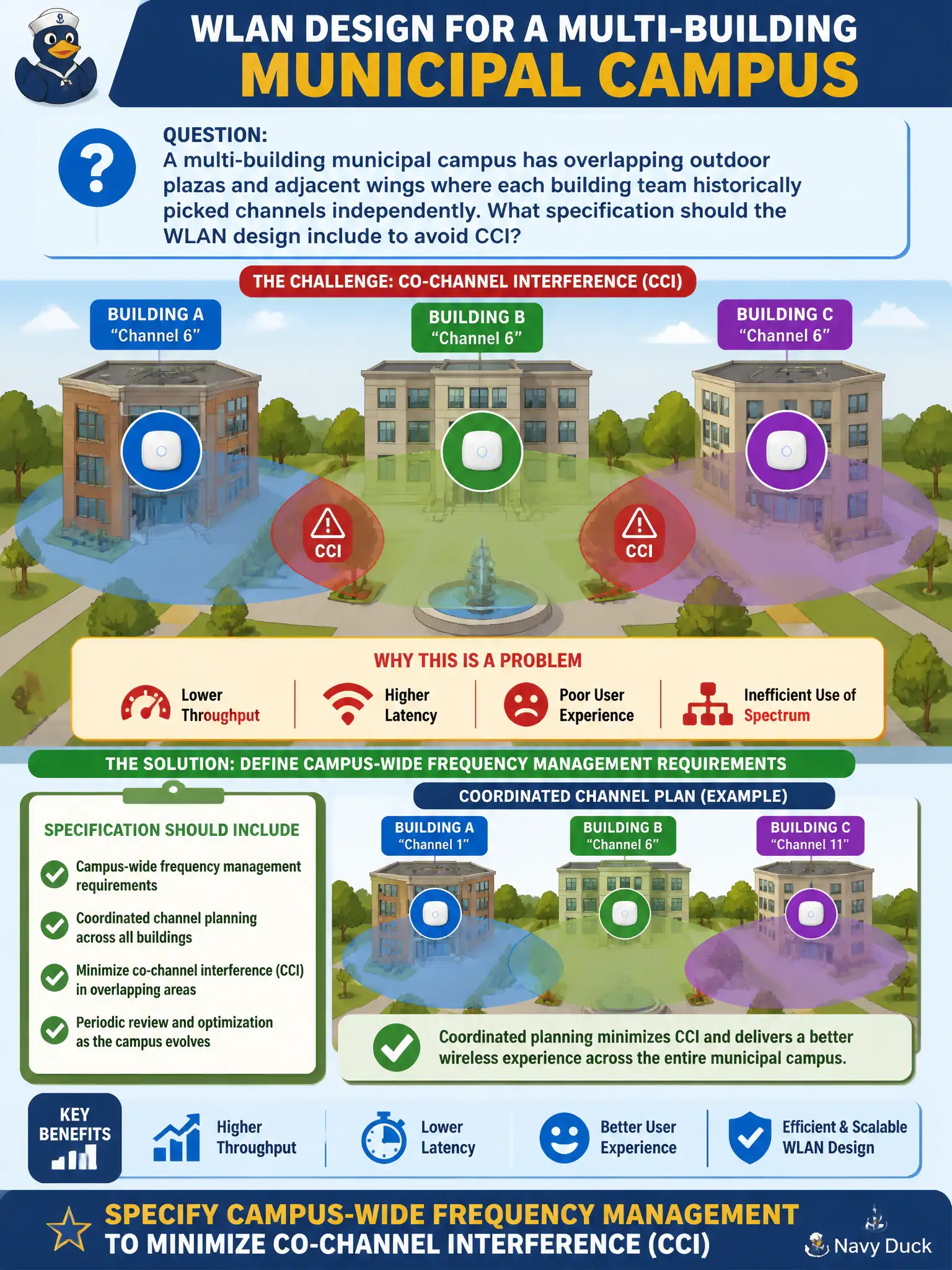
A multi-building municipal campus has overlapping outdoor plazas and adjacent wings where each building team historically picked channels independently. What specification should the WLAN design include to avoid CCI?
Select an answer to reveal the explanation.
Short Explanation
Three buildings picking channels in a vacuum is how plazas become CCI soup. Write campus-wide frequency management into the specs so reuse is planned on purpose.
Full Explanation
Independent per-building channel picks create co-channel interference in overlapping plazas and adjacent wings. A multi-building municipal campus WLAN design should define campus-wide frequency management requirements so channel planning is coordinated across buildings to minimize CCI. Shared outdoor spaces need a single coordinated plan, not tribal automatic defaults from each building team.
Allowing each building to run automatic full-power defaults with no campus coordination fails by concept: uncoordinated auto settings collide in plazas and wings. Using identical primary channels on every adjacent AP to simplify labeling fails by concept: identical channels maximize CCI. Disabling all 5 GHz channels campus-wide to reduce planning effort fails by concept: abandoning 5 GHz destroys capacity rather than coordinating reuse.
Exam caveat: CWNE campus designs treat frequency management as a cross-building specification, especially where outdoor spaces overlap.
Operational check: Produce a campus channel and power matrix covering plazas and adjacent wings, enforce it in controller or cloud RF profiles, and verify CCI with spectrum and Wi-Fi scans at overlap zones. In municipal CWNE practice for item q142, document the decision, tie it to the civic service impact, and re-test after change so operations can defend the design to stakeholders with evidence rather than opinion.