
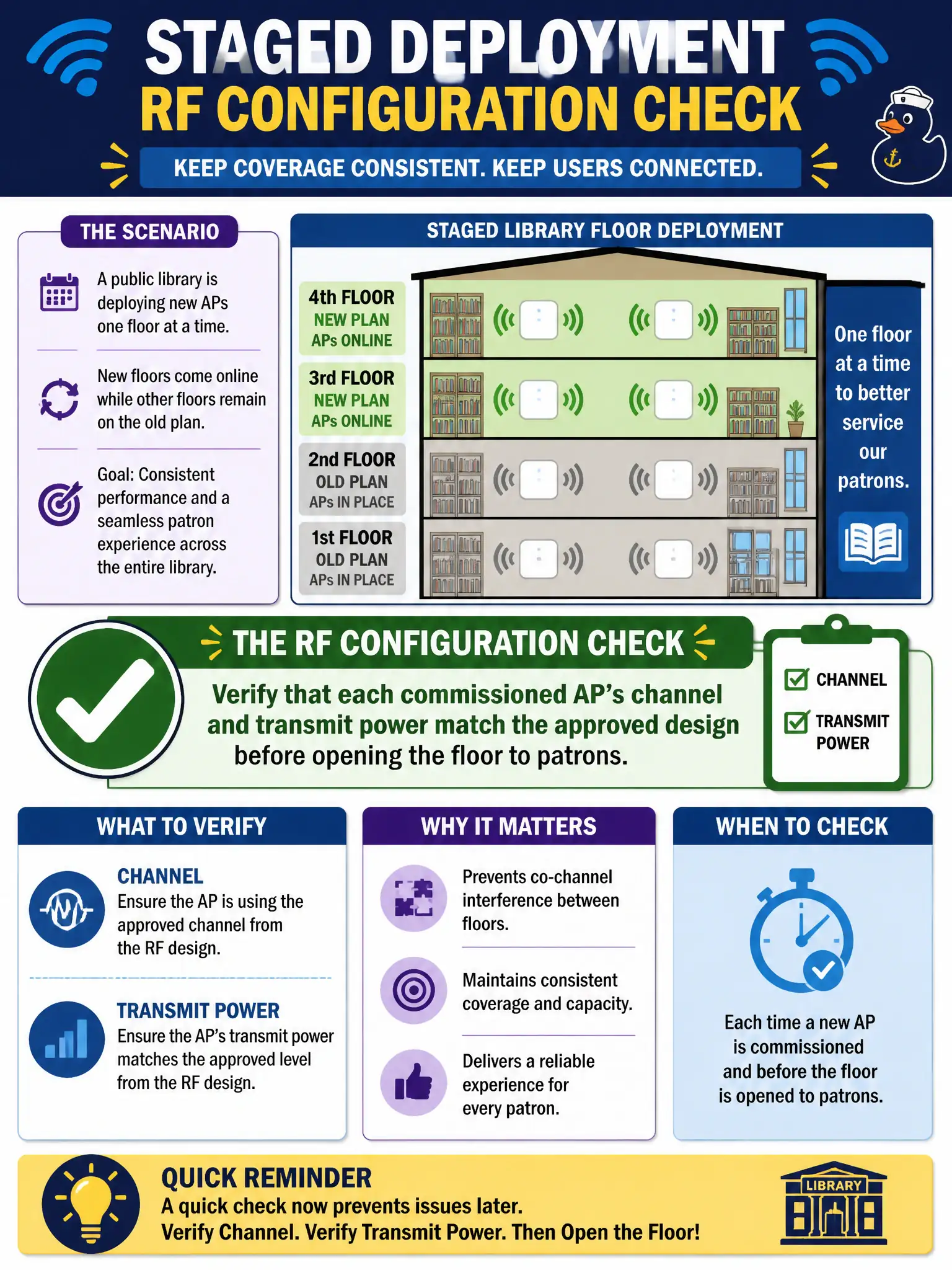
During staged deployment of a public library floor, APs are coming online while other floors remain on the old plan. What RF configuration check should occur as each new AP is commissioned?
Select an answer to reveal the explanation.
Short Explanation
Staged cutovers are where silent config drift sneaks in. As each library AP lights up, check channel and power against the design—not against whatever the previous closet used.
Full Explanation
Staged library cutovers mix new and legacy RF; each newly commissioned AP must still match the approved channel and transmit power design before patrons use that floor. Verifying channel and Tx power against the design prevents accidental max-power or wrong-channel cells that fight remaining legacy floors. Staged deployment is not a license to freestyle RF parameters for convenience during construction, even when floors open on different nights.
Raising every new AP to maximum power to overwhelm legacy cells fails by concept: that creates CCI and unstable boundaries during cutover. Disabling 5 GHz on new APs until the entire campus is finished fails by concept: it unnecessarily withholds capacity and skips validating the designed dual-band plan. Changing SSIDs daily so legacy and new never share a name fails by concept: SSID churn breaks clients and does not ensure channel or power compliance.
Exam caveat: Commissioning checks during phased municipal deployments focus on design conformance per AP, not temporary RF hacks.
Operational check: As each library AP comes online, compare configured channel and transmit power to the approved plan, correct mismatches, then open the floor—and log results in the cutover checklist.