
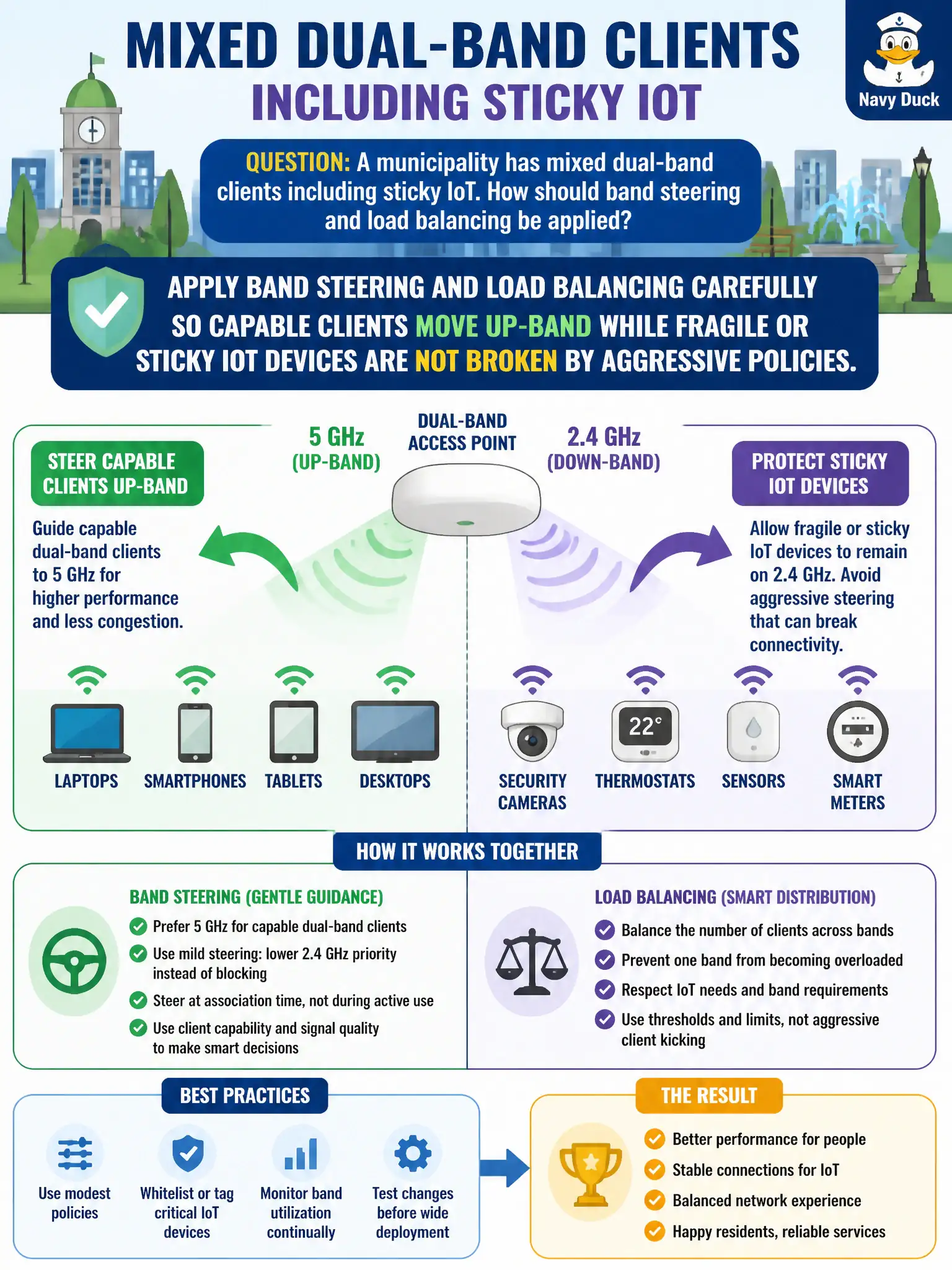
A municipality has mixed dual-band clients including sticky IoT. How should band steering and load balancing be applied?
Select an answer to reveal the explanation.
Short Explanation
Band steering is a helpful usher—until it shoves a fragile IoT sensor off a band it actually needs. Steer the capable phones and laptops; leave room for devices that misbehave when poked. Killing 5 GHz or drowning 2.4 GHz in power are clumsy substitutes.
Full Explanation
Band steering and load balancing help capable clients use 5/6 GHz capacity, but aggressive policies can strand or break sticky IoT that only behaves on 2.4 GHz. For a municipality with mixed dual-band clients including sticky IoT, steering and balancing should be applied carefully so capable clients move up-band while fragile or sticky IoT devices are not broken by aggressive policies—often via exemptions, gentler thresholds, or SSID separation for IoT.
Forcing aggressive steering of every device to 5 GHz with no IoT exceptions fails by concept: sticky or 2.4-only IoT will fail join or flap when coerced. Disabling 5 GHz entirely so steering is unnecessary fails by concept: that wastes capacity and abandons the band-steering goal for capable clients. Steering only by raising 2.4 GHz power far above 5 GHz fails by concept: louder 2.4 GHz encourages stickiness on the wrong band and worsens CCI.
Exam caveat: CWNE high-density and IoT items reward nuanced steering—optimize capable clients without collateral damage to municipal IoT fleets.
Operational check: Inventory sticky IoT OUI/SSID needs, configure steering exemptions or a dedicated IoT SSID, enable moderate steering for employee devices, and validate both classes after policy change.