
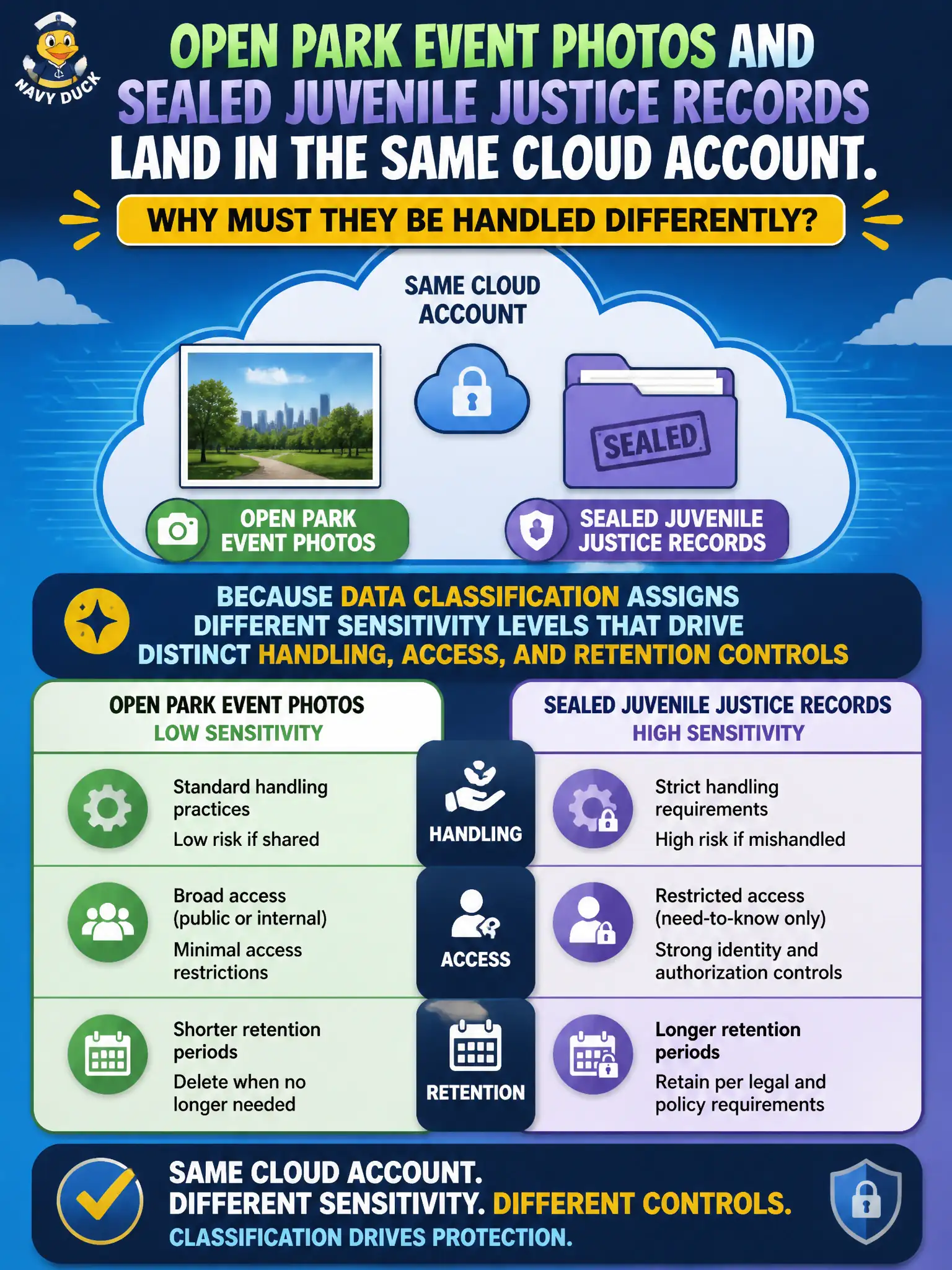
Open park event photos and sealed juvenile justice records land in the same cloud account. Why must they be handled differently?
Select an answer to reveal the explanation.
Short Explanation
A postcard of the parade is not the same as a sealed juvenile file—even in the same cloud bucket prefix. Classification labels the sensitivity so access, encryption, and retention match the real risk.
Full Explanation
Data classification assigns sensitivity levels that drive distinct handling, access, and retention controls. Open park event photos and sealed juvenile justice records must not share identical cloud handling simply because they land in one account—juvenile records typically demand far stricter access, encryption, retention, and audit than public event photos. Classification is how municipalities apply proportionate protections.
Claiming all municipal files share one handling rule once digitized erases required distinctions. Asserting photos always require stronger controls than sealed court records reverses typical sensitivity. Believing juvenile records become public automatically when stored as objects is legally and ethically wrong.
Exam caveat: classification labels (public, internal, confidential, restricted, etc.) map to control baselines. Storage account colocation does not imply identical policy—use separate buckets/accounts/keys as needed.
Operational check: label both datasets, place sealed records in a restricted store with strict IAM and encryption, keep open photos in a public-appropriate repository, and audit access differently. Document classification in the city’s data inventory tied to justice and parks systems.