
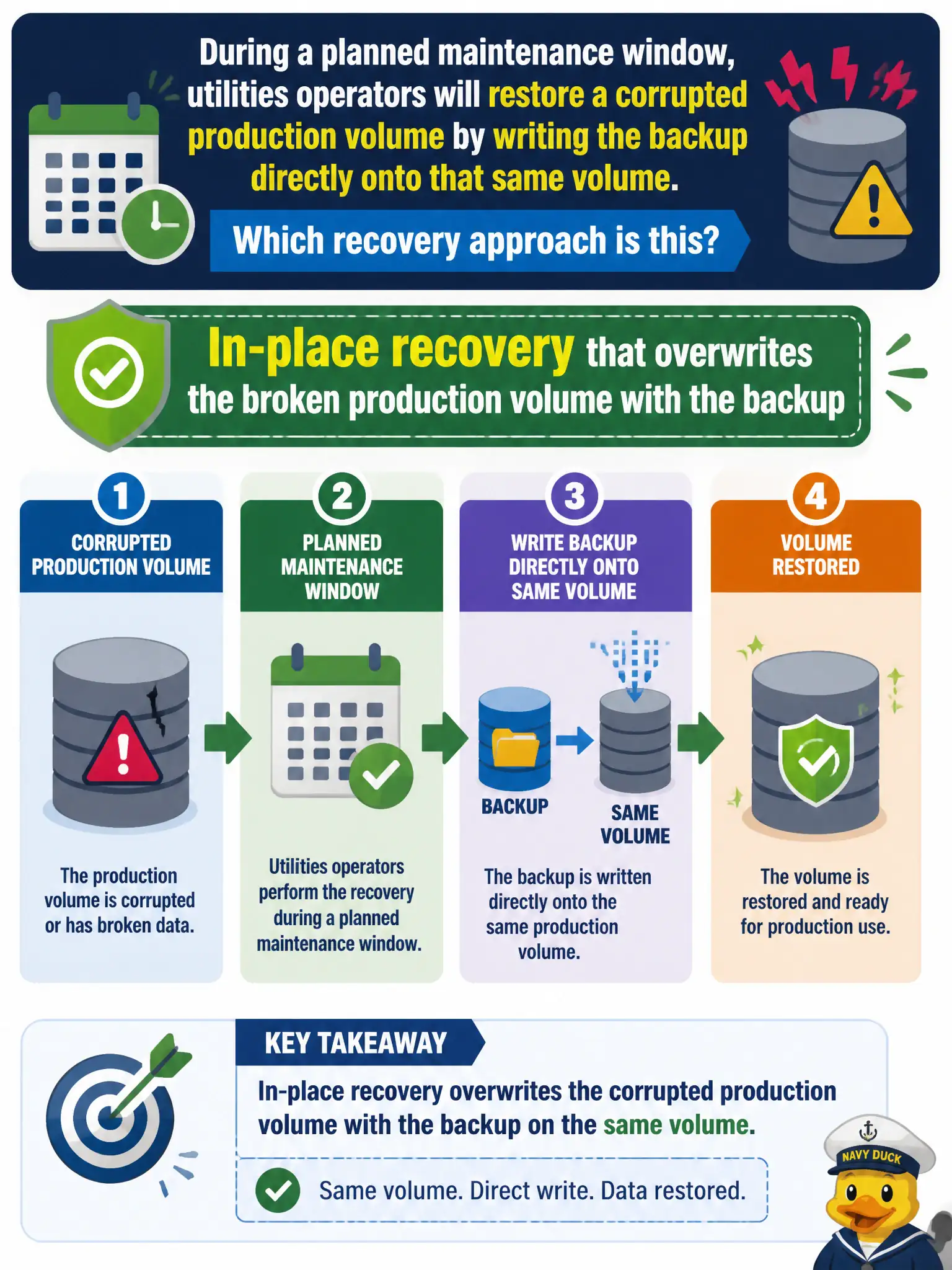
During a planned maintenance window, utilities operators will restore a corrupted production volume by writing the backup directly onto that same volume. Which recovery approach is this?
Select an answer to reveal the explanation.
Short Explanation
In-place restore is like sanding and refinishing the same table instead of building a second table beside it. You overwrite the damaged production volume during the window. That is different from restoring first into a parallel environment.
Full Explanation
In-place recovery restores data onto the existing production resource, typically overwriting damaged content in situ. During a planned maintenance window, utilities operators who write a backup directly onto the same corrupted production volume are performing in-place recovery—fast to describe, but destructive to whatever still existed on that volume. Civic operators must understand that tradeoff before approving the window.
Parallel recovery into a separate environment before cutover is a different approach that preserves the broken volume for forensics or fallback. Granular item-level restore of a single mailbox only describes selective object recovery, not whole-volume overwrite. Cross-region warm standby failover without restoring backups is a replication failover pattern, not backup restore onto the damaged volume.
Exam caveat: in-place restore can meet tight RTO but increases risk if the backup is wrong or incomplete—parallel restore is safer when validation time exists. Always confirm you are not overwriting the only remaining good copy.
Operational check: snapshot or copy any residual production data if possible before overwrite, restore the backup onto the production volume in the change window, validate utilities application health and data samples, and keep an out-of-band copy until acceptance. Record the in-place decision and rollback limits in the maintenance ticket for auditors and future on-call staff.