
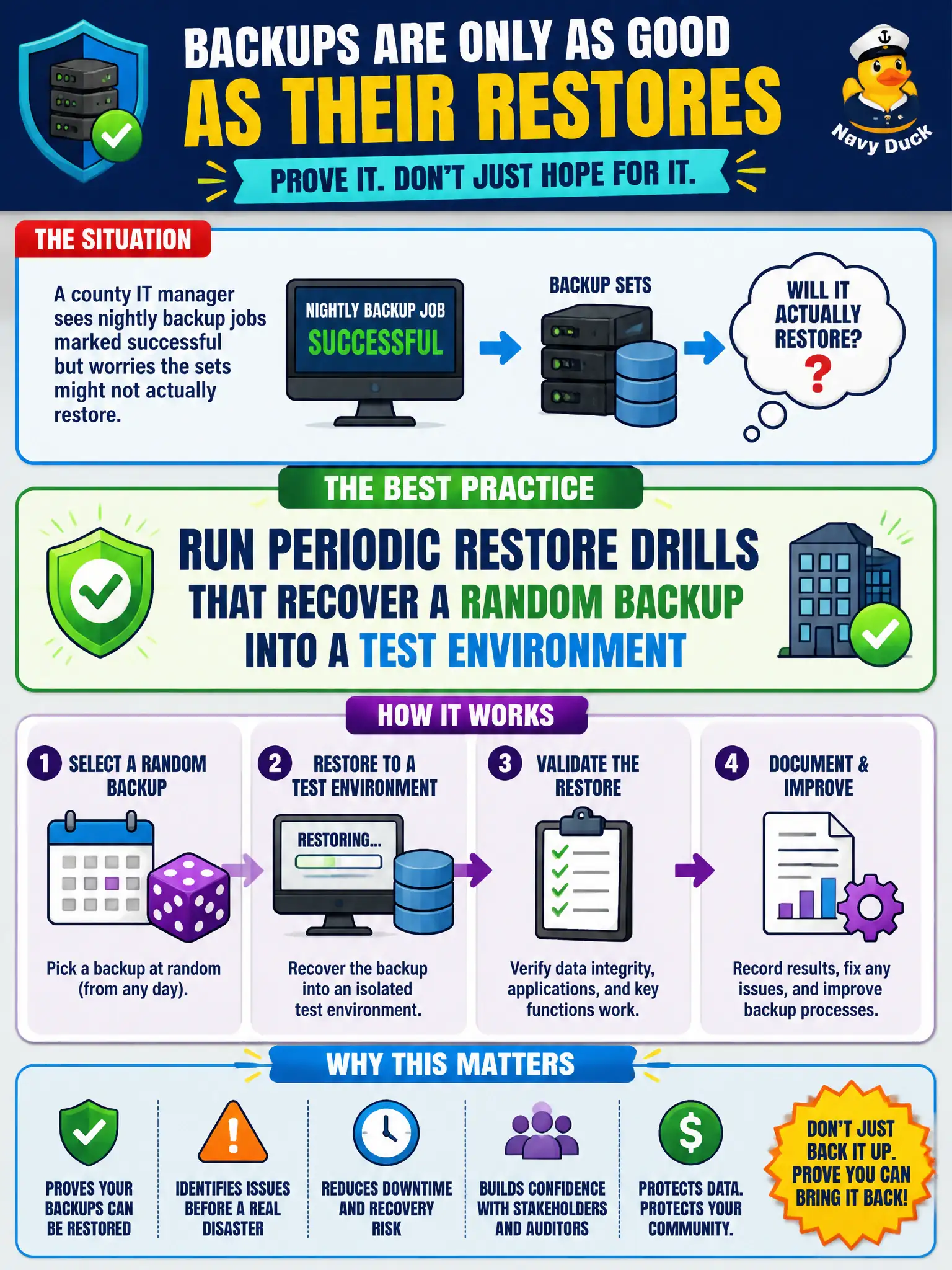
A county IT manager sees nightly backup jobs marked successful but worries the sets might not actually restore. What practice best proves recoverability?
Select an answer to reveal the explanation.
Short Explanation
A green checkmark on the backup job is like packing a parachute without ever doing a test jump. Periodic restore drills prove the gear actually works.
Full Explanation
Successful backup job status confirms that a copy process completed, not that the data is usable for recovery. Periodic restore drills that recover a random backup into a test environment prove recoverability for county workloads and surface corruption, bad credentials, missing chains, or runbook gaps before a real outage. For municipal IT managers, tested restores are how public services earn confidence in continuity claims.
Increasing backup compression until job duration drops by half may save time or space but does not validate restore success. Deleting old full backups immediately after each incremental succeeds can break restore chains and destroy known-good baselines. Disabling alerting on backup failures reduces noise only by hiding real problems.
Exam caveat: "backup successful" ≠ "restore tested." Exams often contrast monitoring job status with verification via restore. Random or sampled restores beat restoring the same low-risk system every time.
Operational check: schedule recurring restore tests into an isolated network, pick backups by sampling across systems and ages, measure RTO, validate application smoke tests on restored county data, and file results with gaps assigned to owners. Escalate any drill failure as a P1 process defect, not as optional homework.