
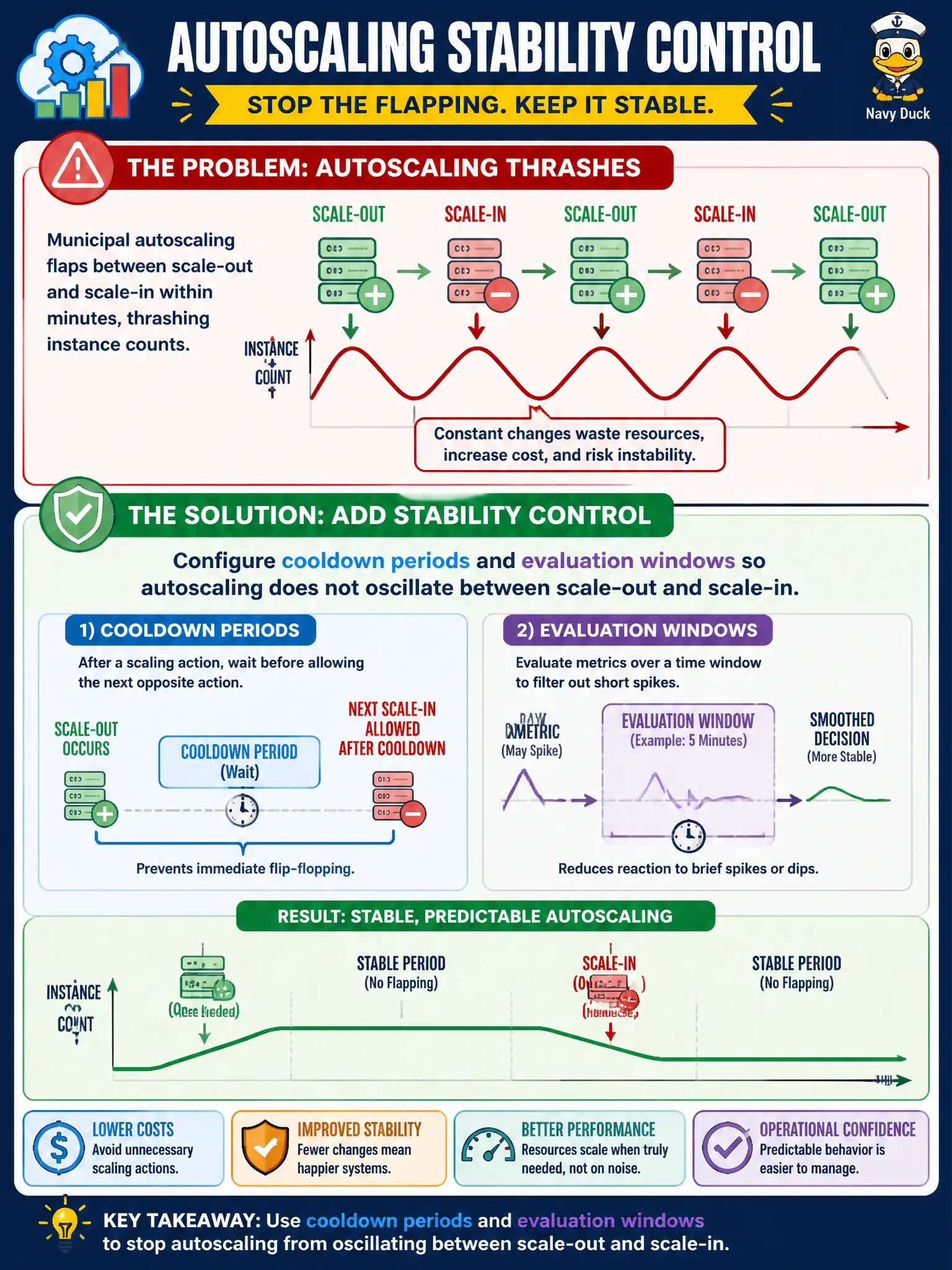
Municipal autoscaling flaps between scale-out and scale-in within minutes, thrashing instance counts. What stability control should ops add?
Select an answer to reveal the explanation.
Short Explanation
Flapping autoscaling is a thermostat that turns the furnace on and off every thirty seconds—exhausting and expensive. Cooldown periods and sensible windows let the system settle before the next move. Stability is part of scaling, not an afterthought.
Full Explanation
Configuring cooldown periods and evaluation windows so autoscaling does not oscillate between scale-out and scale-in stabilizes municipal fleets that thrash instance counts within minutes. Removing all thresholds so scaling decisions become random worsens instability. Paging executives on every single scale activity with no delay creates noise without fixing flapping. Forcing continuous scale-out with no scale-in path ever fixes flapping only by abandoning cost control. Exam caveat: cooldowns and longer evaluation windows are the standard anti-flapping controls for autoscaling. Operational check: set cooldown after each scale action, average metrics over a window, simulate threshold hovering, and confirm instance churn drops for civic APIs. In municipal platform operations, record the chosen control and the rejected alternatives in the change record so future on-call engineers understand the failure modes avoided for citizen services. Re-check the decision after the next provider feature change or compliance update to ensure the same answer still holds for the city's estate. Confirm monitoring, access reviews, and backup coverage still align with the selected approach before closing the civic hypercare period.