
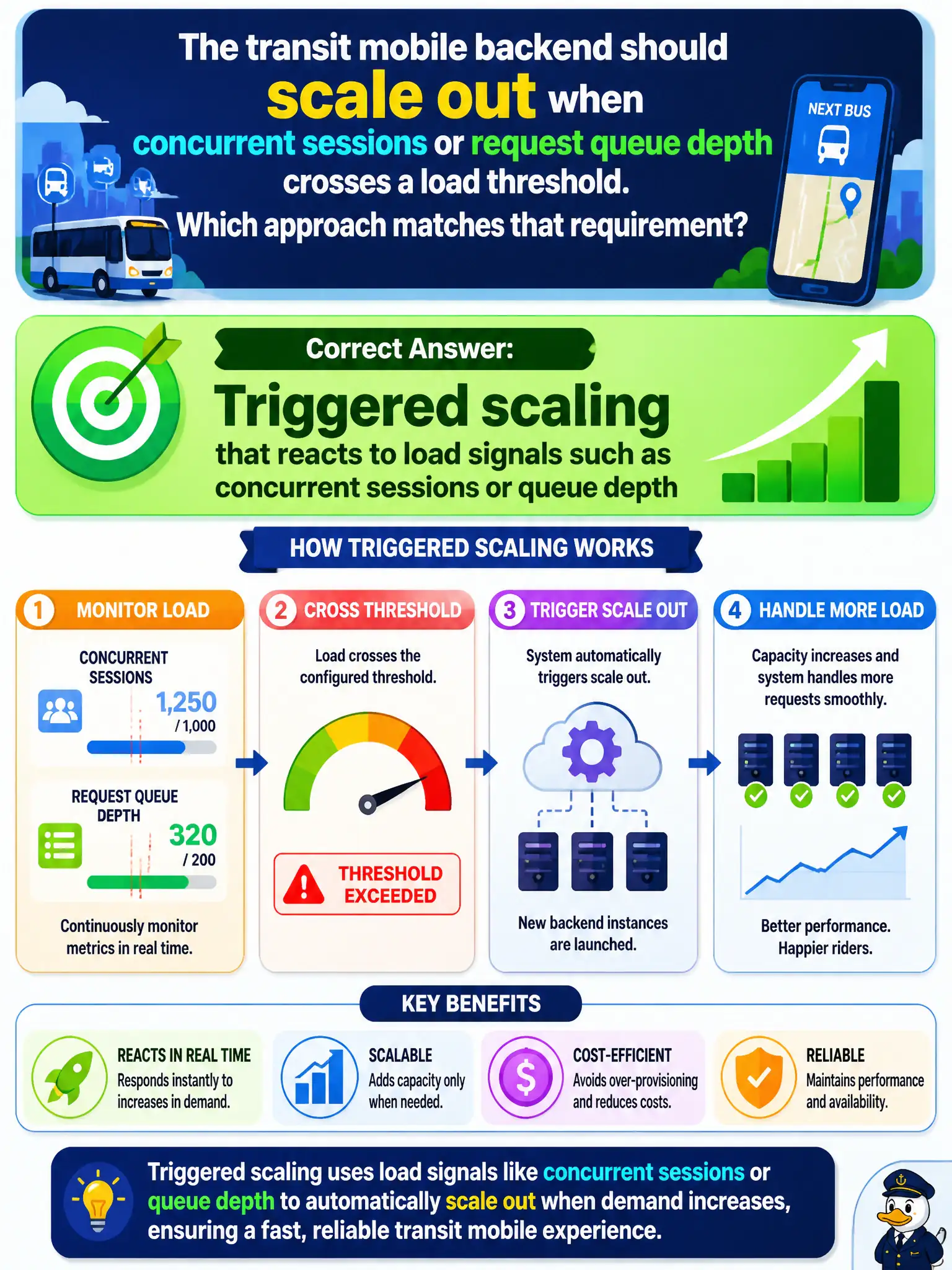
The transit mobile backend should scale out when concurrent sessions or request queue depth crosses a load threshold. Which approach matches that requirement?
Select an answer to reveal the explanation.
Short Explanation
Concurrent sessions and queue depth are the “how crowded is the bus” gauges. When they cross the line, triggered scaling rolls out more backend capacity for riders. Waiting for angry tweets is not a load signal.
Full Explanation
Triggered scaling that reacts to load signals such as concurrent sessions or queue depth matches a transit mobile backend that should scale out when those thresholds are crossed. Scaling only when an administrator notices social-media complaints fails proactive automation. Fixed instance counts with no reaction to session or queue metrics ignore the stated load signals. Vertical scaling of a single instance with no additional workers fails scale-out on session/queue pressure. Exam caveat: load-based triggers (sessions, queue depth) are first-class scaling signals alongside CPU. Operational check: emit queue/session metrics, wire scaling policies, load-test commute peaks, and confirm new workers register with the transit load balancer. In municipal platform operations, record the chosen control and the rejected alternatives in the change record so future on-call engineers understand the failure modes avoided for citizen services. Re-check the decision after the next provider feature change or compliance update to ensure the same answer still holds for the city's estate. Confirm monitoring, access reviews, and backup coverage still align with the selected approach before closing the civic hypercare period.