
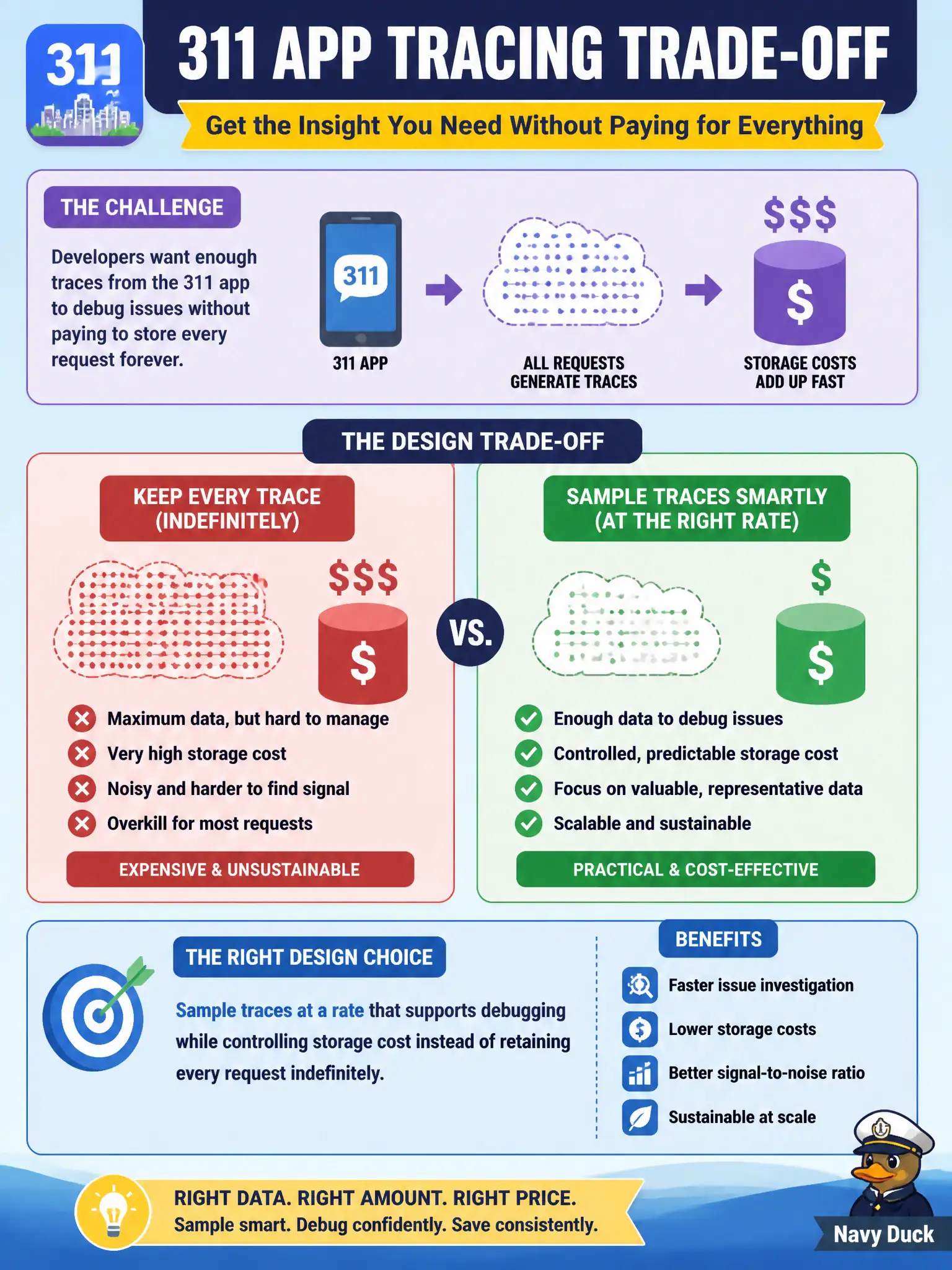
Developers want enough traces from the 311 app to debug issues without paying to store every request forever. Which design trade-off should ops apply?
Select an answer to reveal the explanation.
Short Explanation
Tracing every leaf that falls would fill the warehouse—and the budget. Sampling keeps enough request paths to debug 311 issues without forever-storing every click. Observability that bankrupts storage isn’t sustainable ops.
Full Explanation
Sampling traces at a rate that supports debugging while controlling storage cost—rather than retaining every 311 request indefinitely—balances diagnostic value against observability spend for the civic app. Disabling tracing entirely and relying only on weekly user surveys fails timely debugging of request paths. Storing 100% of traces for ten years in the hottest storage tier inflates cost without proportional operational value. Duplicating every trace into email attachments for each engineer fails scale, privacy, and cost discipline. Exam caveat: tracing volume/retention is a cost-design trade-off; sampling is the usual control, not all-or-nothing extremes. Operational check: set sample rates by environment, keep higher fidelity on errors, review monthly ingest bills, and adjust before budget overruns. In municipal platform operations, record the chosen control and the rejected alternatives in the change record so future on-call engineers understand the failure modes avoided for citizen services. Re-check the decision after the next provider feature change or compliance update to ensure the same answer still holds for the city's estate. Confirm monitoring, access reviews, and backup coverage still align with the selected approach before closing the civic hypercare period.