
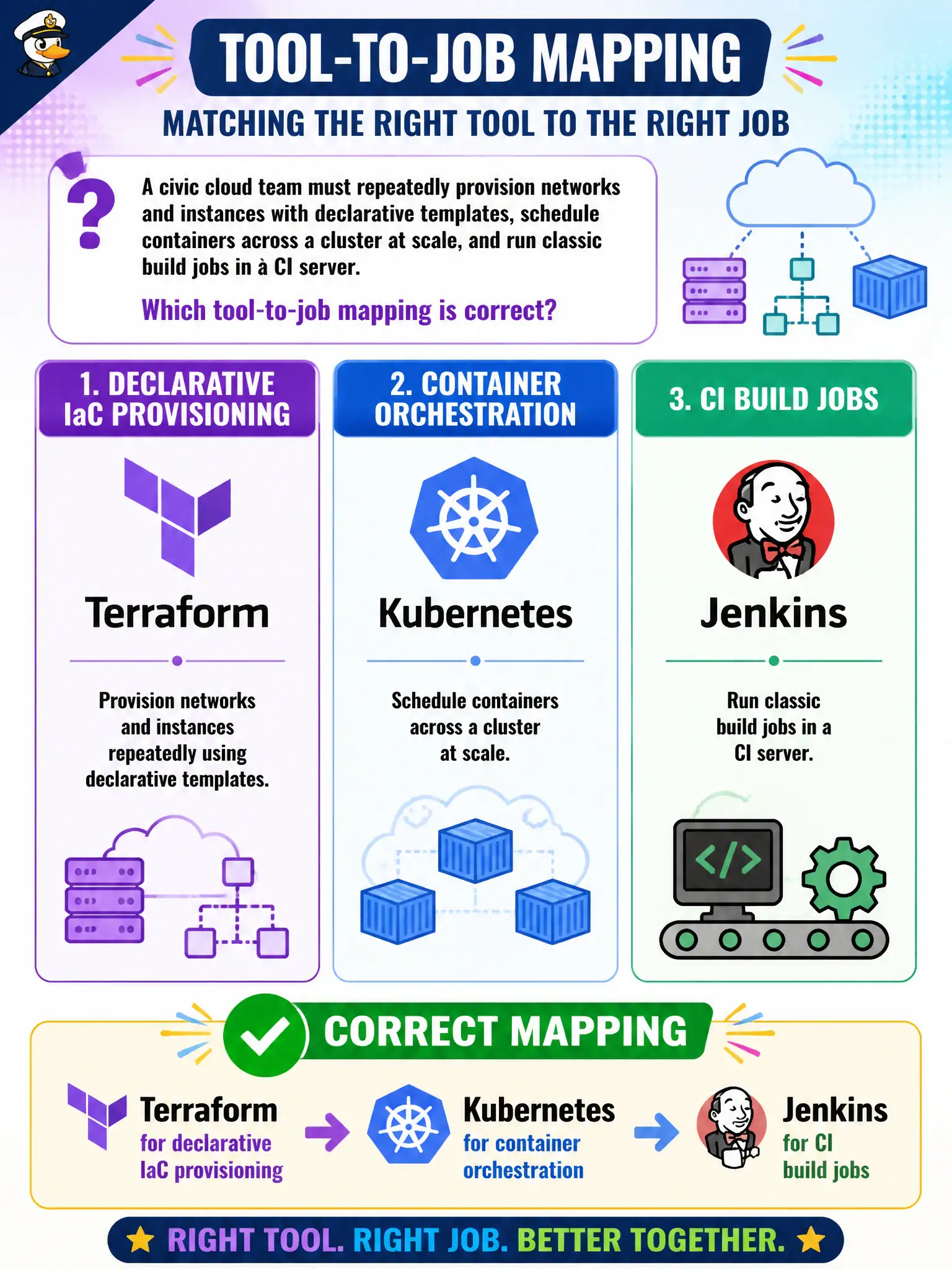
A civic cloud team must repeatedly provision networks and instances with declarative templates, schedule containers across a cluster at scale, and run classic build jobs in a CI server. Which tool-to-job mapping is correct?
Select an answer to reveal the explanation.
Short Explanation
Match the wrench to the bolt: Terraform writes the cloud wiring as code, Kubernetes places containers on the cluster, and Jenkins (or similar) runs the classic build jobs. Mixing those jobs across the wrong tools is a common exam trap. Keep each tool’s purpose straight and the mapping clicks.
Full Explanation
A civic cloud team that must repeatedly provision networks and instances with declarative templates, schedule containers across a cluster at scale, and run classic build jobs in a CI server maps correctly to Terraform for declarative IaC provisioning, Kubernetes for container orchestration, and Jenkins for CI build jobs. Each tool's purpose aligns to a distinct municipal platform concern. Using Jenkins for VPC subnet creation templates, Terraform for live container scheduling, and Kubernetes for compiling Java only swaps responsibilities and breaks the standard tool-to-job mapping. Claiming Kubernetes alone covers all IaC, CI, and package state overstates one platform. Using Grafana for provisioning subnets, ELK for orchestrating pods, and Docker Hub for running all CI compilers confuses observability and registries with provisioning and orchestration. Exam caveat: products overlap in the real world, but exam questions test canonical primary purposes—IaC vs orchestration vs CI. Operational check: provision a sample VPC with Terraform, deploy a workload to Kubernetes, run a build in Jenkins (or equivalent), keep each codebase separate in Git, and document the tool roles for new civic engineers.