
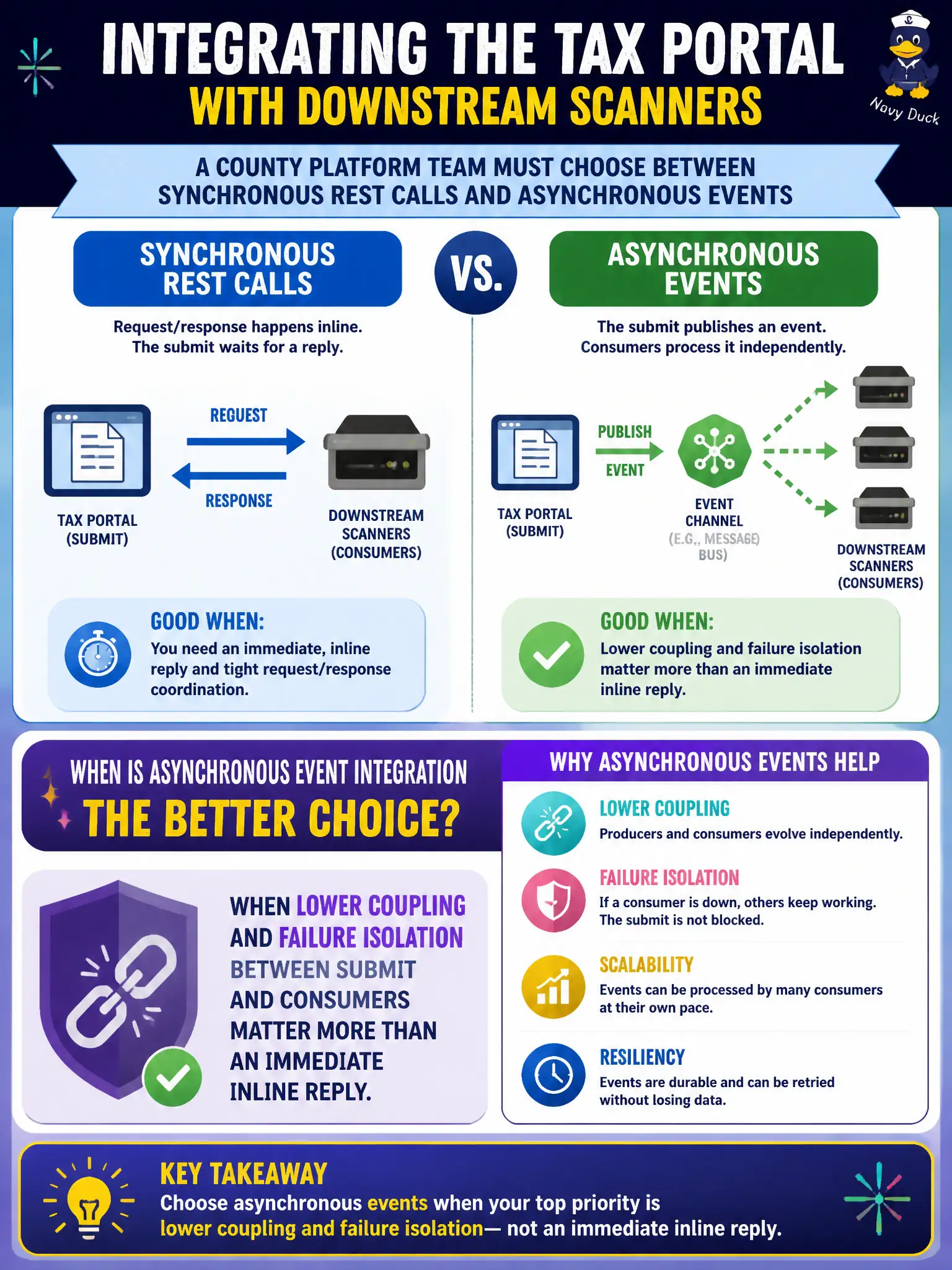
A county platform team must choose between synchronous REST calls and asynchronous events for integrating a tax portal with downstream scanners. When is asynchronous event integration the better choice?
Select an answer to reveal the explanation.
Short Explanation
If the submit page should not crash just because one scanner is down, go async with events. You trade the "answer right now in this HTTP call" feeling for looser coupling and better isolation. That trade-off is the heart of picking REST sync versus event-driven flows.
Full Explanation
When a county platform team chooses between synchronous REST calls and asynchronous events for integrating a tax portal with downstream scanners, asynchronous event integration is better when lower coupling and failure isolation between submit and consumers matter more than an immediate inline reply. Events let municipal scanners lag, retry, or scale without blocking the citizen submit path. When every scanner must succeed inside the same blocking HTTP request as the citizen submit, synchronous orchestration is the tighter pattern. Sharing one in-process function call with no network boundary is not cross-service integration. Disabling all retries and discarding events after a single attempt forever undermines the resilience advantage of async design. Exam caveat: choose sync when the user must receive the downstream result to complete the transaction; choose async when eventual processing and isolation matter more for civic scale. Operational check: publish tax-submit events, confirm scanners consume independently, simulate a scanner outage without failing the portal submit, monitor dead-letter queues, and record the integration style decision in the county architecture notes. In municipal cloud operations, record the chosen control and the rejected alternatives in the change or incident ticket so future on-call staff understand which failure modes were avoided for city services. Re-validate after the next maintenance window that the same decision still holds under current provider limits, identity bindings, and application versions used by the civic platform team.