
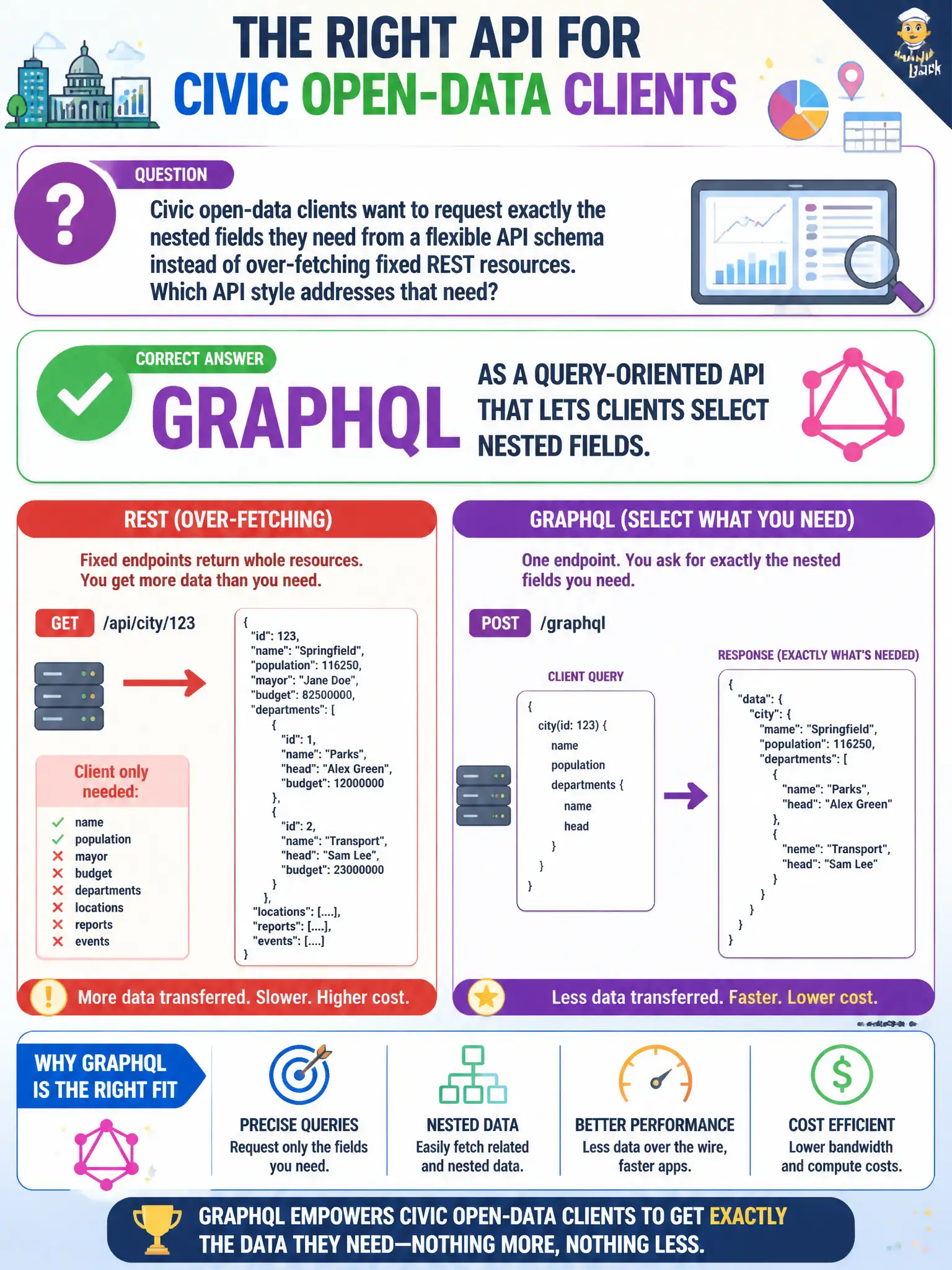
Civic open-data clients want to request exactly the nested fields they need from a flexible API schema instead of over-fetching fixed REST resources. Which API style addresses that need?
Select an answer to reveal the explanation.
Short Explanation
Open-data apps hate dragging home whole objects when they only need two nested fields—GraphQL lets them ask for exactly that. It is a query-oriented API style built around flexible schemas. Fixed dumps and "return everything" SOAP miss that selectivity.
Full Explanation
Civic open-data clients that want to request exactly the nested fields they need from a flexible API schema instead of over-fetching fixed REST resources are addressed by GraphQL as a query-oriented API that lets clients select nested fields. GraphQL reduces over-fetching for diverse municipal consumers while exposing a typed schema. Fixed nightly XML dumps with no client-side field selection cannot satisfy flexible per-request field needs. Raw FTP directory listings of entire database exports are bulk file transfer, not a query API. Mandatory SOAP operations that always return every column force over-fetching contrary to the requirement. Exam caveat: GraphQL shifts complexity to the server (N+1 queries, authorization per field); civic platforms must still enforce authz and query cost limits. Operational check: publish a GraphQL schema for the open-data set, run a client query selecting nested fields only, compare payload size to the old REST resource, apply depth/complexity limits, and document the schema ownership for the open-data program. In municipal cloud operations, record the chosen control and the rejected alternatives in the change or incident ticket so future on-call staff understand which failure modes were avoided for city services. Re-validate after the next maintenance window that the same decision still holds under current provider limits, identity bindings, and application versions used by the civic platform team.