
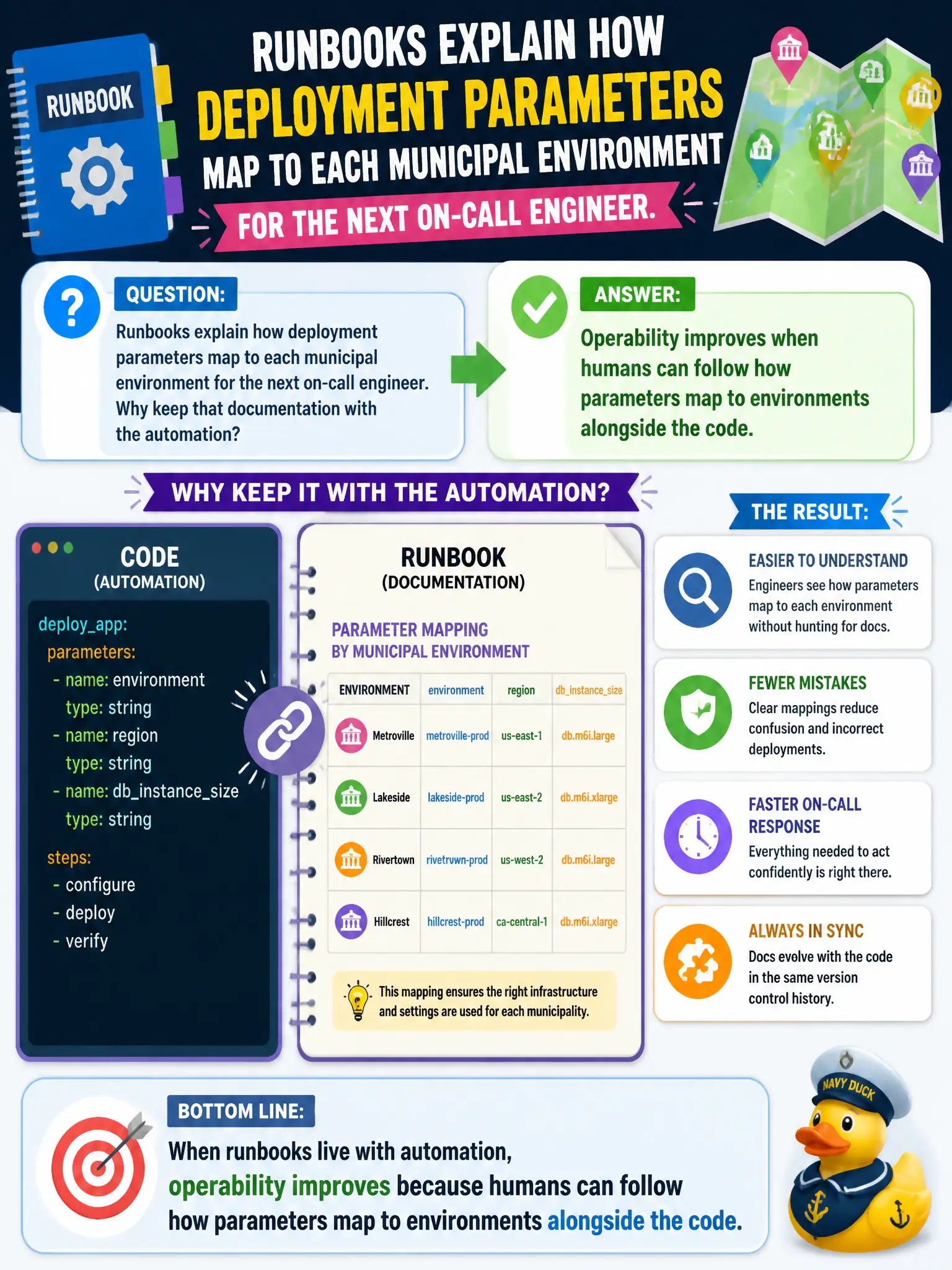
Runbooks explain how deployment parameters map to each municipal environment for the next on-call engineer. Why keep that documentation with the automation?
Select an answer to reveal the explanation.
Short Explanation
Automation without a runbook is like a subway map with no station names—the next on-call still needs the legend. Documenting how parameters map to environments keeps the system operable for people.
Full Explanation
Operability improves when humans can follow how deployment parameters map to each municipal environment alongside the automation. Runbooks kept with the code explain those mappings for the next on-call engineer and reduce tribal-knowledge failures. Documentation permanently replaces the need for identity federation fails; docs complement controls, they do not replace IAM. Runbooks disable drift detection by policy fails as a false linkage. Parameter maps make source control unnecessary fails because documentation is not a VCS substitute. Exam caveat: Cloud+ values automation plus operable human procedures—especially parameter-to-environment clarity. Operational check: store runbooks next to templates, include parameter tables for staging and production, link monitoring dashboards, and review docs in the same PR as code changes that alter civic environment mappings. In municipal platform operations, record the chosen control and the rejected alternatives in the change record so future on-call engineers understand the failure modes avoided for citizen services. Re-check the decision after the next provider feature change or compliance update to ensure the same answer still holds for the city's estate.