
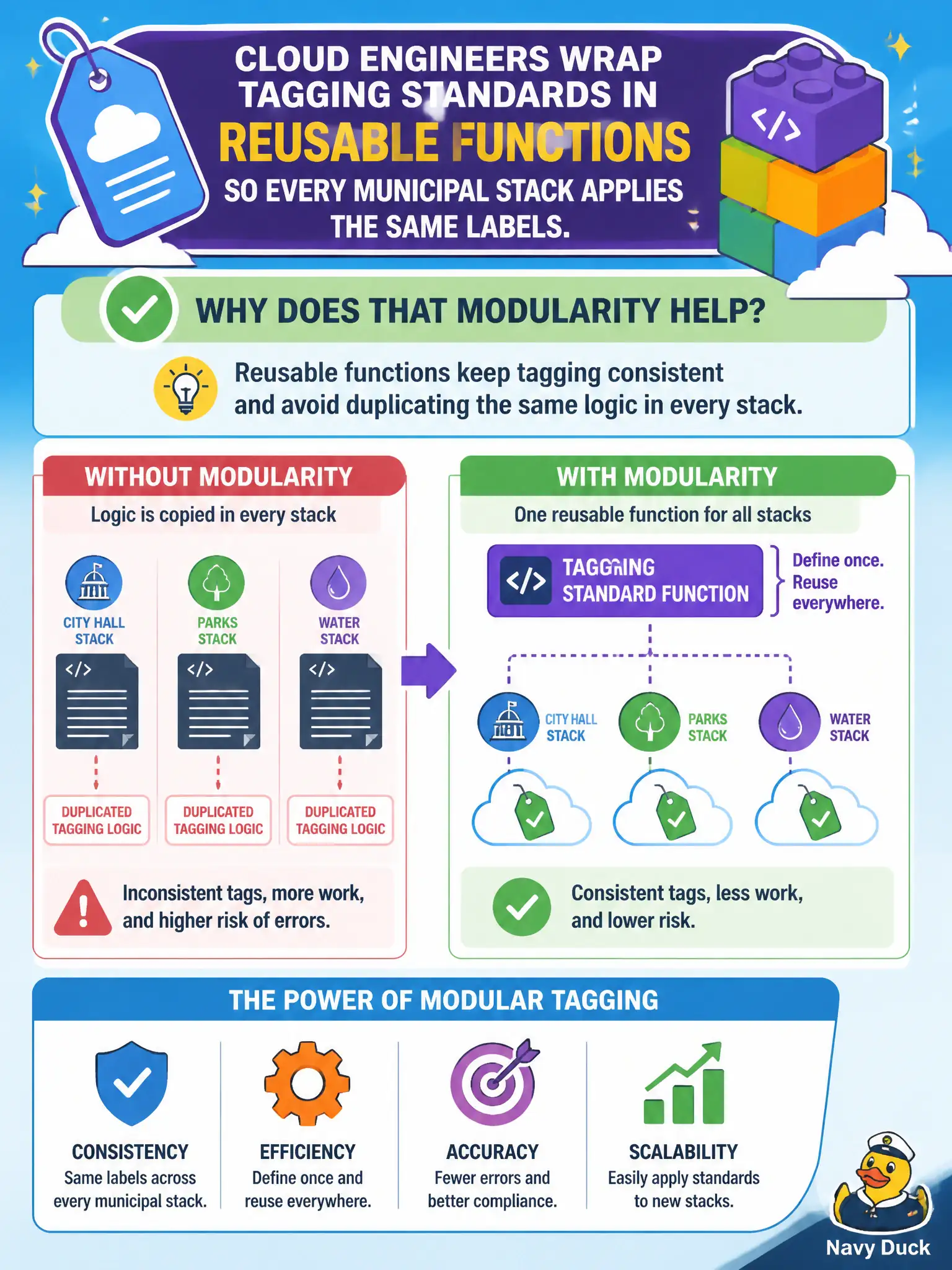
Cloud engineers wrap tagging standards in reusable functions so every municipal stack applies the same labels. Why does that modularity help?
Select an answer to reveal the explanation.
Short Explanation
One shared tagging function is like one official city stamp—every department presses the same seal instead of inventing their own. DRY modularity keeps the labels consistent without copy-paste chaos.
Full Explanation
Reusable functions keep tagging consistent and avoid duplicating the same labeling logic in every municipal stack, improving DRY automation and cost or ownership attribution. Wrapping tagging standards in shared functions means each stack calls one tested implementation. Functions permanently disable cost allocation tags across all accounts fails the purpose of modular tagging helpers. Modularity forces every resource to use a unique random tag key fails; standards aim for consistent keys and values, not randomness. Reusable code blocks replace the need for identity and access controls fails because modularity does not substitute for IAM. Exam caveat: modularity and functions questions are about consistency and reuse, not about replacing security controls. Operational check: publish a shared tagging module, require it in pipeline policy, unit-test required keys such as Owner, CostCenter, and Environment, and scan live civic accounts for missing tags after applies. In municipal platform operations, record the chosen control and the rejected alternatives in the change record so future on-call engineers understand the failure modes avoided for citizen services. Re-check the decision after the next provider feature change or compliance update to ensure the same answer still holds for the city's estate.