
A deployment script sets the cloud region from a variable and creates a NAT gateway only when a flag is true. What scripting concepts does this demonstrate?
Select an answer to reveal the explanation.
Short Explanation
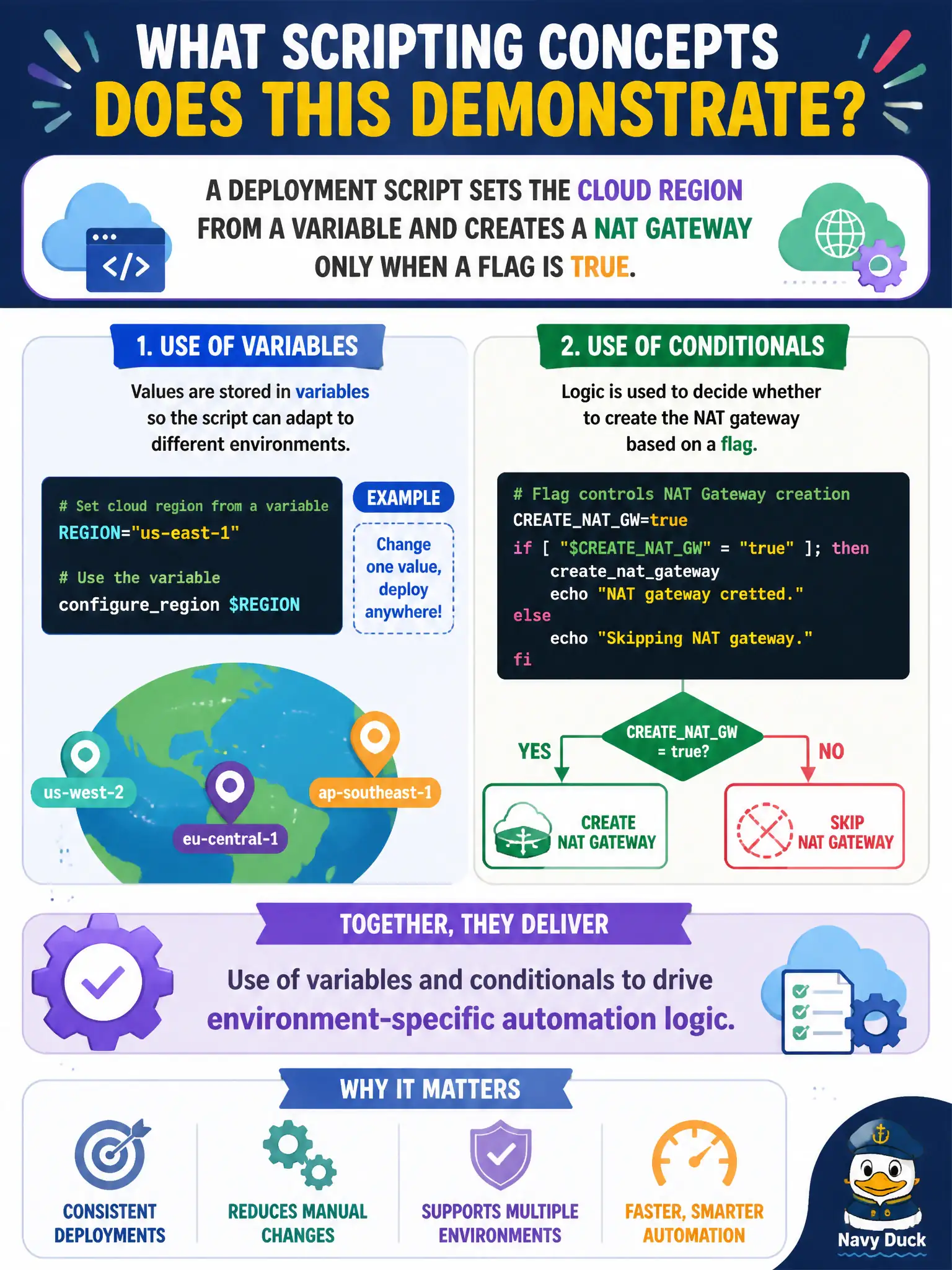
Variables are the fill-in-the-blank blanks; conditionals are the 'if we need a NAT, build it' fork in the road. That is plain scripting logic making one template flexible across environments.
Full Explanation
Variables and conditionals drive environment-specific automation logic: a script can set the cloud region from a variable and create a NAT gateway only when a flag is true. That parameterization keeps one codebase useful across municipal sandboxes and production without hard-coding every difference. Immutable object storage lifecycle policies only fails because the stem is about scripting constructs, not lifecycle rules. Hardware TPM attestation for every template line fails as unrelated security theater for this concept. DNSSEC signing of all infrastructure parameters fails similarly—the demonstrated concepts are variables and conditionals. Exam caveat: automation literacy items test basic programming constructs inside IaC and scripts; do not overfit to unrelated cloud security features. Operational check: externalize region and feature flags into approved parameter files or pipeline variables, deny undeclared overrides, and peer-review conditionals that gate networked civic resources like NAT. In municipal platform operations, record the chosen control and the rejected alternatives in the change record so future on-call engineers understand the failure modes avoided for citizen services. Re-check the decision after the next provider feature change or compliance update to ensure the same answer still holds for the city's estate.