
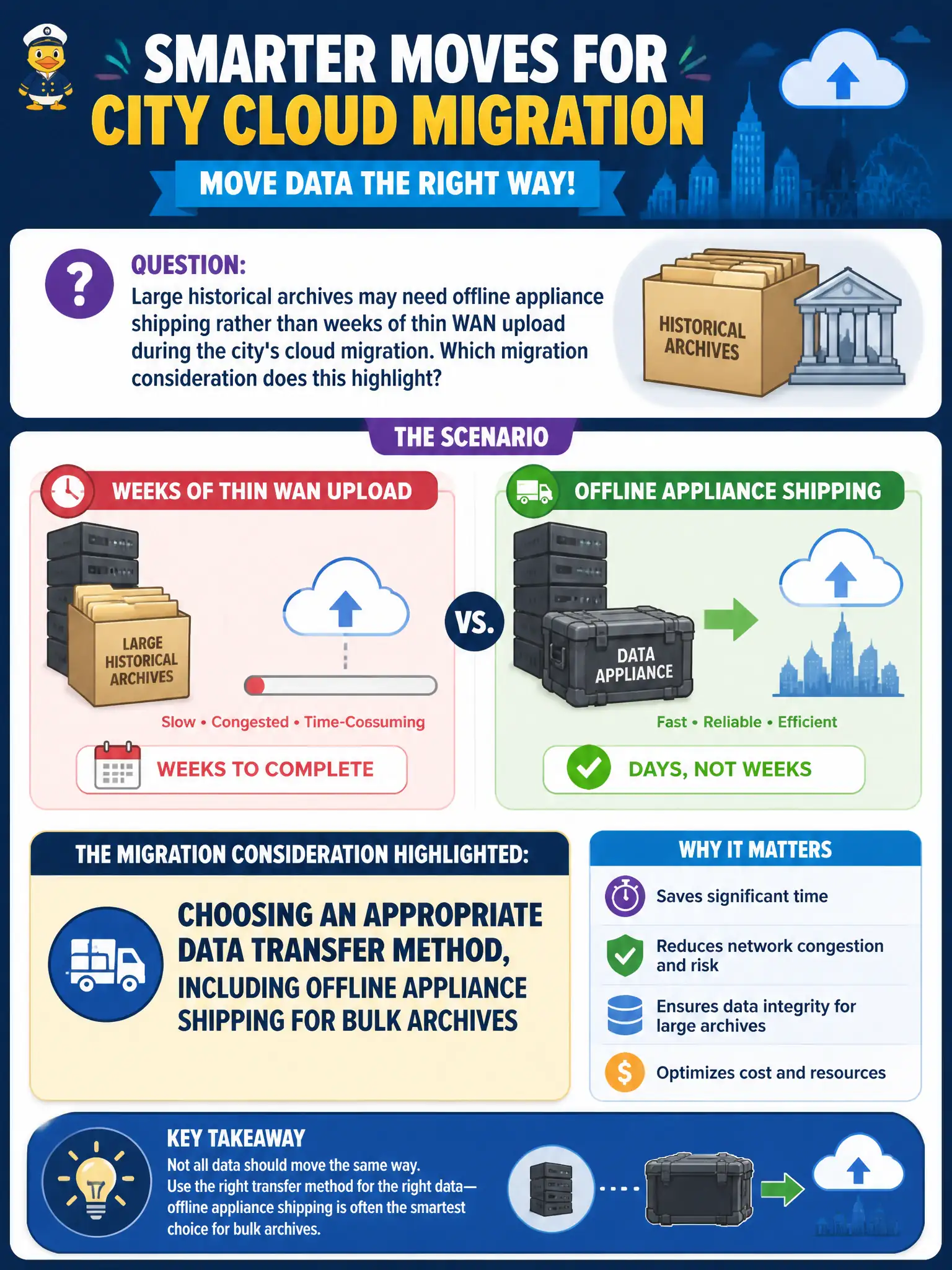
Large historical archives may need offline appliance shipping rather than weeks of thin WAN upload during the city's cloud migration. Which migration consideration does this highlight?
Select an answer to reveal the explanation.
Short Explanation
When the pipe is a garden hose and the archive is a swimming pool, ship the disks. Offline transfer appliances exist so you are not stuck watching a WAN crawl for weeks. Transfer method is a first-class migration decision, not an afterthought.
Full Explanation
Choosing an appropriate data transfer method—including offline appliance shipping for bulk archives—is a first-class migration consideration when volume, bandwidth, and deadlines make WAN uploads impractical. Large historical city archives that would take weeks over a thin link are exactly when offline import appliances should be evaluated. Always uploading petabytes only over a congested site-to-site VPN fails because it ignores transfer method selection and timeline risk. Deleting archives before migration so no transfer method is required fails preservation and legal retention duties common to municipal records. Re-architecting application code as a substitute for moving the data fails because code changes do not relocate the archive bytes the city must keep. Exam caveat: transfer method is not an afterthought; Cloud+ treats bandwidth, volume, and offline options as planning inputs. Operational check: estimate bytes and WAN capacity, compare online versus appliance timelines and cost, maintain chain-of-custody for the shipped device, verify checksums after cloud ingest, and update the civic records index before decommissioning source media. In municipal platform operations, record the chosen control and the rejected alternatives in the change record so future on-call engineers understand the failure modes avoided for citizen services. Re-check the decision after the next provider feature change or compliance update to ensure the same answer still holds for the city's estate.