
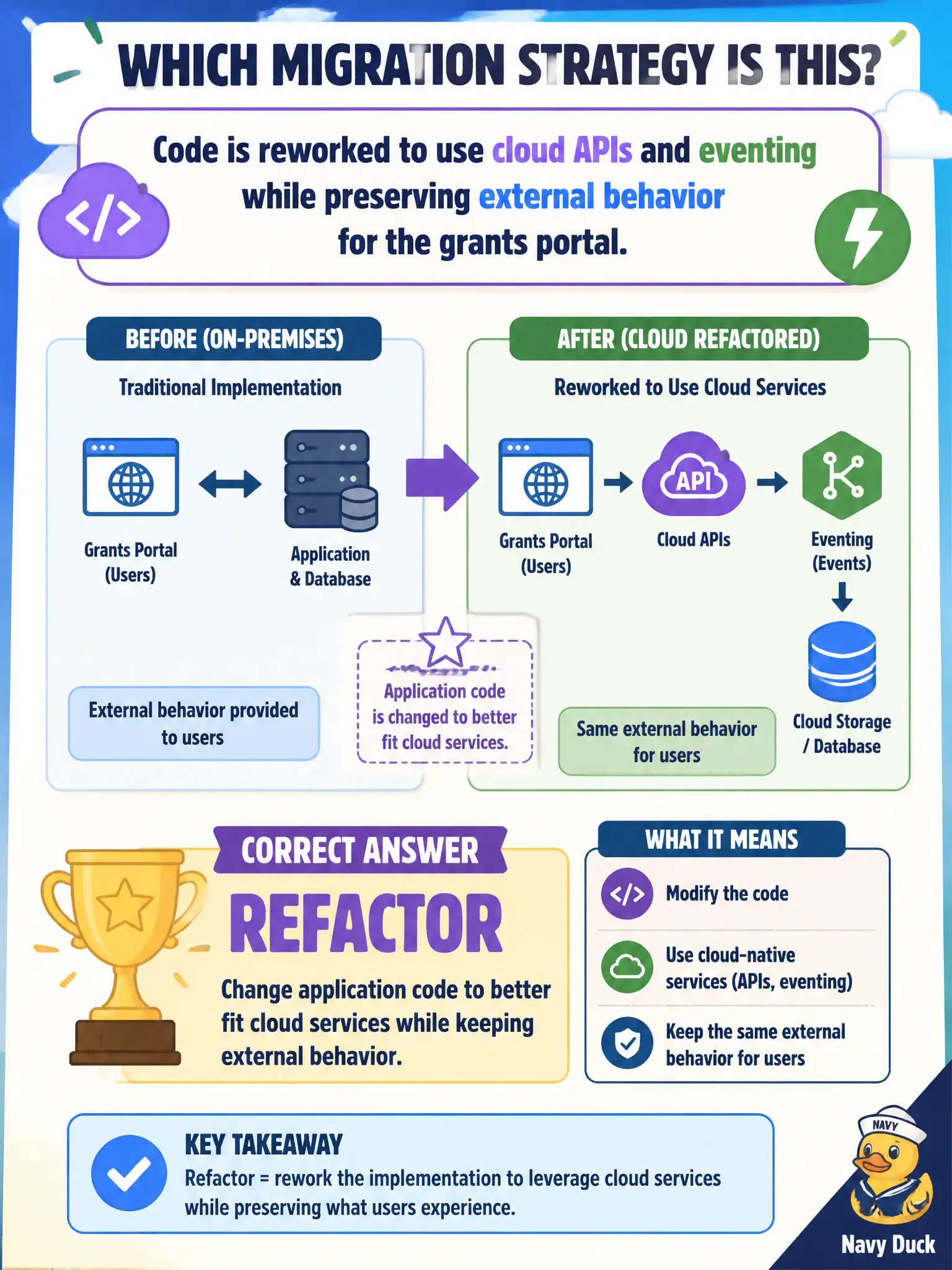
Code is reworked to use cloud APIs and eventing while preserving external behavior for the grants portal. Which migration strategy is this?
Select an answer to reveal the explanation.
Short Explanation
Refactor is rewriting the engine so it uses cloud APIs and events, but the car still drives the same routes for citizens. External behavior stays; internals get cloud-smart. That is deeper than lift-and-shift and different from shutting the app down.
Full Explanation
Refactoring changes application code to fit cloud services—APIs, eventing, messaging—while aiming to preserve external behavior for users and integrators. Reworking the grants portal to use cloud APIs and eventing without changing its outward civic behavior matches refactor. Rehost with no code changes beyond moving VM images fails because code is explicitly reworked. Retire the grants portal fails because the service continues. Retain on aging hardware with code frozen fails because active code change for cloud services is occurring. Exam caveat: refactor focuses on code-level cloud alignment with preserved external behavior; re-architect implies deeper structural decomposition—read the stem for which depth is described. Operational check: lock behavioral acceptance tests for citizen and agency grant workflows, roll out behind flags, compare event throughput and error budgets, and only then decommission old integration paths. In municipal platform operations, record the chosen control and the rejected alternatives in the change record so future on-call engineers understand the failure modes avoided for citizen services. Re-check the decision after the next provider feature change or compliance update to ensure the same answer still holds for the city's estate.