
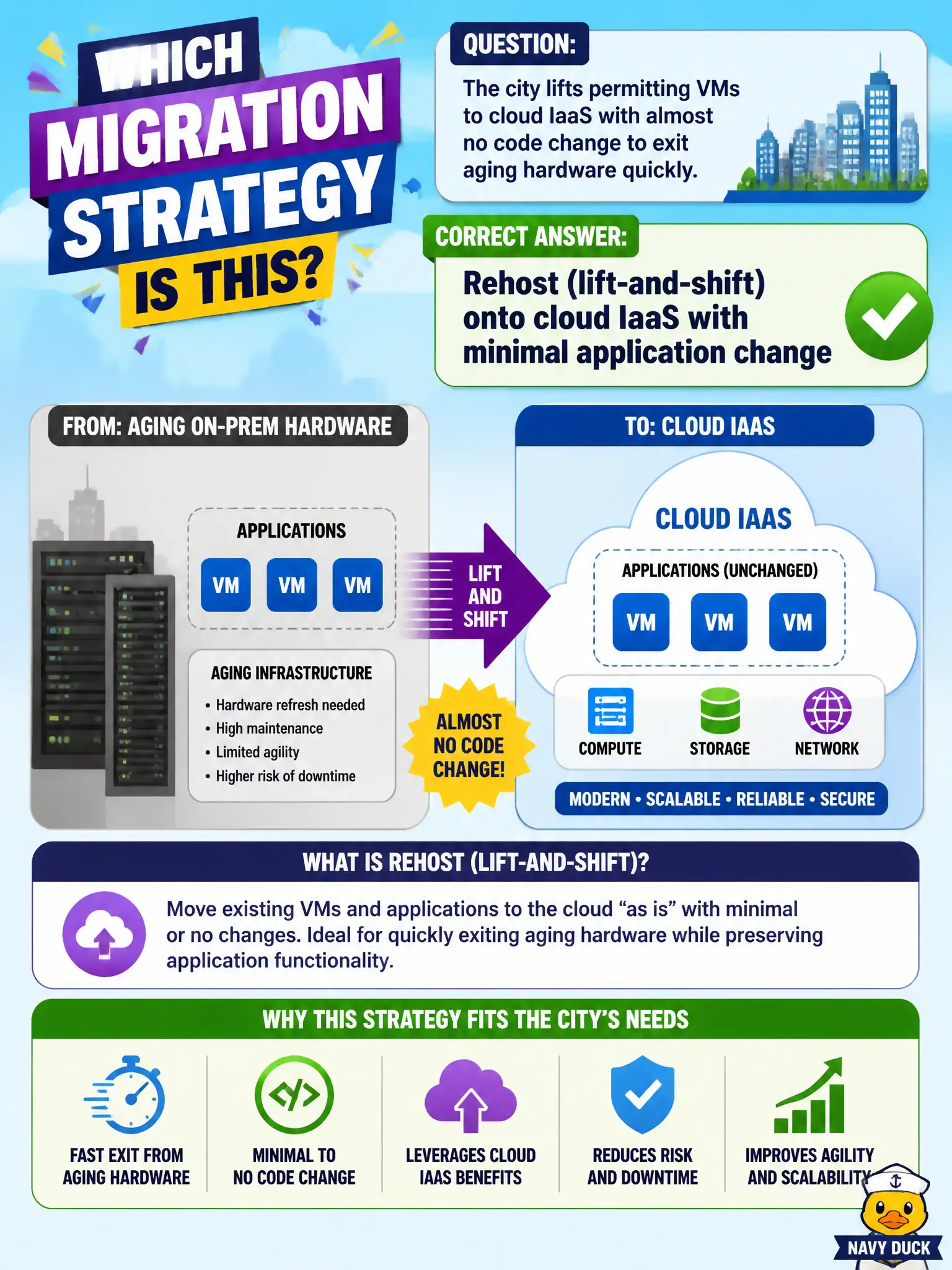
The city lifts permitting VMs to cloud IaaS with almost no code change to exit aging hardware quickly. Which migration strategy is this?
Select an answer to reveal the explanation.
Short Explanation
Lift-and-shift is moving the furniture as-is into a new apartment so you can leave a leaking building fast. VMs to IaaS with almost no code change is rehost. Save the big remodel (re-architect/refactor) for later if speed off old hardware is the goal.
Full Explanation
Rehost, commonly called lift-and-shift, relocates workloads onto cloud IaaS with little or no application redesign to exit aging hardware quickly. Lifting permitting VMs to cloud IaaS with almost no code change is the textbook municipal rehost path when timeline pressure outweighs immediate cloud-native optimization. Re-architect into microservices and managed serverless before any move fails as the answer because that is a deep structural redesign strategy, not the minimal-change lift described. Retire the permitting system fails because the system is relocated rather than decommissioned. Refactor deep application logic to event-driven APIs as the first step fails because the stem emphasizes almost no code change. Exam caveat: the migration strategies are distinct—rehost prioritizes speed and minimal change; do not pick re-architect merely because cloud is the destination. Operational check: capture VM inventories, rightsizing signals, and dependency maps; validate boot, agents, and backups in the landing VPC; and schedule a civic hypercare period with a rollback image. In municipal platform operations, record the chosen control and the rejected alternatives in the change record so future on-call engineers understand the failure modes avoided for citizen services. Re-check the decision after the next provider feature change or compliance update to ensure the same answer still holds for the city's estate.