
After green proves healthy for the licensing portal, blue is kept briefly as instant rollback capacity and then recycled. Which practice does this describe?
Select an answer to reveal the explanation.
Short Explanation
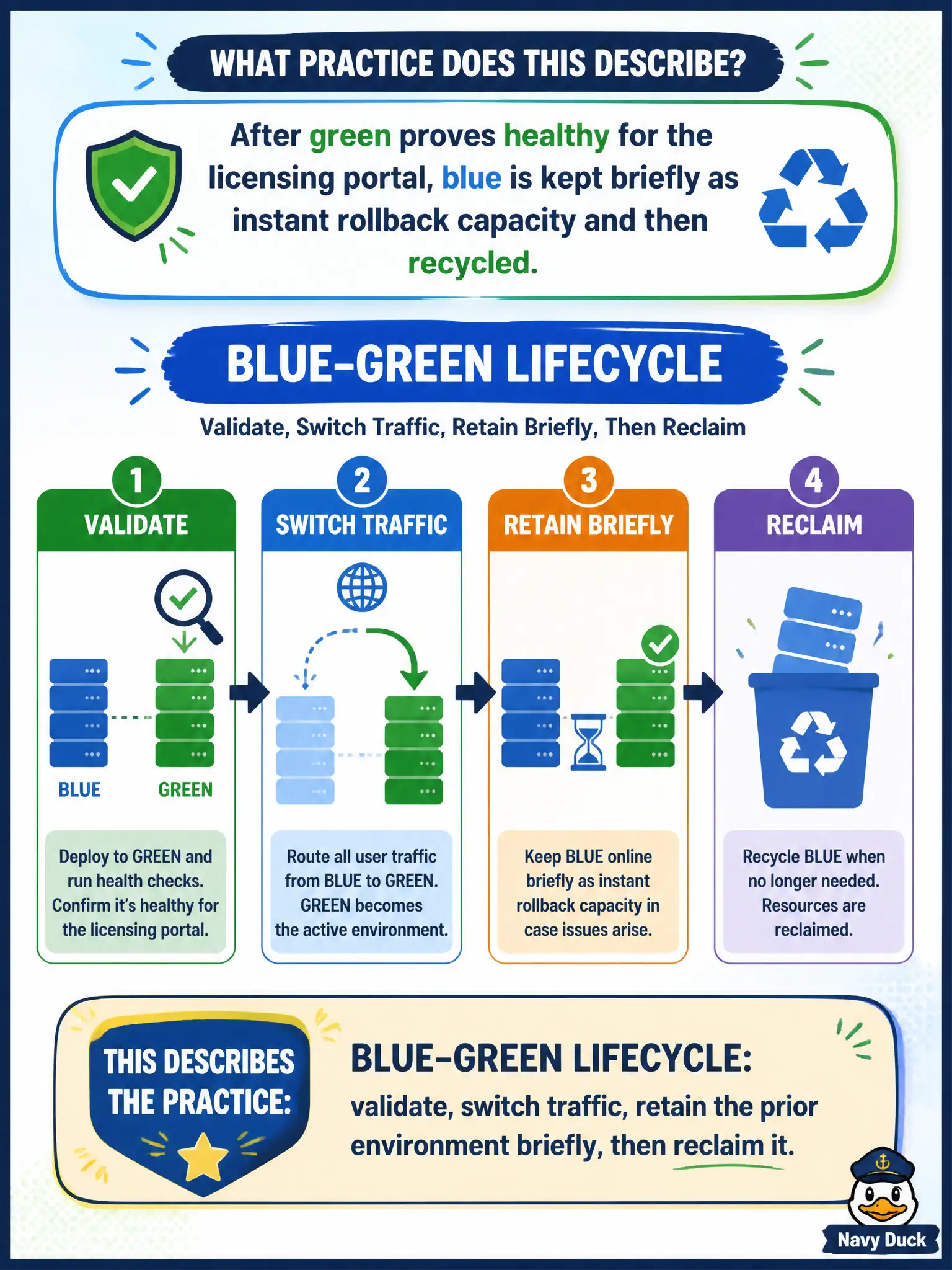
Blue-green is a handoff dance: prove green, flip traffic, keep blue warm for a bit in case you need to flip back, then reclaim the old stack so you are not paying forever. That validate–switch–retain–recycle loop is the blue-green lifecycle in a nutshell.
Full Explanation
The blue-green lifecycle after a successful cutover typically includes validating green, switching traffic, retaining blue briefly as instant rollback capacity, and then reclaiming or recycling that capacity to control cost. Keeping blue briefly for the licensing portal then recycling it matches that standard municipal release hygiene. Canary lifecycle that never keeps a full prior environment after a 1% test fails because canary does not center on retaining a complete parallel production environment as rollback capacity. Permanent dual production spend with blue never decommissioned fails the cost-control half of the practice the stem describes. In-place patching that has no second environment to retain or recycle fails because there is no blue/green pair in that model. Exam caveat: blue-green is not only the switch—exam items may test the post-cutover retain-then-reclaim phase that balances rollback readiness against cloud spend. Operational check: set a time-boxed retain window tied to licensing portal error budgets, block destructive teardown until the window ends, then destroy or repurpose blue with tags that prove cost reclamation. Note the window in the civic change record so finance and operations share the same dual-stack duration expectation.