
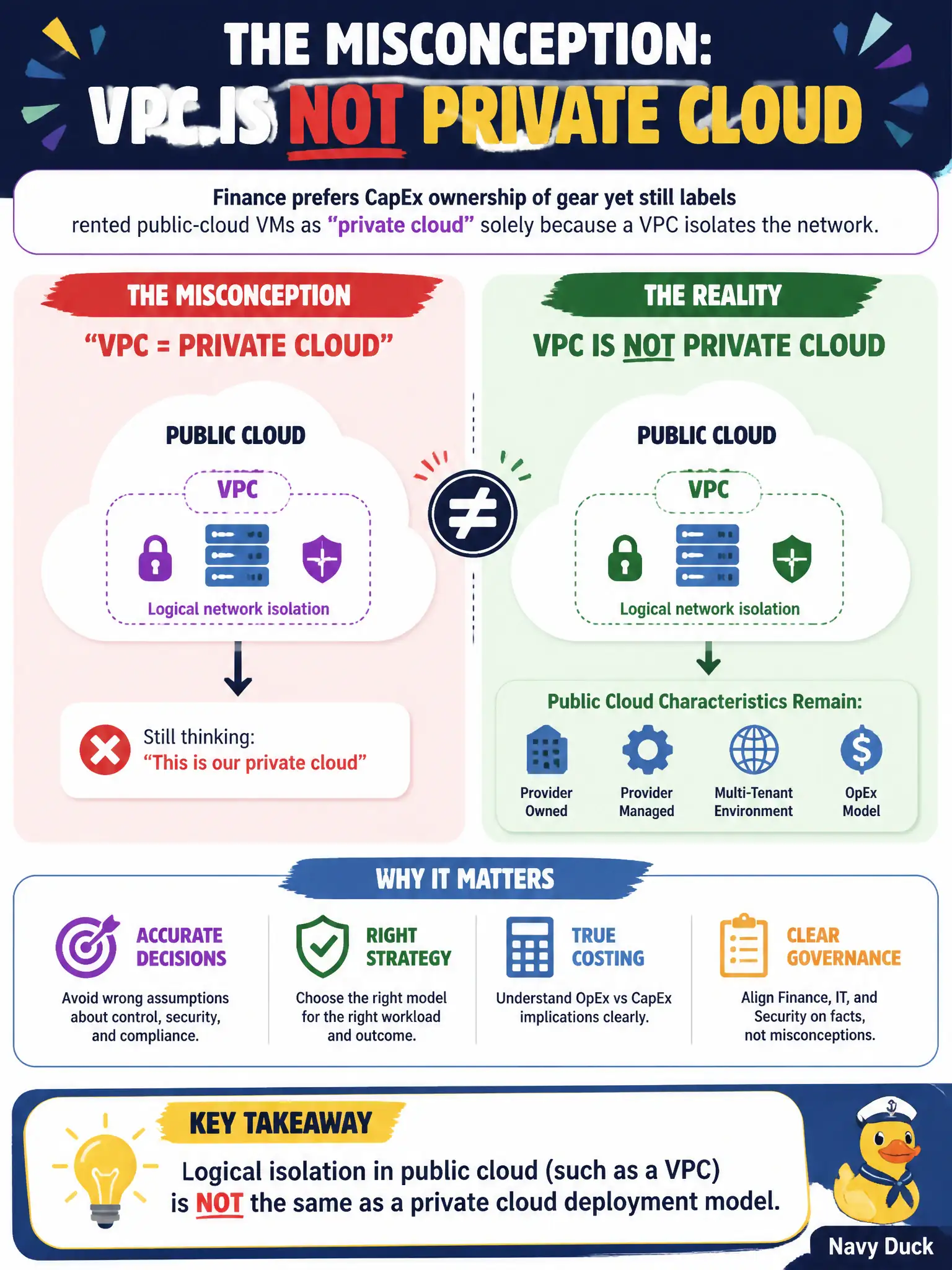
Finance prefers CapEx ownership of gear yet still labels rented public-cloud VMs as 'private cloud' solely because a VPC isolates the network. What misconception should be corrected?
Select an answer to reveal the explanation.
Short Explanation
A VPC is a good fence inside the provider's big shared ranch — handy, but still public cloud. Private cloud is a different ownership and tenancy story, often tied to dedicated infrastructure. Do not rename rented public VMs 'private' just because the subnet is yours.
Full Explanation
Logical isolation constructs in public cloud—such as a VPC, private subnets, and security groups—segment networking inside a provider’s multi-tenant environment; they do not by themselves convert the deployment model into private cloud. Finance preferring CapEx ownership of gear yet labeling rented public-cloud VMs as “private cloud” solely because a VPC isolates the network conflates network tenancy features with deployment model and capital ownership. Claiming CapEx ownership is identical to OpEx rental in every accounting standard is false and sidesteps the cloud-model issue. Asserting that VPCs are illegal in public cloud and never provide isolation is incorrect. Claiming public cloud cannot offer virtual networks of any kind is also false—VPCs are standard public-cloud features. Exam caveat: private cloud is about dedicated organizational infrastructure/tenancy; public cloud can still offer strong logical isolation without becoming private cloud. Operational check: classify each workload’s deployment model accurately in financial and architecture records, explain VPC isolation benefits without mislabeling public VMs as private cloud, align CapEx/OpEx language with how resources are actually procured, and ensure auditors receive consistent terminology.