
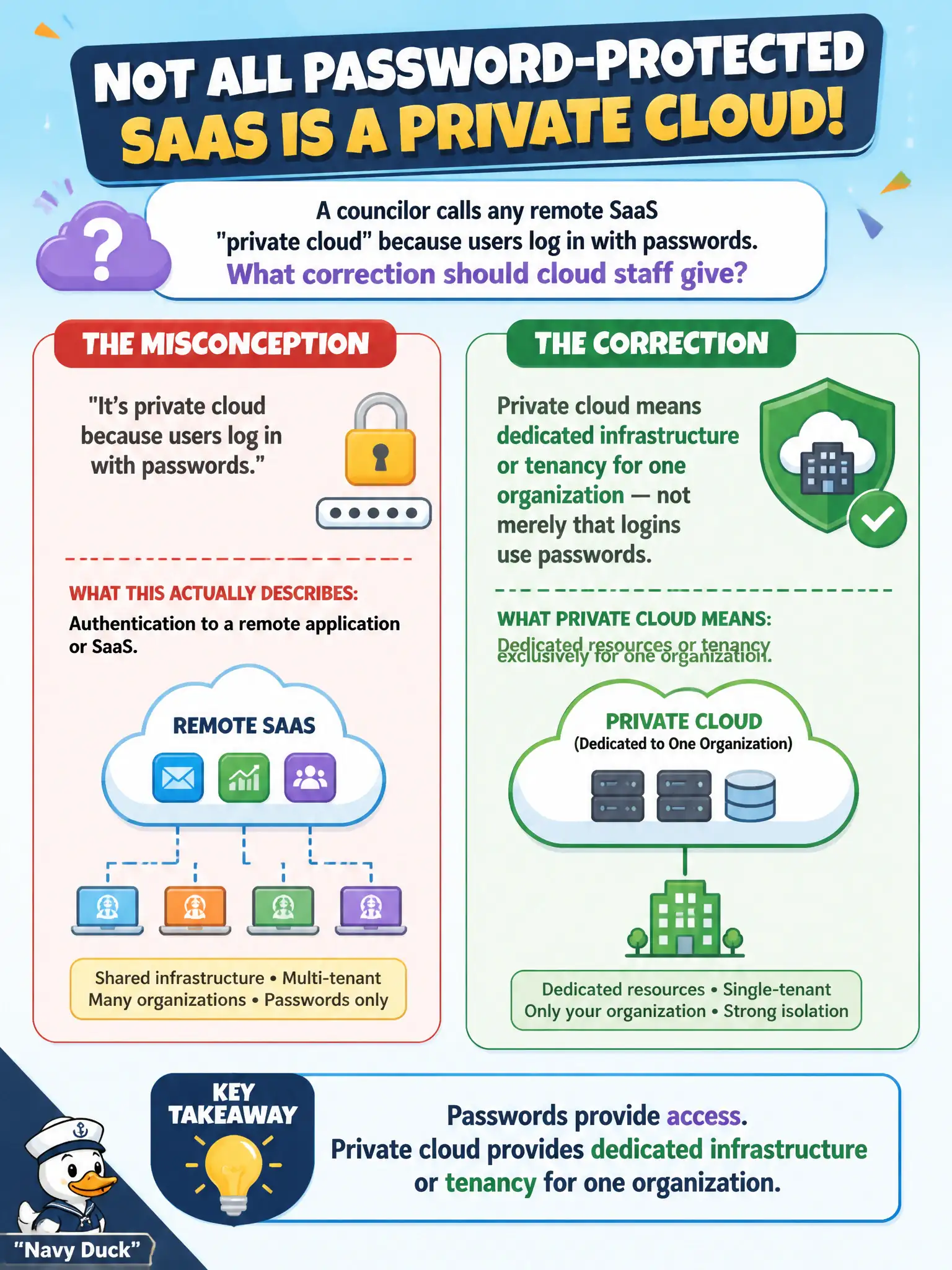
A councilor calls any remote SaaS 'private cloud' because users log in with passwords. What correction should cloud staff give?
Select an answer to reveal the explanation.
Short Explanation
A password on a shared SaaS box does not magically make it 'private cloud.' Private means the infrastructure is dedicated to your organization. Login secrets are authentication — they are not the deployment model.
Full Explanation
Private cloud means infrastructure or tenancy dedicated to one organization—typically city-controlled or single-tenant—not merely that remote users authenticate with passwords. A councilor calling any remote SaaS “private cloud” because logins use passwords confuses authentication with deployment model and should be corrected with that precise distinction. Agreeing that any password-protected website is private cloud infrastructure spreads the misconception into procurement and audits. Stating that private cloud means the provider refuses all encryption and authentication is false and dangerous. Claiming SaaS cannot use passwords and must rely only on postal mail PINs is incorrect and irrelevant to deployment-model definitions. Exam caveat: Cloud+ deployment-model questions often use everyday language traps—password protection is not the definition of private cloud; multi-tenant SaaS remains public cloud consumption even when MFA is enforced. Operational check: update council-facing architecture briefs with clear definitions and local examples (private CAD cluster versus public SaaS email), label each major system’s deployment model in the inventory, and train service owners to use the terms consistently in RFPs, contracts, and audits.