
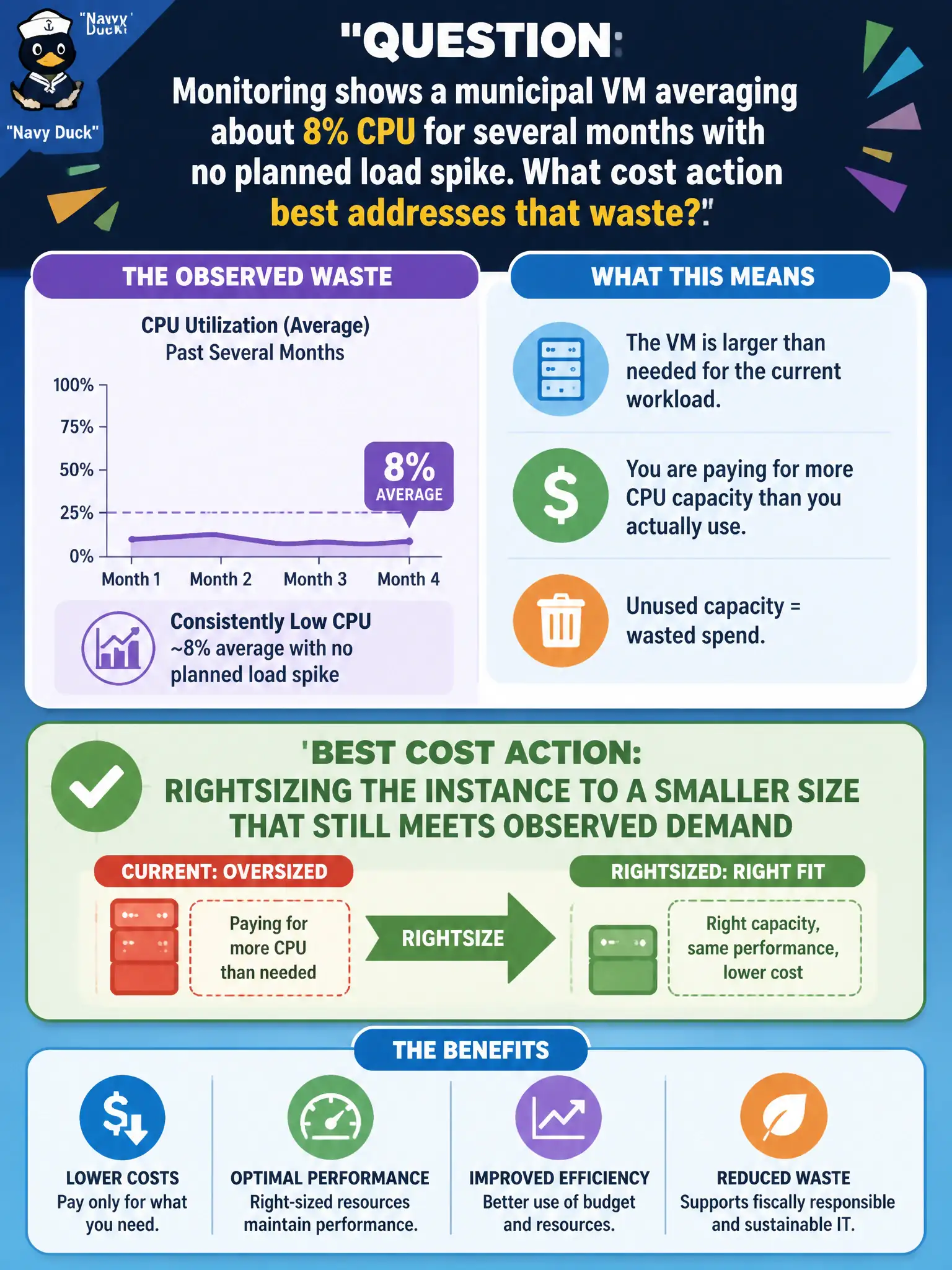
Monitoring shows a municipal VM averaging about 8% CPU for several months with no planned load spike. What cost action best addresses that waste?
Select an answer to reveal the explanation.
Short Explanation
Leaving a huge truck idling in the city lot when a compact sedan would do the job is pure burn. Rightsizing means shrink the VM to match the real CPU you are actually using. The workload still runs — you just stop paying for empty horsepower.
Full Explanation
Rightsizing matches instance capacity to observed demand so the city stops paying for unused CPU, memory, or I/O headroom that never serves citizens. A municipal VM averaging about 8% CPU for several months with no planned spike is a classic rightsizing candidate: move to a smaller size that still meets measured need and application SLOs for the workloads hosted there. Moving the idle VM to a dedicated host usually increases isolation charges rather than eliminating structural waste. Disabling monitoring so low utilization disappears from dashboards hides the problem, weakens capacity planning, and violates operational transparency expected of public agencies. Switching the guest OS to raise software license spend without changing size can increase cost while leaving the oversized compute footprint intact. Exam caveat: rightsizing is not the same as buying reserved capacity or switching to spot—first remove structural waste, then choose the purchasing model for the correctly sized baseline. Operational check: review CPU, memory, disk, and network percentiles over a representative multi-week window, resize during a maintenance window, re-check application latency and error rates for citizen services, document the before/after cost delta for finance, and set ongoing utilization alerts so the VM does not quietly grow oversized again.