
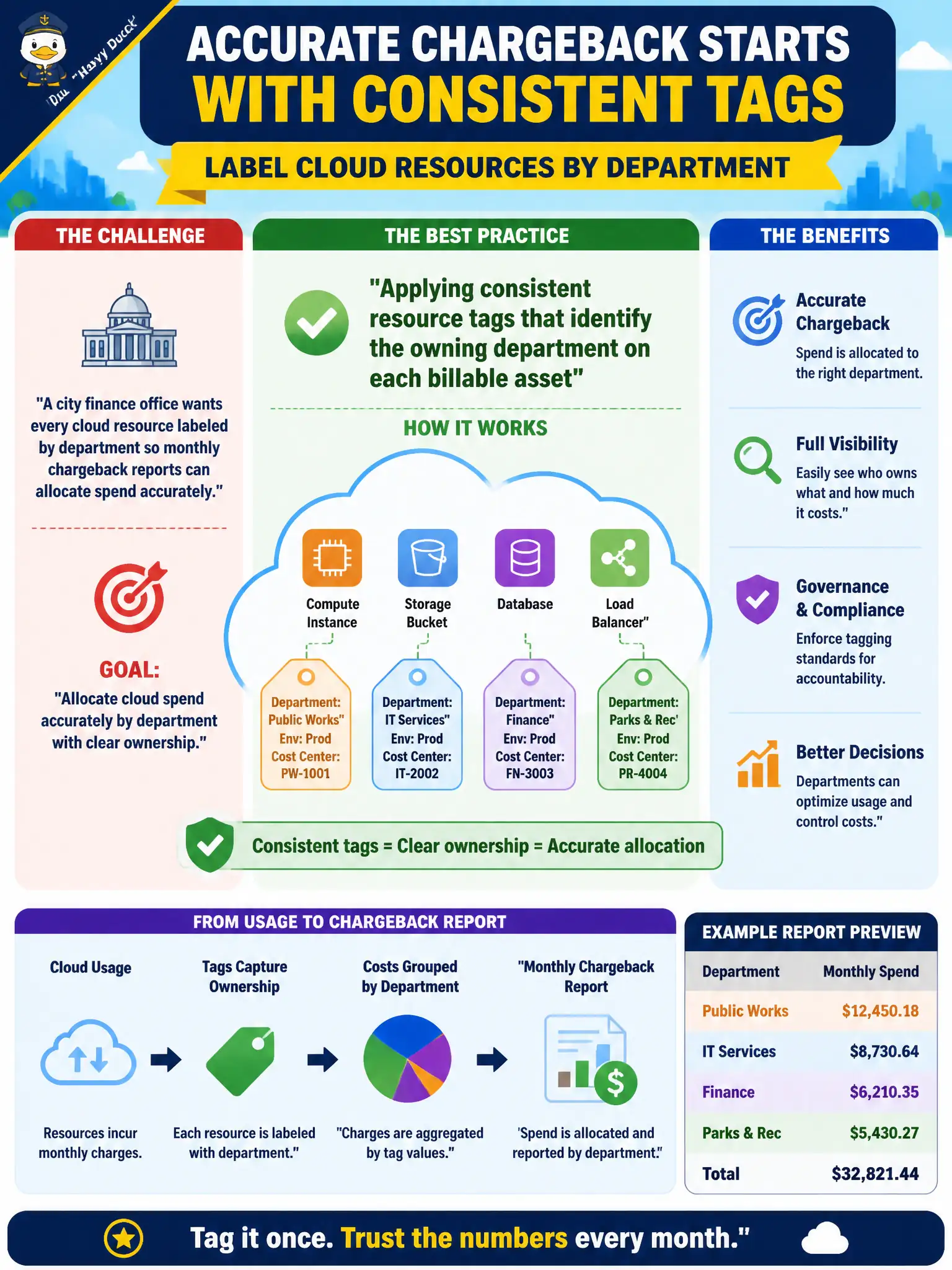
A city finance office wants every cloud resource labeled by department so monthly chargeback reports can allocate spend accurately. Which practice best enables that cost allocation?
Select an answer to reveal the explanation.
Short Explanation
Picture the city's cloud bill like a shared grocery receipt with no names next to the items — nobody knows who ordered what. Tags are those little department stickers on every resource so finance can sort the receipt. Without them, chargeback is guesswork; with them, Parks, Police, and Public Works each see their own slice.
Full Explanation
Consistent resource tags that identify the owning department on each billable asset enable chargeback and showback because cloud billing systems can group and allocate spend by those metadata keys. A city finance office that wants monthly reports by department therefore needs a tagging standard applied at creation time—and enforced by policy—across compute, storage, databases, and networking. Deleting unused snapshots without recording ownership metadata may reduce waste but does not allocate remaining spend to departments. Buying reserved capacity for every workload regardless of department is a purchasing decision that still requires tags or accounts to attribute savings and charges. Routing all traffic through a single public load balancer might centralize some metrics but does not label each billable resource’s departmental owner for accurate chargeback. Exam caveat: Cloud+ cost-management items treat tagging as foundational governance—without consistent keys, even perfect reserved-instance math cannot produce trustworthy departmental reports. Operational check: publish required tags (department, cost center, environment), enforce them with policy-as-code on create, backfill missing tags on existing municipal resources, and validate that the monthly chargeback export groups cleanly by department with no large “untagged” bucket.