
Static park maps and videos should cache near citizens worldwide to cut origin load and latency. Which cloud networking capability provides that?
Select an answer to reveal the explanation.
Short Explanation
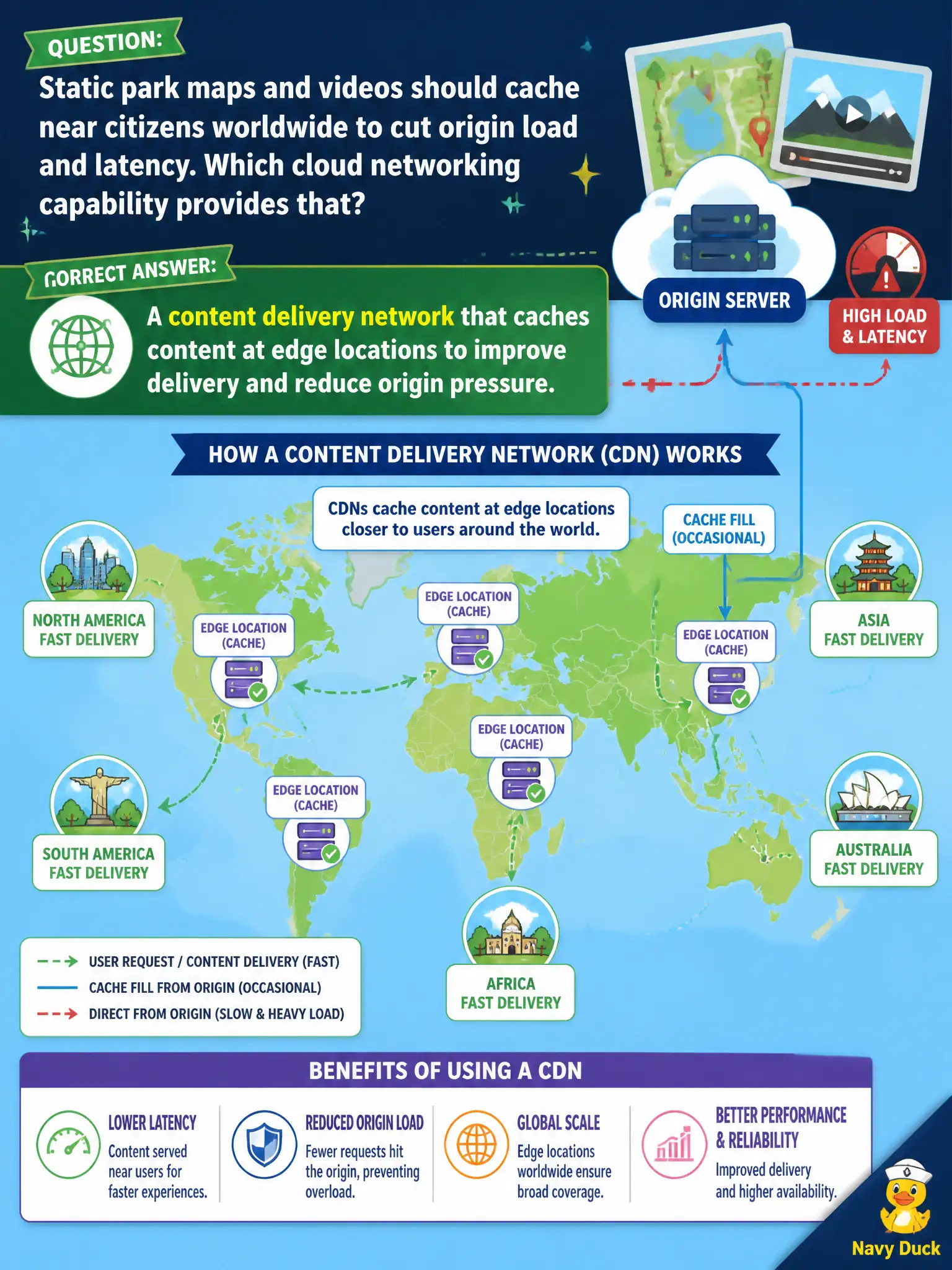
A CDN is a chain of neighborhood lockers for maps and videos so citizens are not all tugging on one distant warehouse. Edge caches cut latency and ease origin load. Making every laptop hold a full database copy—or parking tiles in deep archive—misses that delivery pattern.
Full Explanation
A content delivery network caches cacheable objects at geographically distributed edge locations, improving performance for worldwide citizens and reducing request pressure on origin systems. Static park maps, images, and videos that many users request repeatedly are strong CDN candidates because edge caches absorb most reads close to the requester. A single origin virtual machine in one region with no edge caching layer forces every global request back to that origin, raising latency and creating a hotspot. Nightly full database replication to every end-user laptop is not a realistic distribution method for map tiles and creates unmanaged data sprawl. An archive or glacier-style vault optimized for infrequent, delayed retrieval cannot satisfy interactive map tile and video playback requests. Exam caveat: CDNs excel at static and explicitly cacheable content; highly personalized or constantly changing dynamic pages need careful cache-control design or origin/edge compute rather than blind caching. Operational check: host park media in durable origin storage, place a CDN in front with HTTPS and appropriate TTLs, invalidate or version objects when parks publish updates, monitor cache hit ratio and citizen latency from multiple geographies, and restrict origin access so clients prefer the CDN path.