
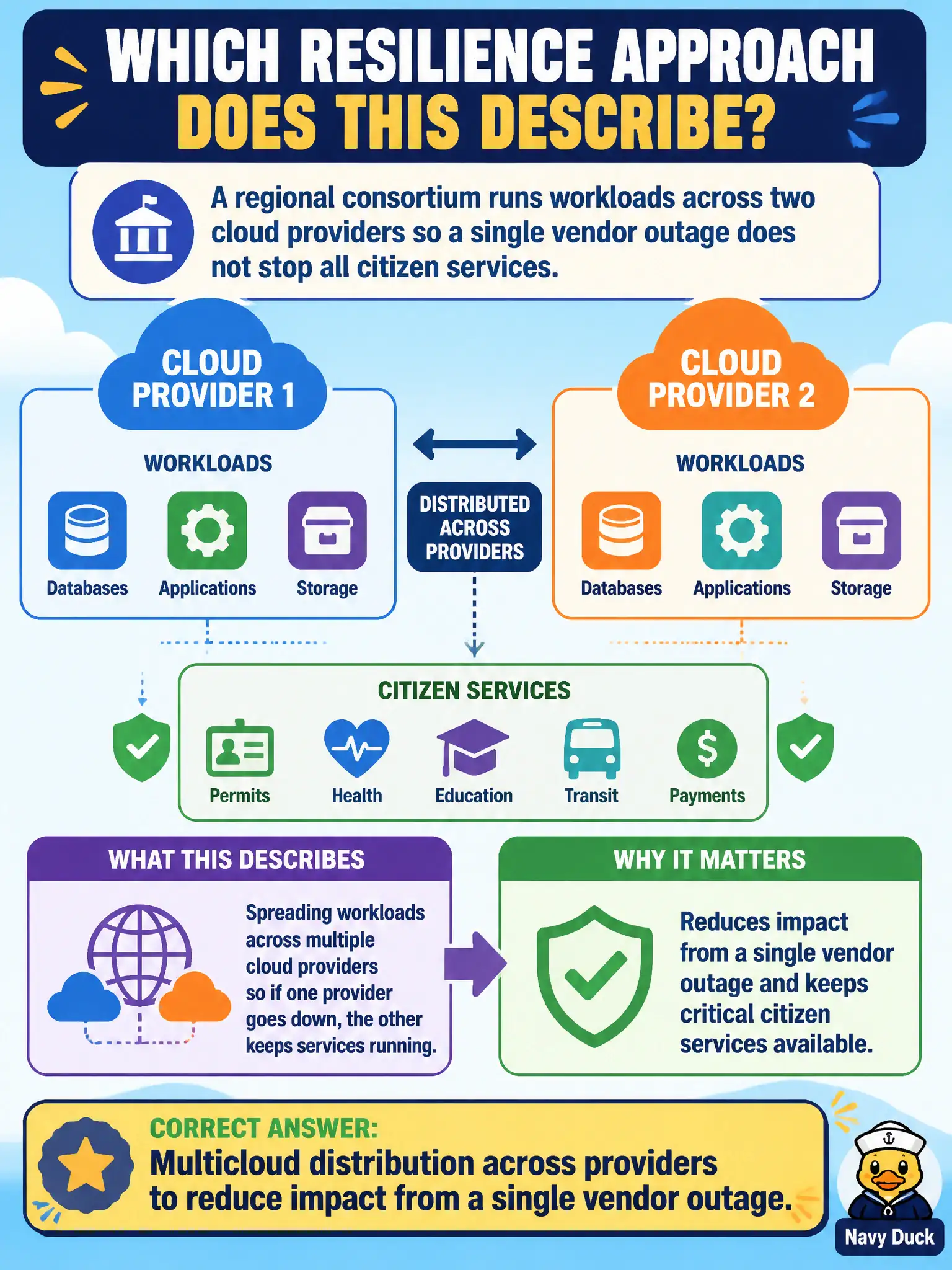
A regional consortium runs workloads across two cloud providers so a single vendor outage does not stop all citizen services. Which resilience approach does that describe?
Select an answer to reveal the explanation.
Short Explanation
Multicloud is not putting all eggs in one vendor’s basket—you deliberately split work across providers. Hybrid can mean on-prem plus one cloud; multicloud specifically spreads across clouds. When the goal is surviving a vendor outage, that second provider matters.
Full Explanation
Multicloud distribution places workloads across more than one public cloud provider so a single vendor outage or commercial failure does not stop all citizen services. A regional consortium that deliberately runs across two providers is implementing multicloud resilience and reducing lock-in concentration risk. Single-cloud vertical scaling of one larger virtual machine only increases capacity inside one provider and does not protect against that provider’s regional or control-plane outage. Tape-only backups stored in the same provider region as production fail both cross-provider diversity and timely failover. Hybrid connectivity that exclusively means on-premises plus one provider is hybrid, not multicloud across two public clouds. Exam caveat: hybrid and multicloud are related but not interchangeable—hybrid emphasizes private/on-premises plus cloud; multicloud emphasizes multiple public providers. Operational check: identify which citizen services can run actively-active or hot-standby on a second provider, standardize identity and observability across clouds, rehearse failover of DNS and data sync, and avoid assuming backups in one provider automatically cover a vendor-wide incident.