
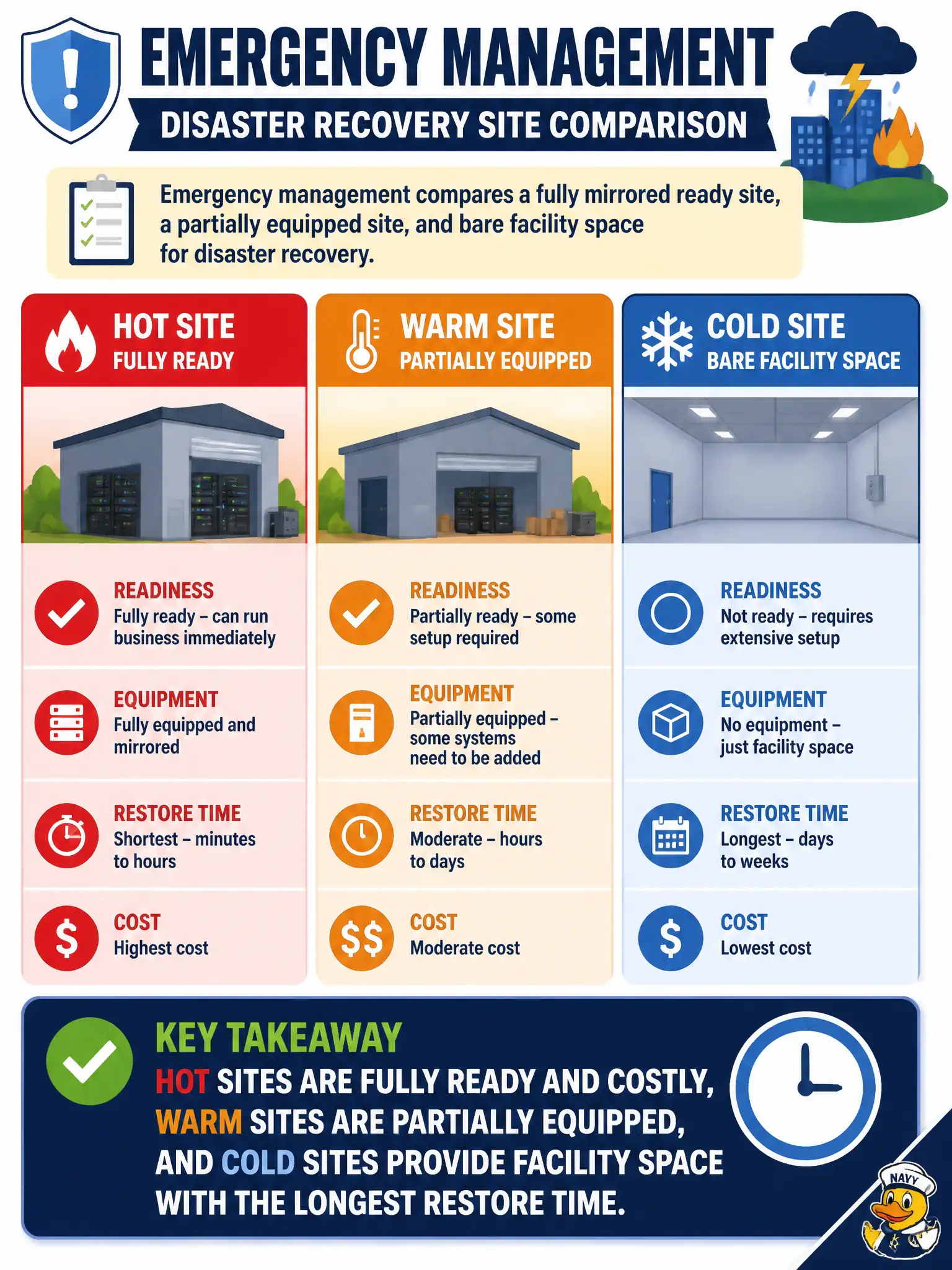
Emergency management compares a fully mirrored ready site, a partially equipped site, and bare facility space for disaster recovery. Which statement correctly contrasts those site types?
Select an answer to reveal the explanation.
Short Explanation
Hot, warm, and cold sites are like keeping a fully stocked spare firehouse, a half-stocked one, or just an empty lot. Hot is ready and expensive; warm is in between; cold is cheap space that takes longest to stand up. Pick based on how fast you must fail over versus what you can spend.
Full Explanation
Hot sites are fully equipped and often continuously mirrored so failover can be rapid, at the highest ongoing cost. Warm sites are partially equipped with some networking, hardware, or pre-staged images that still need configuration and data bring-up. Cold sites primarily provide facility space—power and floor—with little or no pre-provisioned compute until a disaster is declared, yielding the slowest recovery and lowest steady-state cost. Emergency management comparing options must balance citizen-service downtime against budget. Reversing the definitions so cold sites are described as fully mirrored and hot sites as empty floor space invalidates both cost models and timing expectations. Claiming warm sites never include any networking or partial equipment contradicts the standard intermediate definition used in Cloud+ materials. Asserting that all three site types offer identical failover time erases the operational distinction the question is designed to test. Exam caveat: as site “temperature” increases from cold to warm to hot, recovery speed improves and recurring cost rises—memorize that trade-off rather than marketing names alone. Operational check: for each critical municipal system, document the chosen DR site type, estimated failover hours, contracts for space and circuits, how replicas or backups reach the site, who declares a disaster, and the date of the last successful restore or failover test.