
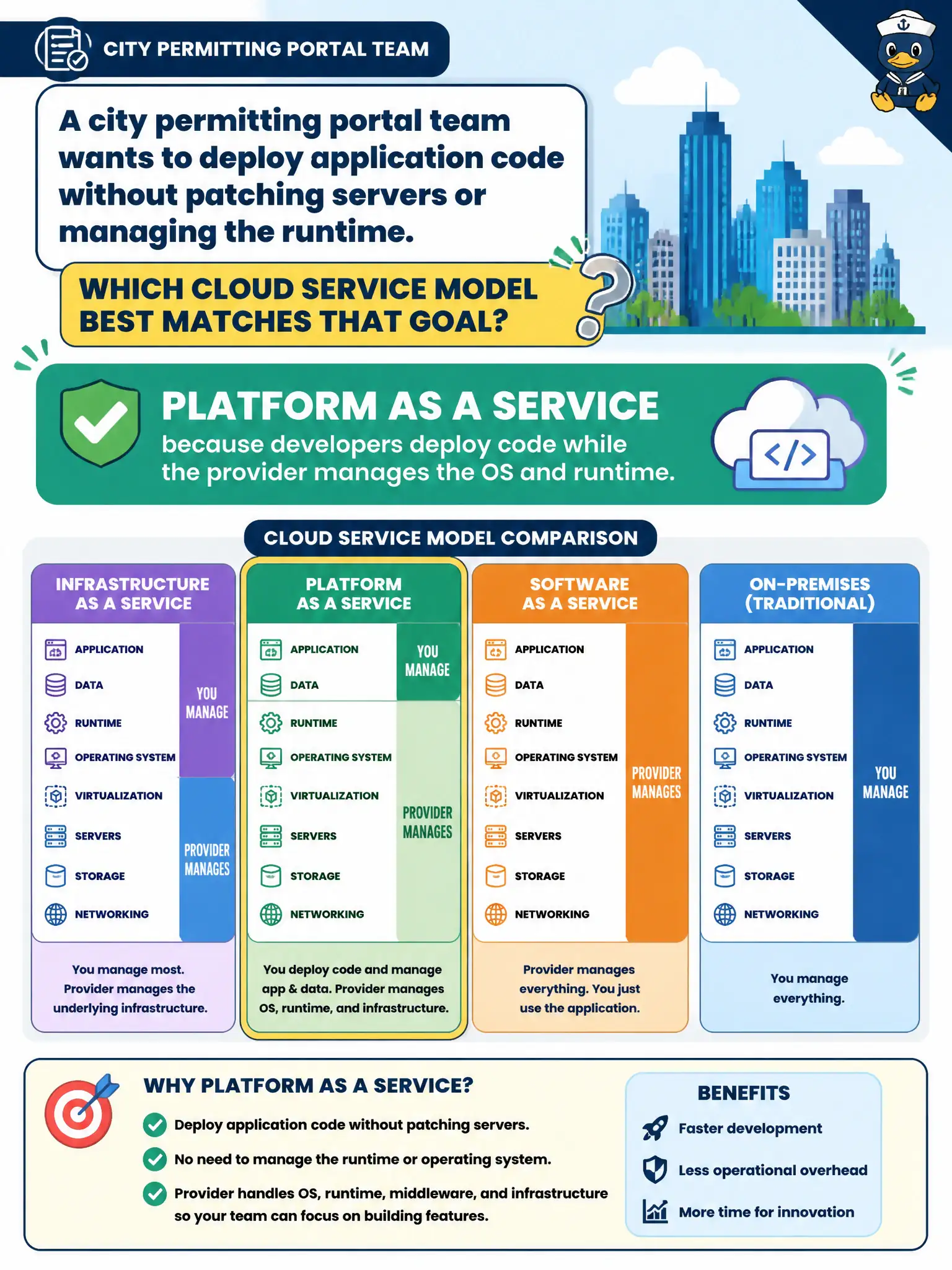
A city permitting portal team wants to deploy application code without patching servers or managing the runtime. Which cloud service model best matches that goal?
Select an answer to reveal the explanation.
Short Explanation
Picture the developers dropping apps onto a managed kitchen while someone else keeps the ovens and plumbing working. That kitchen is PaaS—you ship code, the provider handles OS and runtime. IaaS still leaves the city washing dishes on every guest OS.
Full Explanation
Platform as a Service abstracts the operating system and runtime so city developers can deploy application code, configure scaling, and iterate on features without installing patches on guest servers. A permitting portal team whose goal is to ship code while the provider manages OS and runtime therefore matches PaaS. Infrastructure as a Service still leaves guest OS installation, hardening, and patching with the city, which contradicts the stated desire to avoid server and runtime administration. Colocation rents physical rack space while the municipality continues to own and operate hardware and runtimes, so it increases rather than removes infrastructure burden. Bare-metal hosting grants exclusive physical servers and likewise requires deep OS and platform ownership for every microservice. Exam caveat: Cloud+ questions often tempt candidates to pick IaaS whenever compute is involved; the deciding clue is whether the customer must manage the OS and runtime or only deploy application artifacts. Operational check: after adopting PaaS for permits, verify deployment pipelines publish only application packages, confirm the provider’s shared-responsibility matrix still assigns the city data protection and app configuration, and ensure platform health alerts and scaling policies are documented for peak filing windows.