
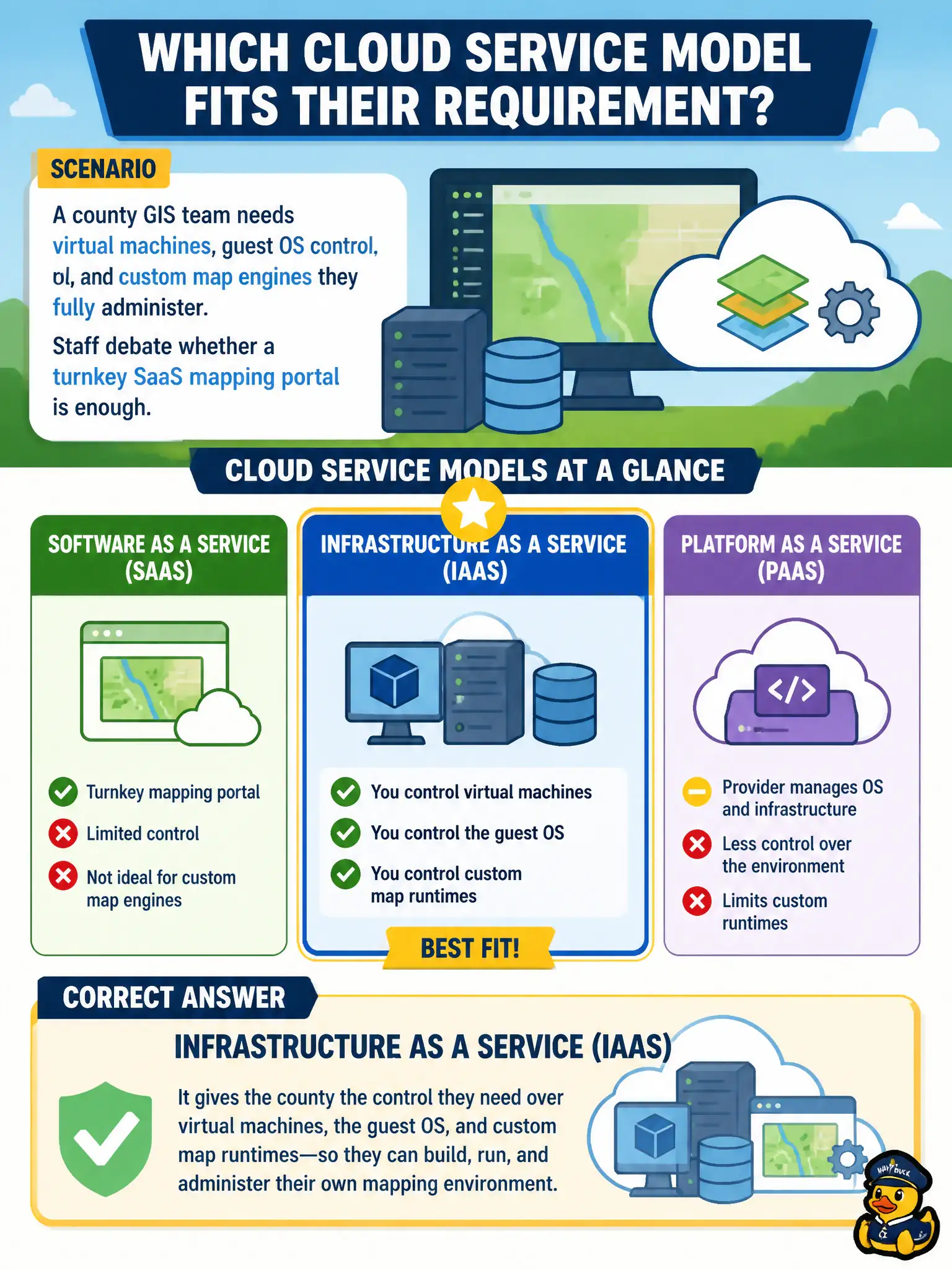
A county GIS team needs virtual machines, guest OS control, and custom map engines they fully administer. Staff debate whether a turnkey SaaS mapping portal is enough. Which cloud service model fits their requirement?
Select an answer to reveal the explanation.
Short Explanation
Think of GIS like needing your own workshop, not just buying finished maps from a kiosk. If the county must own the VMs, patch the OS, and run custom engines, that is IaaS—not a turnkey SaaS portal. SaaS is great when you only consume the app; here they still need the workshop keys.
Full Explanation
Infrastructure as a Service supplies virtualized compute, storage, and networking while leaving the municipal customer responsible for the guest operating system, middleware, and applications that run on those virtual machines. A county GIS team that must administer guest OS instances and install custom map engines therefore needs IaaS so staff retain full control of the stack above the hypervisor. A turnkey Software as a Service mapping portal fails that requirement because SaaS delivers a finished, provider-operated application without guest OS or custom runtime access for the county. Function as a Service fits short-lived, event-triggered code and deliberately removes persistent server and OS administration, so it cannot host continuously administered custom GIS engines. Desktop as a Service only presents virtual desktops to analysts and does not grant the team ownership of cloud virtual machines or map-engine hosts. Exam caveat: CompTIA Cloud+ distinguishes service models by how much of the stack the customer still operates—wanting VM and OS control is the classic IaaS signal, even when a SaaS product could draw a similar map for less effort. Operational check: after selecting IaaS, confirm the GIS runbooks include guest OS patching, hardened images, custom engine installation paths, backup of map data volumes, and identity controls on the virtual machines—none of which a SaaS portal would expose to county administrators.