
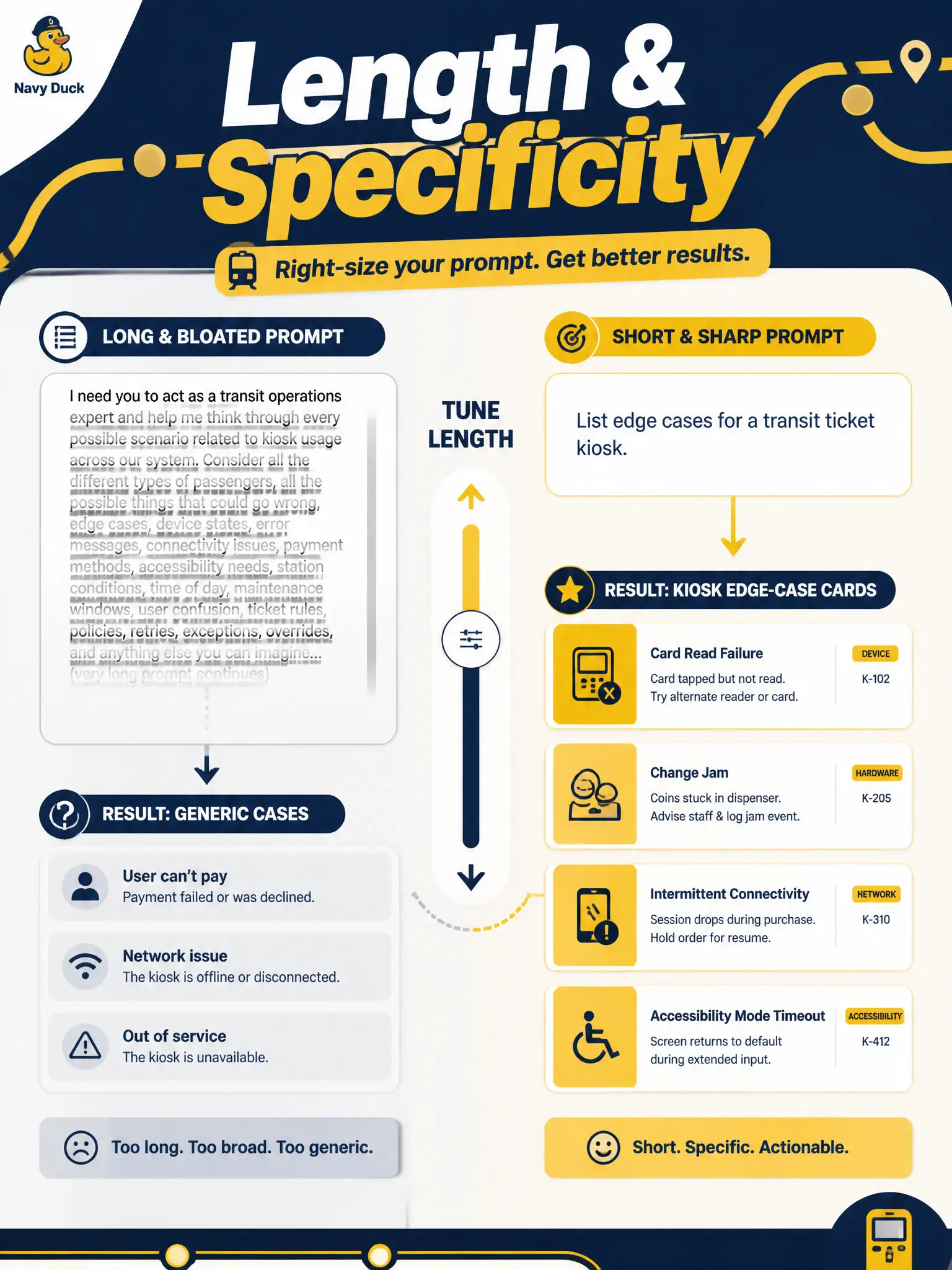
A transit-pass refill prompt grew into a page of background and the cases became generic; a shorter, sharper version recovered the kiosk edge cases. Which refinement practice does this illustrate?
Select an answer to reveal the explanation.
Short Explanation
Sometimes the prompt got too fluffy and the cases went mushy. Trimming length and sharpening specifics brought the kiosk edges back.
Full Explanation
When a transit-pass refill prompt grew into a page of background and cases became generic, while a shorter, sharper version recovered kiosk edge cases, the refinement practice is adjusting prompt length and specificity—more context can help, but shorter can generalize better. Civic rider payment testing needs prompts that preserve edge signal rather than drown it in prose. Only adding more few-shot rows without touching length or specificity fails to address the bloat problem described. Switching to neuron coverage of a fare-calculation model as the sole fix fails by concept. Deleting all domain terms so the model invents any transit product fails relevance for the municipal kiosk. Exam caveat: length/specificity tuning is bidirectional—trim when excess context harms focus. Operational check: maintain long and short civic prompt variants, compare edge-case recovery on refill scenarios, keep the sharper winner, and archive the bloated version with a note on why it generalized poorly. Retain the municipal audit note so later testers can see why the decision protects public service quality and fairness. Retain the municipal audit note so later testers can see why the decision protects public service quality and fairness.