
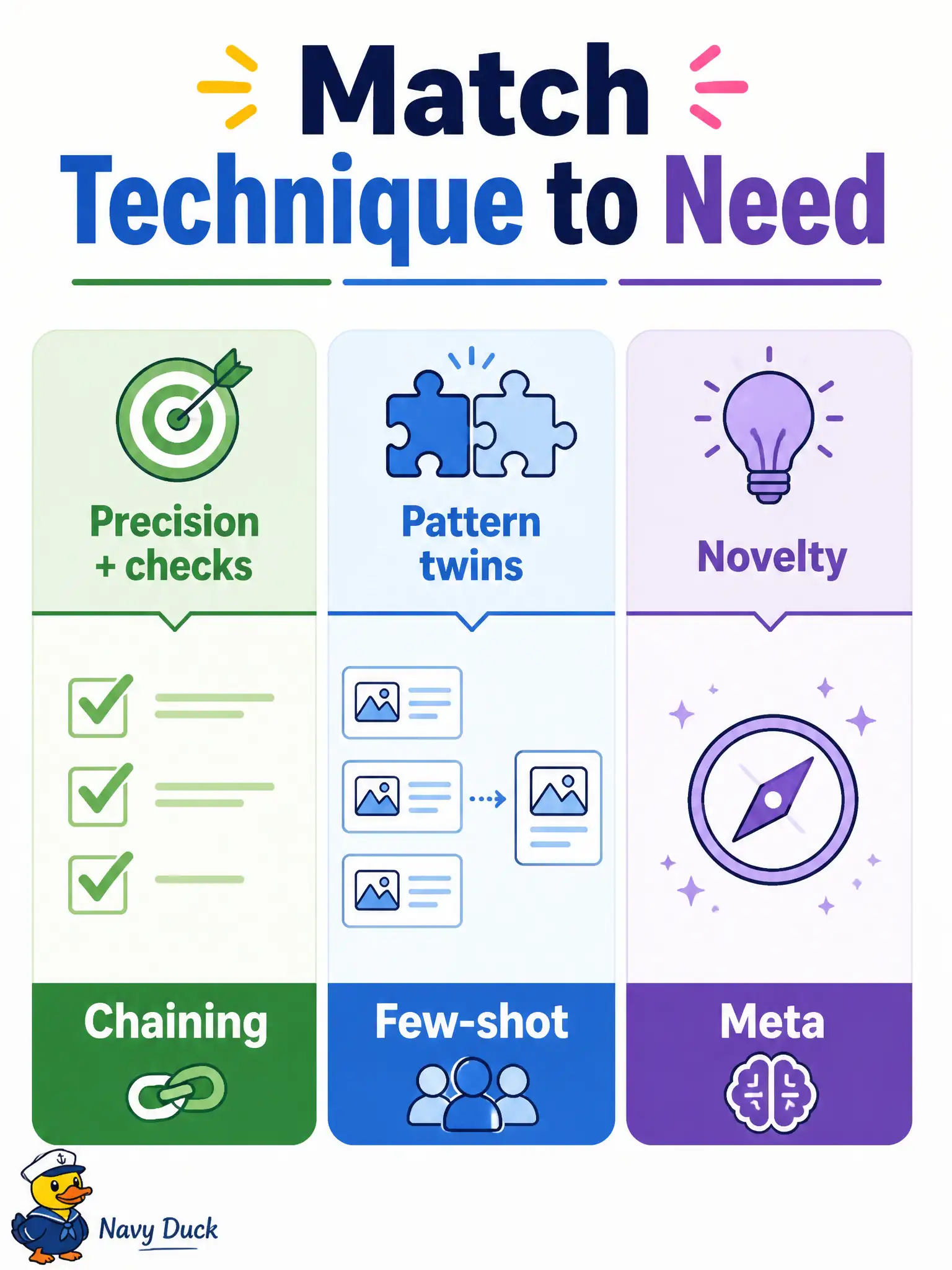
On one morning a park-permit team faces three asks: (1) risk-ordered conditions with a check after each factor, (2) twenty Gherkin twins in the house style, and (3) a completion narrative they have never prompted before. Which technique mapping is correct?
Select an answer to reveal the explanation.
Short Explanation
Match the tool to the job: chain when you need checked steps, few-shot when you need twins, meta when the task is brand new.
Full Explanation
On one morning a park-permit team faces three asks—(1) risk-ordered conditions with a check after each factor, (2) twenty Gherkin twins in the house style, and (3) a completion narrative they have never prompted before—the correct technique mapping is chaining for the stepwise checked analysis, few-shot for the repeating Gherkin format, and meta prompting for the novel narrative task. Civic permitting work often multiplexes techniques by job shape rather than forcing one tool everywhere. Using few-shot for all three fails because stepwise checked analysis needs chaining and a never-prompted narrative needs meta help more than examples. Neuron coverage for (1), jailbreak prompts for (2), and vendor SKU fine-tuning for (3) fails by concept across the board relative to application prompting needs. Zero-shot only for all three, refusing examples or intermediate checks, fails the explicit need for checks, house style twins, and prompt crafting. Exam caveat: match technique to task structure—sequence, repetition, novelty. Operational check: run chained risk ordering with civic sign-offs, few-shot the twenty Gherkin twins from two house samples, meta-craft the completion narrative prompt, and review all three outputs before the park-permit release board.