
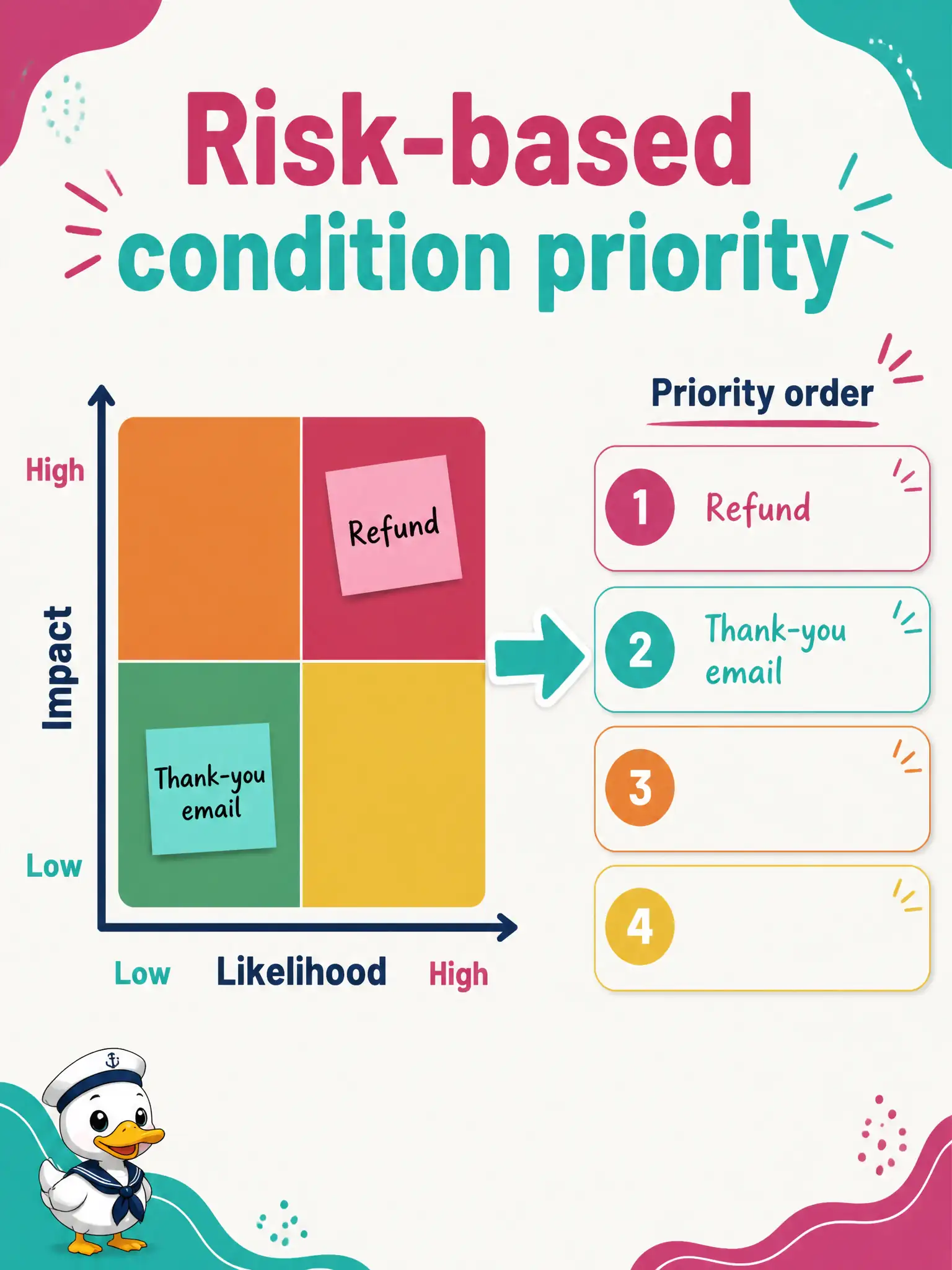
A community-radio pledge desk has likelihood and impact notes comparing refund conditions with thank-you-email conditions. Which GenAI analysis ask is most appropriate?
Select an answer to reveal the explanation.
Short Explanation
Risk notes are the station’s priority dial—likelihood times impact. Have GenAI recommend which conditions to elevate using those risk cues, not vibes or slide art. Refunds may outrank thank-you mail when impact is high.
Full Explanation
When a community-radio pledge desk holds likelihood and impact notes comparing refund conditions with thank-you-email conditions, the most appropriate GenAI analysis ask is to recommend condition priority using risk likelihood and impact—and related factors such as compliance or defect history. Civic fundraising systems should spend scarce test effort where public trust and financial harm concentrate. Asking only for decorative slide art with no reference to risk notes fails because aesthetics do not prioritize conditions. Treating refund handling as out of scope merely because email is “always” higher risk fails as an unjustified heuristic that ignores the provided likelihood/impact evidence; refunds often carry higher impact for donors and regulators. Requesting neuron-coverage targets on the pledge chatbot model under test fails by concept: that metric belongs to LLM-as-SUT evaluation, not risk-based prioritization of application test conditions. Exam caveat: risk-based analysis prompts must consume likelihood and impact inputs rather than vibe-based or off-syllabus model metrics. Operational check: provide GenAI the civic risk notes, require an ordered condition list with rationales tied to likelihood/impact, review with the pledge manager, and schedule refund-path tests earlier when residual public-finance risk is higher.