
A city-bike repair-stand team wants every GenAI session to stay concise and avoid invented part numbers, and they also need one ask that lists boundary values for the torque field. How should those instructions be assigned?
Select an answer to reveal the explanation.
Short Explanation
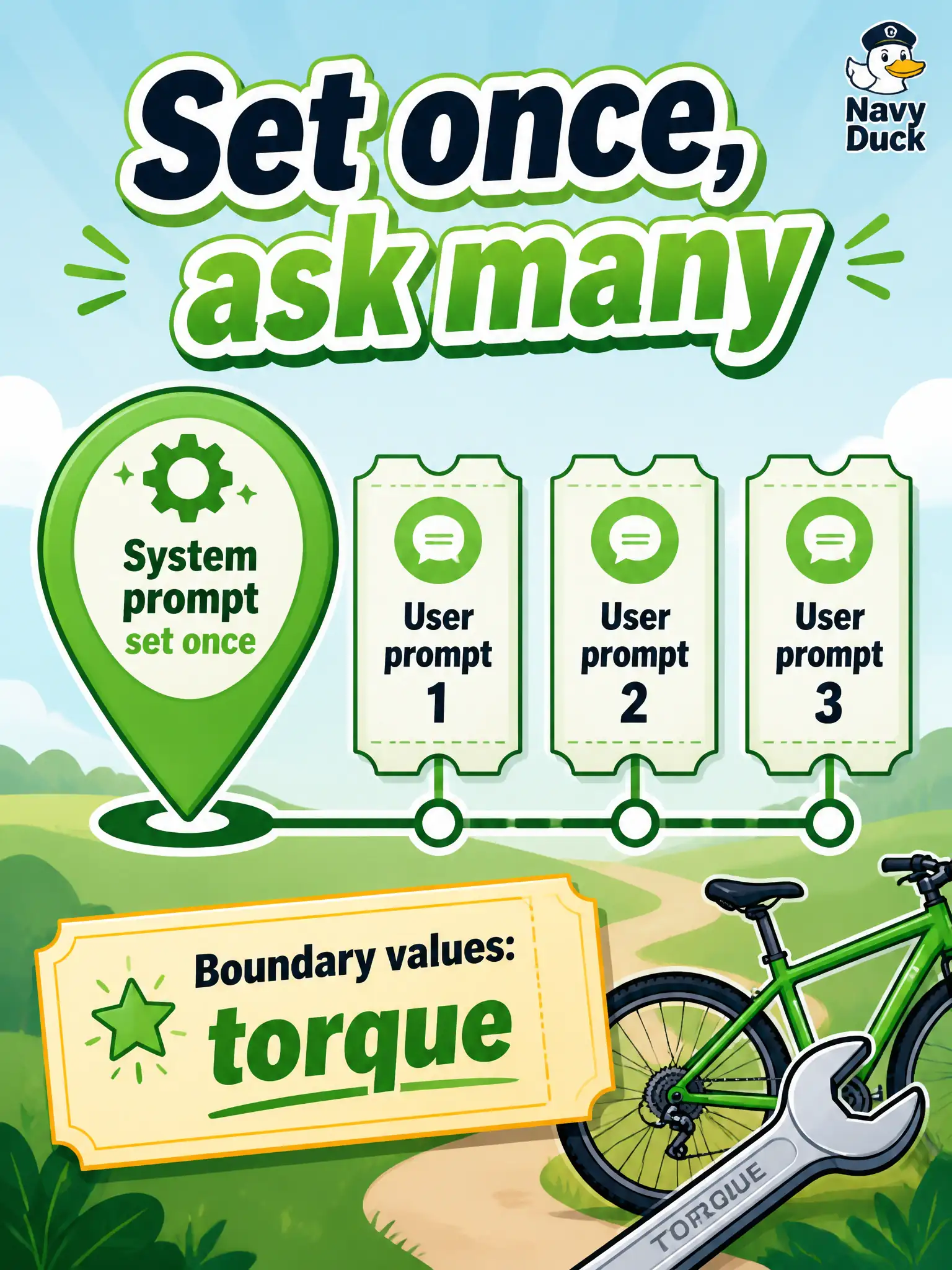
Sticky house style is the shop sign you hang once; the torque boundary list is today’s work ticket. Put lasting “be concise, don’t invent part numbers” in the system prompt, then send the boundary-value ask as a user prompt. That is the usual set-once, ask-many pattern.
Full Explanation
A city-bike repair-stand team should set lasting style and honesty rules—stay concise and do not invent part numbers—in the system prompt once, then send the torque-field boundary-value ask as a user prompt. That assignment matches civic workshop practice: hang the shop rules once, issue today’s work ticket repeatedly. Putting both standing style and the torque ask only into successive system-prompt rewrites fails because ephemeral task content should not force continual mutation of session-constant policy. Reversing the homes—torque ask in the system prompt and standing style in a single user prompt—fails because durable constraints belong in the system layer while a one-time analysis request belongs in the user layer. Ignoring prompts to measure neuron coverage of the LLM as product under test fails by concept: the scenario is about prompting for application test analysis, not evaluating the model’s internal activations. Exam caveat: CT-GenAI repeatedly tests “set-once system, ask-many user” rather than stuffing every sentence into one prompt type. Operational check: configure the repair-stand GenAI with concise/no-invented-parts system rules, run the boundary ask as a user prompt, and verify suggested edges against the posted torque specification before civic maintenance staff rely on the cases.