
A boat-ramp launch-permit tester keeps hidden house rules fixed. For this ask they want a case table with id, step, and expected result. Where should that task and output-format instruction go?
Select an answer to reveal the explanation.
Short Explanation
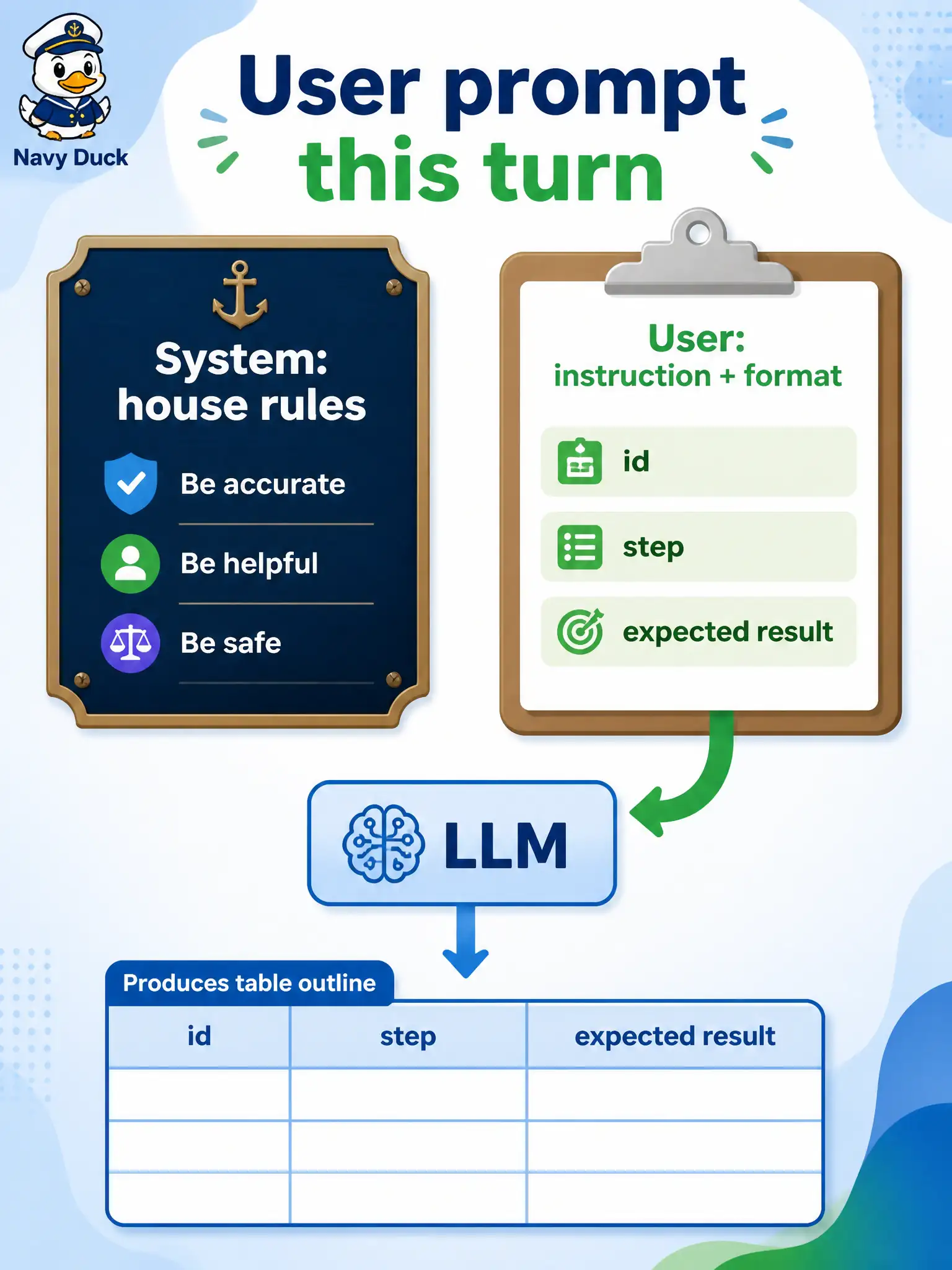
House rules stay bolted to the dock (system prompt); today’s work order goes on the clipboard you hand over (user prompt). Asking for a case table with id, step, and expected result is this turn’s instruction and format. Keep that ask focused and explicit in the user prompt.
Full Explanation
With hidden house rules already fixed for a boat-ramp launch-permit tester, the task and output-format instruction for this ask—a case table with id, step, and expected result—belongs in the user prompt, focused and structured for the current turn. Civic permitting work benefits when standing ethics and style stay bolted in the system prompt while today’s deliverable shape is stated explicitly in the user message. Putting the table request only in the system prompt and replacing prior role and constraint text fails because one-off format orders should not erase lasting civic house rules or rewrite every future session’s behavior. Routing the format ask into a metamorphic oracle that treats the LLM as the system under test fails by concept: metamorphic testing of the model is a different syllabus path from prompting for testware format against a launch-permit application. Leaving the user prompt empty and hoping training infers the table fails because explicit structure reduces ambiguity and protects public test artifacts from ad-hoc layouts. Exam caveat: keep durable policy in the system prompt and ephemeral task/format needs in the user prompt. Operational check: at the municipal boat ramp, confirm system rules remain untouched, send a structured user prompt naming columns id/step/expected result, and spot-check the first rows against posted permit rules before accepting the pack into civic QA.