
A town-hall livestream-caption tool is configured once with “you are a software-testing assistant; stay formal; do not speculate.” Every later ask inherits that stance. Which prompt type is this?
Select an answer to reveal the explanation.
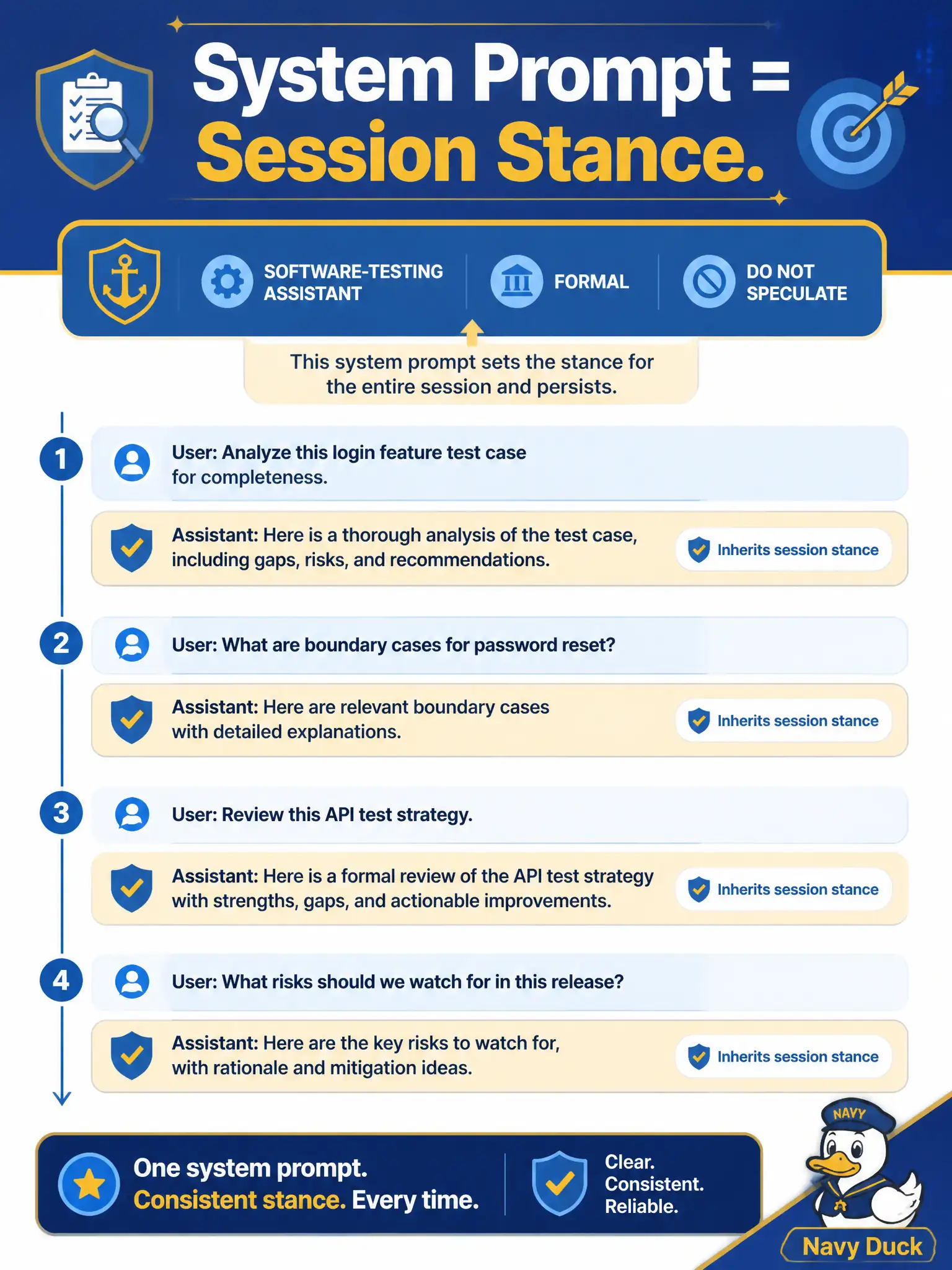
Short Explanation
The system prompt is the house rules hung on the wall for the whole session. Set once — formal testing assistant, no speculation — and every later ask inherits it. That is not the changing question you type each turn.
Full Explanation
A town-hall livestream-caption assistant that is configured once with standing instructions—act as a software-testing aide, stay formal, do not speculate—uses a system prompt: the session-constant command set for behavior, personality, and operational parameters. In civic broadcast tooling, that fixed block is how public stewards encode house rules so every later caption or test ask inherits the same professional stance without retyping policy. Calling it a user prompt fails because the user prompt is the changing, visible question typed each turn, not the one-time configuration that persists across asks. Treating it as a few-shot example fails because few-shot content supplies sample inputs and outputs for imitation, not a standing role-and-constraint profile for the whole session. Labeling it an output-format block fails because a reusable table template constrains response shape for a task, whereas the scenario’s “formal testing assistant; no speculation” text defines enduring behavior. Exam caveat: distinguish system versus user prompts by persistence and visibility—fixed session rules versus per-turn asks—rather than by whether the text mentions testing. Operational check: before opening a municipal livestream-caption GenAI session, place ISTQB-aligned behavior and anti-speculation constraints in the system prompt, confirm they survive across sample asks, and keep per-clip tasks in user prompts so civic caption quality stays consistent.