
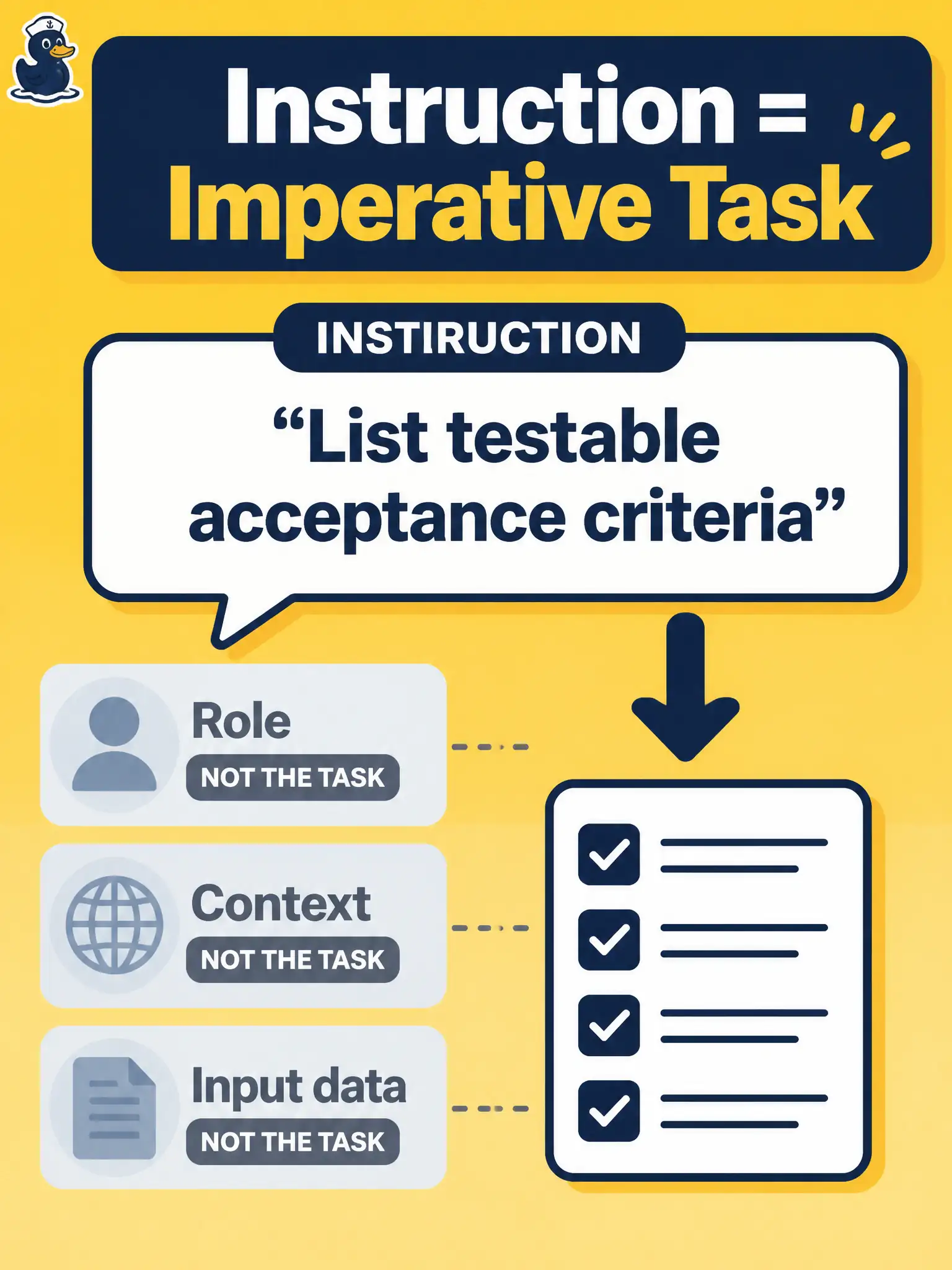
A school-lunch allergy board prompt describes the cafeteria well but never says “list testable acceptance criteria.” Which prompt component is the clear, imperative directive that states the task and its requirements?
Select an answer to reveal the explanation.
Short Explanation
Instruction is the coach’s whistle — “do this, now.” Describing the cafeteria (context) or attaching the story (input data) is not the same as saying “list testable acceptance criteria.” Without that imperative, the model lacks a clear task.
Full Explanation
Instruction is the clear, imperative directive that states the task and its requirements—for example “list testable acceptance criteria.” A school-lunch allergy board prompt that describes the cafeteria well but never issues that imperative is missing Instruction even when Role, Context, and Input data look rich. Civic allergy programs cannot assume the model will infer the deliverable from ambiance; children’s safety work needs an explicit task line.
Role sets persona and tester responsibilities, not the task imperative. Input data are the story or artefacts attached for the model to use. Context is background about the cafeteria and allergy board—necessary orientation, but not a substitute for saying what artefact to produce and which requirements apply to that production.
Exam caveat: beautiful Context without Instruction yields aimless help. The six-component structure requires an imperative task line with stated requirements.
Operational check: insert an Instruction line that names the deliverable (testable acceptance criteria) and any must-include allergen rules; regenerate; verify the reply is criteria-shaped rather than a cafeteria essay; save the completed template for the school-lunch municipal suite.