
A county recycling-pickup app needs weekend-overflow test ideas. One prompt begins “act as a test automation engineer,” and another begins “act as a test manager.” Which prompt component sets the persona, tone, and responsibilities for the model?
Select an answer to reveal the explanation.
Short Explanation
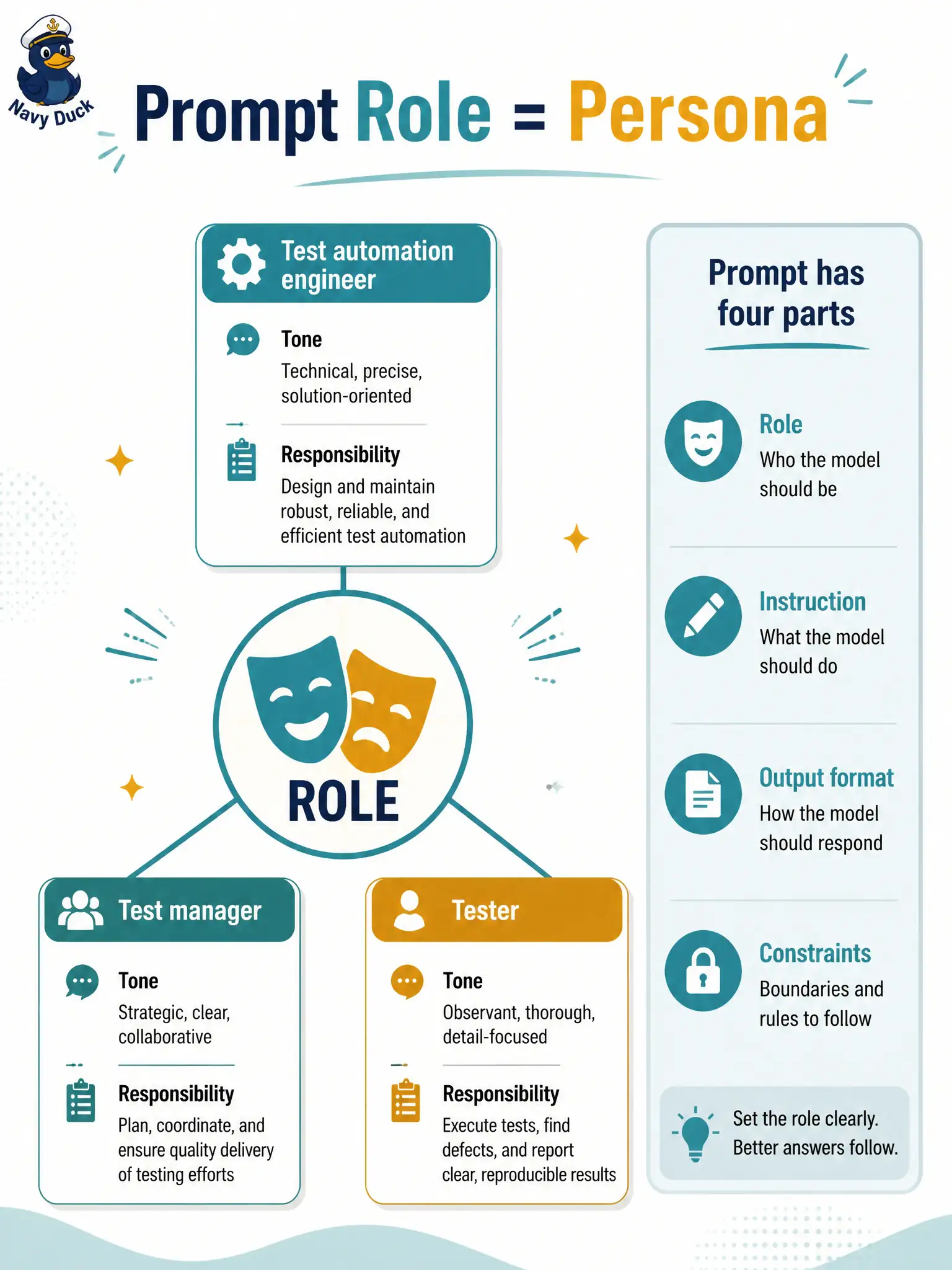
Think of role like casting an actor before the scene starts — it decides who is speaking. Saying “act as a test automation engineer” or “act as a test manager” sets persona, tone, and responsibilities. That is different from the task line, the reply shape, or the house limits.
Full Explanation
Role is the prompt-structure component that sets the persona, tone, and responsibilities for how the model should think and respond—such as “act as a test automation engineer” versus “act as a test manager.” Weekend-overflow test ideas for a county recycling-pickup app will emphasize different concerns under those personas: scripting and tooling versus prioritization, staffing, and risk. Civic teams use Role deliberately when they want the model to inhabit a tester identity rather than a generic assistant voice.
Instruction is the imperative line that names the testing task; it is not the persona. Output format is the structure expected in the reply, such as a table or bullets; structure is not identity. Constraints are restrictions on how instructions may be applied—scope limits, policy bans—not the Role assignment itself.
Exam caveat: CT-GenAI’s six-component structure separates Role from Instruction, Context, Input data, Constraints, and Output format. A leading “act as…” line is Role even when it appears before the task sentence.
Operational check: take the recycling overflow ask; vary only the Role line between automation engineer and test manager while holding task and format fixed; compare emphasis in the drafts; record Role as the persona control in the municipal prompt template checklist and train staff not to relabel it as Instruction.